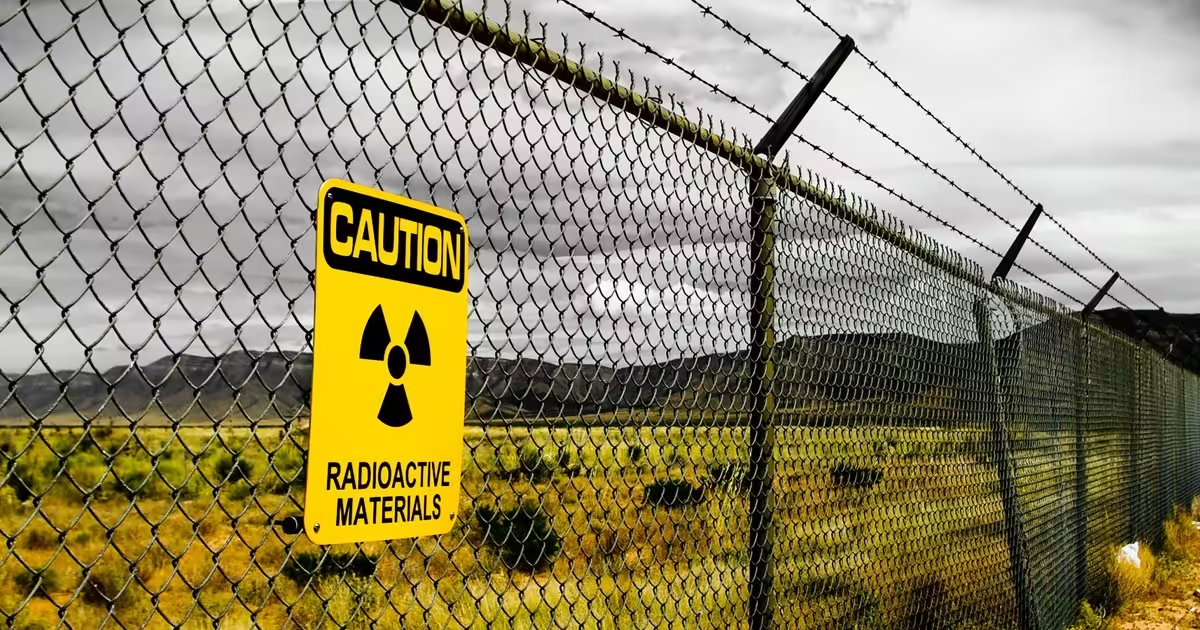

The latest operation, which marks the second of its kind, began on Sunday at the Beryl E2 test site in ‘In Ekker’, in the southern province of Tamanrasset, according to a statement released by Algeria’s Defence Ministry.
The operation is ongoing despite the claim by Algeria that France has refused to provide maps showing where radioactive materials were buried.
The lack of these records has made it harder to identify contaminated areas and clean them up.
The Defence Ministry said the new operation is being carried out by Algerian specialists, with support from the National Agency for the Rehabilitation of Former French Nuclear Test and Explosion Sites.
The team currently carrying out the operation has been tasked with identifying areas affected by radiation, collecting the waste and placing it in specially built concrete containers.
According to the ministry, the work will follow national and international safety standards.
The cleanup is part of a wider effort to deal with the damage caused by France’s nuclear testing programme in southern Algeria.
The ministry said the missing records continue to hold back development in In Ekker and Reggane, another former test site in Adrar province, as seen in the Middle East Monitor.
Algeria has committed significant funds and personnel to the work, as it continues to press France to provide information about the buried waste and take responsibility for its removal.
French forces carried out nuclear tests in the Sahara during the colonial period.
France invaded Algeria in 1830 and ruled it for 132 years.
Unlike many other French colonies, Algeria was treated as an integral part of France, although Algerians faced widespread discrimination and unequal rights.
Algeria gained independence on July 5, 1962, following a long and bloody war for independence that began in 1954.
However, it is believed that somewhere between Algeria’s fight for independence and when it achieved it, France conducted nuclear tests in the Sahara.
France’s experimental activities in Algeria
According to the United Nations Scientific Committee on the Effects of Atomic Radiation report, “between 1960 and 1966, France conducted four atmospheric tests, 13 underground tests and 40 minor experiments at remote locations near Reggane and In Ekker, in southern Algeria.”
The report also adds that the “Reggane Test Sites are in the Sahara Desert approximately 50 km south-southwest of the village of Reggane, which had an estimated population of a few thousand inhabitants at the time of the tests.
The tests conducted at Reggane are known as the Gerboise series of tests (Gerboise Bleue, Gerboise Blanche, Gerboise Rouge, and Gerboise Verte); the total yield was previously reported as 73 kt but has more recently been estimated to be between 70 kt and 120 kt.”
Another major French nuclear testing ground was the Taourirt Tan Afella mountain range near In Ekker in southern Algeria, where France carried out 13 underground nuclear tests.
At the time, the area was sparsely populated, with fewer than 2,000 people living within a 100-kilometre radius of the testing site.
However, not all the explosions were successfully contained underground. Four tests resulted in radioactive material escaping, with two causing significant releases into the atmosphere.
A French parliamentary report examined the possible exposure of nearby communities following the incidents.
It estimated that 280 people exposed after the Amethyst test received radiation doses below 1 millisievert (mSv) through external exposure.
Following the Rubis test, radioactive particles detected as far as 150 kilometres away in Tamanrasset were estimated to have resulted in a dose of 0.01 mSv.
The report found no estimated public exposure from the Beryl and Jade tests.
Source: africa.businessinsider.com