
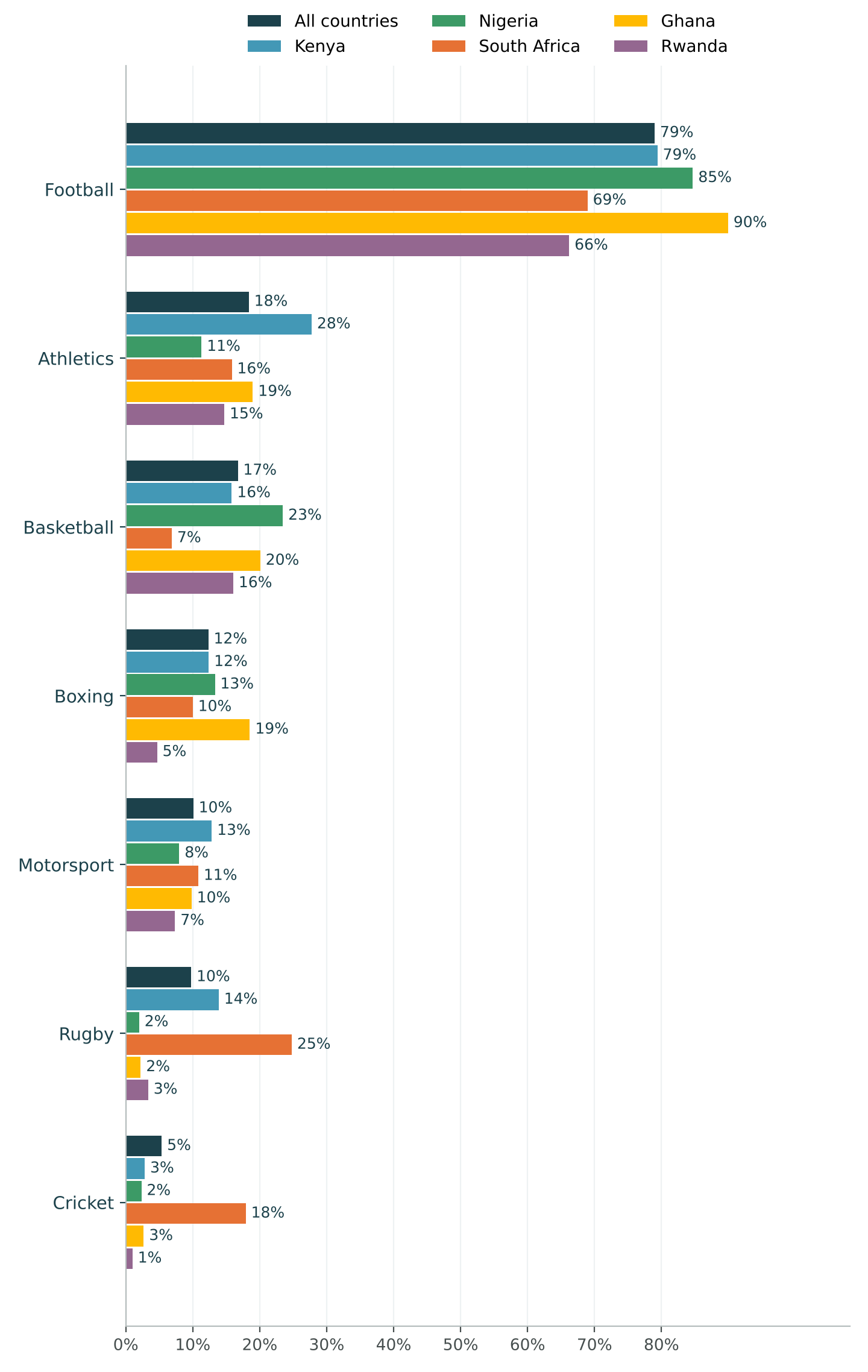
Football is the common language of sport. 79% of respondents are interested in football and 71% follow it more closely than any other sport. Interest peaks in Ghana (90%) and Nigeria (85%) and is lowest in South Africa (69%) and Rwanda (66%).
25%
of South Africans are interested in rugby and 18% in cricket, making South Africa the most multi-sport market, with interest in both sports significantly higher than in other countries.
55%
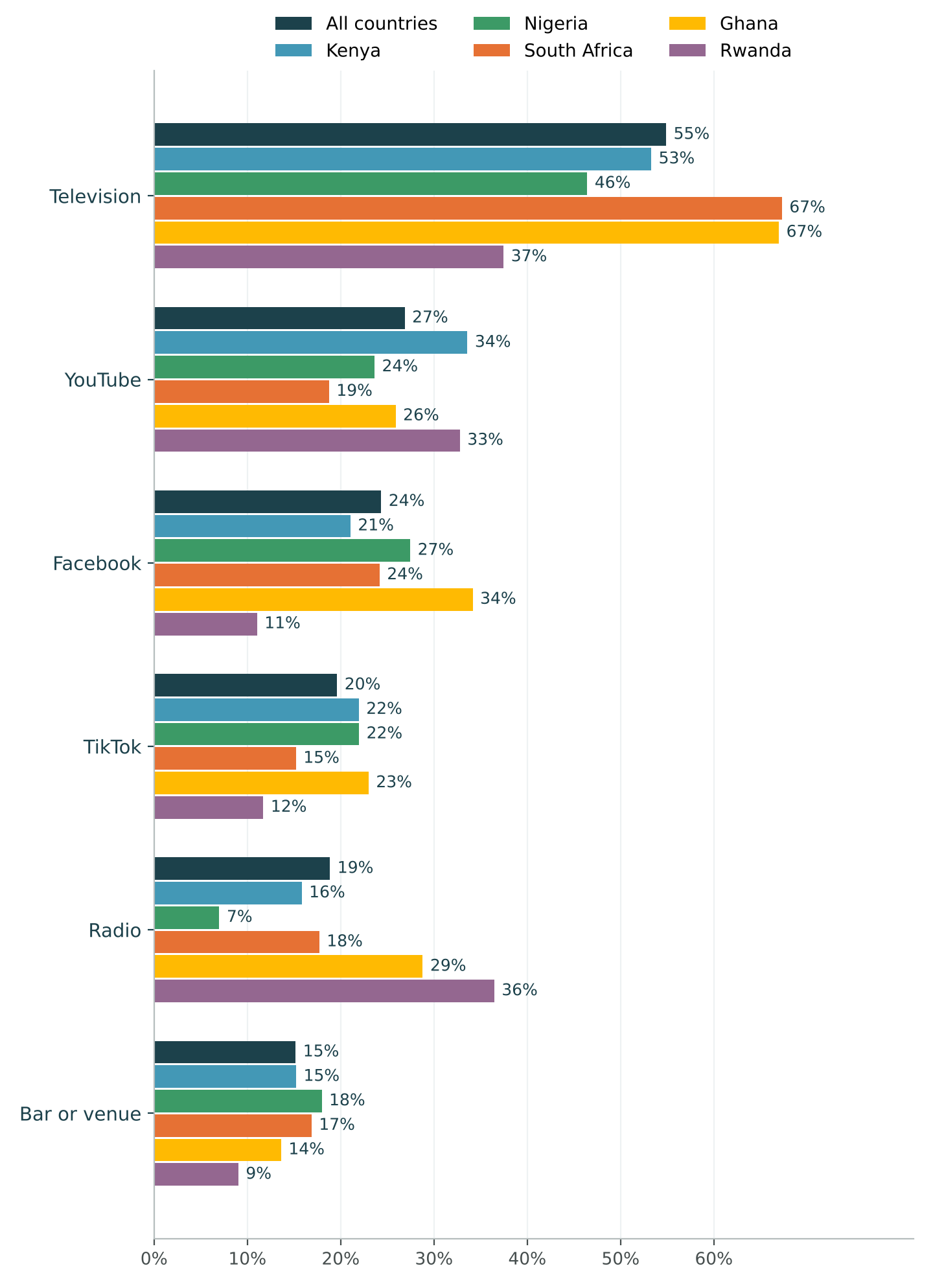
follow sports primarily through television, rising to 67% in both South Africa and Ghana. Radio remains important in Rwanda (36%) and Ghana (29%), but has limited relevance in Nigeria (7%).
17%
express interest in basketball, highlighting its niche appeal, although interest is higher in Nigeria (23%) and particularly low in South Africa (7%). 93% would attend an NBA or BAL game.
54%
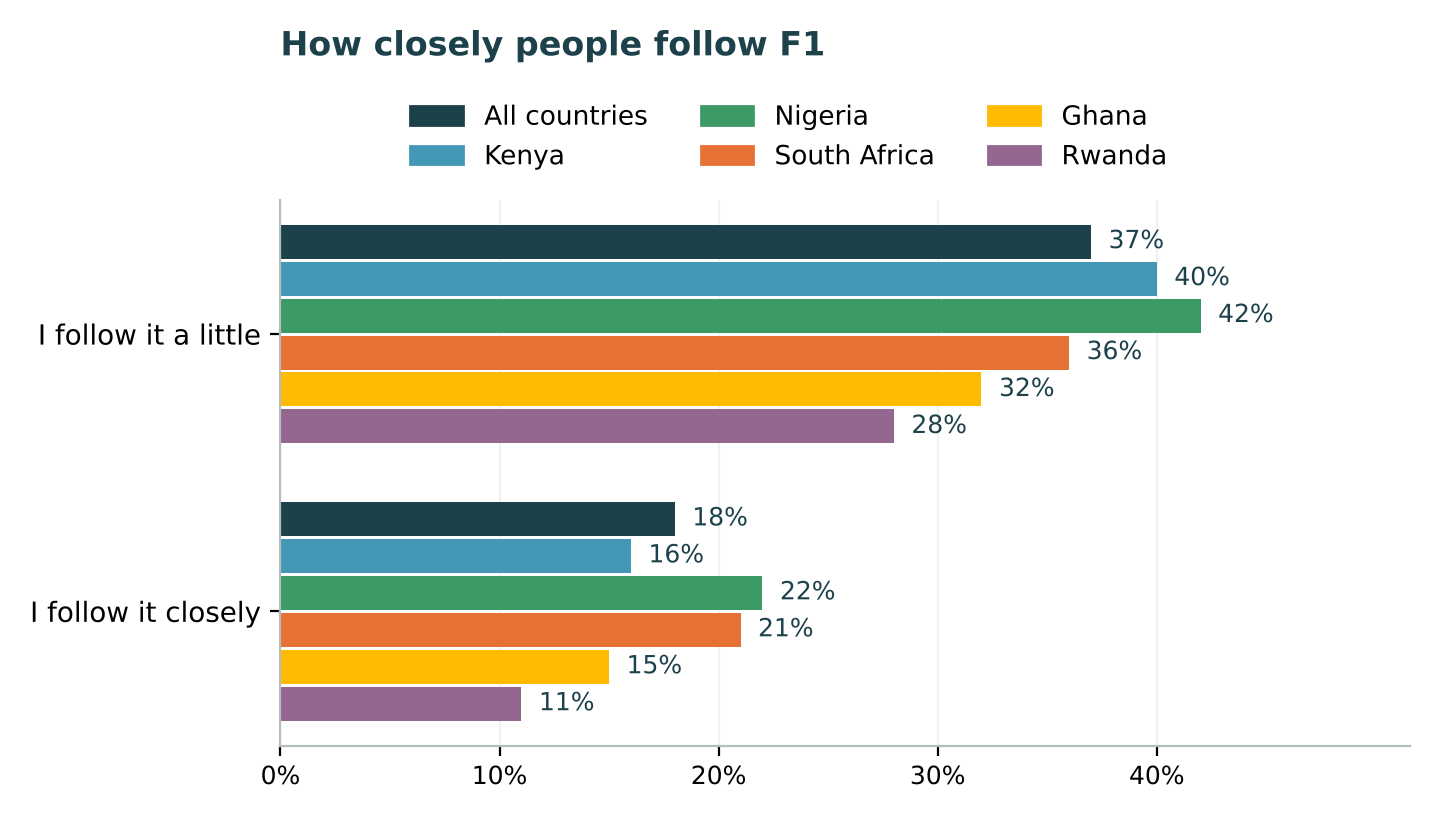
follow Formula 1 to some extent, with Nigeria leading at 64%, indicating broad audience reach across markets. Among F1 followers, 89% are interested in attending a race in Africa.
Sport in Africa is growing in scale, reach and commercial interest. The Basketball Africa League (BAL) began its sixth season in 2026 with 12 teams, opening in Pretoria. Industry coverage describes a market where sponsorship has not yet caught up with audience size, which makes the sponsorship findings in this report relevant to brands. See this analysis of the African sports sponsorship gap.
GeoPoll ran a mobile survey on sport, basketball and Formula 1 in five African markets. The questionnaire covered sports interest and habits, media channels, sponsorship, the NBA and the Basketball Africa League (BAL), Formula 1 and monthly spend on sport. Rwanda was fielded in Kinyarwanda and the other four countries in English.
Sports engagement
Half of respondents 51% follow sport regularly and a further 35% follow it occasionally, so 86% follow sport in some form. Rwanda is the outlier, with only 13% following sport regularly and 62% following it occasionally. Lapsed followers, who used to follow sport but no longer do, are highest in Rwanda (13%) and South Africa (12%), while 5% of respondents have never followed sport.
Half of respondents (51%) follow sport regularly, and 79% follow it at least once a week. Nigeria (59%), Kenya (56%) and Ghana (56%) lead, while Rwanda is far behind at 13%.
Daily following is strongest in Ghana (37%) and Nigeria (34%), both significantly ahead of South Africa (22%) and Rwanda (9%). Men follow sport daily at 33% against 17% for women, a gap that holds after controlling for country and age.
Live attendance is common. 58% attend a live sporting event at least every few months. Nigeria (68%) is significantly ahead of Kenya, South Africa, Ghana and Rwanda. Rwanda has the largest share who never attend (26%), and women are far less likely than men to attend.
Which sports people follow
Football is the common language of sport. 79% of respondents are interested in football, and 71% name it as the sport they follow most. Football interest is higher than interest in any other sport in every country, and it is the only sport in which more than half of respondents are interested in every country.
Ghana leads on football, with 90% of respondents interested. Ghana is significantly ahead of all four other countries. Nigeria (85%) and Kenya (79%) come next, and both are significantly above South Africa (69%) and Rwanda (66%). In South Africa, rugby and cricket draw a large share of fans alongside football, as shown below.
Football is more popular with men (85%) than with women (66%), and the gap holds after controlling for country and age. Interest also varies by age. It peaks among 25 to 34 year olds (81%) and is lowest among those aged 45 and over (69%).
Basketball interest is 17% overall. Nigeria (23%) is significantly ahead of Kenya, South Africa and Rwanda, and Ghana (20%) is significantly ahead of South Africa. South Africa is lowest at 7%. Interest does not differ significantly by gender or age.
Athletics is strongest in Kenya, where 28% are interested, significantly higher than every other country. Ghana (19%) and South Africa (16%) are significantly ahead of Nigeria (11%). Older respondents are slightly more likely to follow athletics (21% of those 45 and over, against 18% of 18 to 24 year olds).
South Africa is the most multi-sport market. Rugby interest is 25%, significantly higher than every other country, and cricket is 18%, also significantly higher than all others. Rugby and cricket interest both rise with age, from 9% and 2% among 18 to 24 year olds to 19% and 12% among those 45 and over.
Ghana is also the market for boxing, where 19% are interested. That is significantly ahead of every other country. Boxing interest is higher among men (14%) than women (8%).
Motorsport interest is low overall at 10%. Kenya (13%) is significantly above Nigeria and Rwanda, and men (11%) are more interested than women (8%).
Football is more popular with men (85%) than with women (66%), and the gap holds after controlling for country and age. Interest also varies by age. It peaks among 25 to 34 year olds (81%) and is lowest among those aged 45 and over (69%).
How fans follow sport
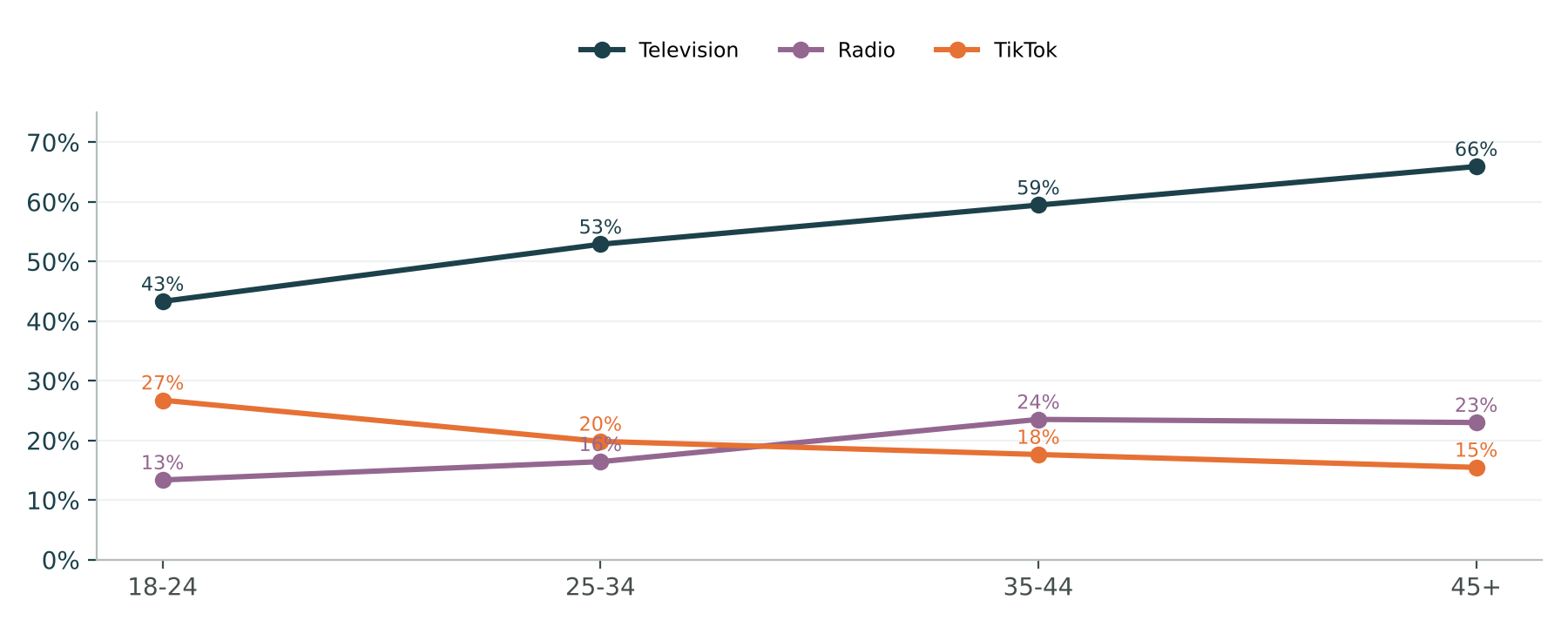
Television is the leading channel in every country and the main way fans follow sport overall (55%). The lead is narrowest in Rwanda, where radio (36%) comes close to TV (37%), and widest in South Africa and Ghana, where 67% follow sport on TV. TV use rises with age, from 43% of 18 to 24 year olds to 66% of those aged 45 and over, and it does not differ by gender.
YouTube is strongest in Kenya (34%) and Rwanda (33%), where it is significantly ahead of Nigeria, South Africa and Ghana. Its use is similar across age groups, so it is not tied to one generation of fans.
Facebook is strongest in Ghana (34%), significantly ahead of all other countries. Men (26%) use it more than women (20%), and use is lowest among 18 to 24 year olds (18%).
Radio is a major channel in Rwanda (36%), where it is significantly ahead of every other country, and in Ghana (29%). It reaches only 7% of respondents in Nigeria. Radio use rises with age, from 13% of 18 to 24 year olds to 23% of those aged 45 and over.
TikTok reaches about one in five respondents (20%), and it is the channel of the youngest fans. Use falls from 27% among 18 to 24 year olds to 15% among those aged 45 and over. Kenya (22%), Nigeria (22%) and Ghana (23%) are significantly ahead of South Africa (15%) and Rwanda (12%).
Channel use by age
Age is the clearest driver of channel choice. Controlling for country and gender, TV and radio use rise with age, with radio levelling off after 35. TV reaches 43% of 18 to 24 year olds and 66% of those aged 45 and over, while radio climbs from 13% to 23%. TikTok runs the other way, with use falling from 27% among the youngest group to 16% among those aged 45 and over.
Viewing at a bar or venue follows a different pattern. It is lowest among 18 to 24 year olds (9%), peaks among 35 to 44 year olds (19%), and eases to 17% among those aged 45 and over. Men (18%) are much more likely than women (8%) to watch at a venue, and that gap holds after controlling for country and age.
Sponsorship and brands
Sports sponsorship has a strong pull. 71% say a company sponsoring their favourite team or athlete makes them more likely to buy from that company. Rwanda (77%) and Nigeria (76%) are the most receptive markets, and both are significantly ahead of Kenya, South Africa and Ghana. Ghana is the least receptive market, at 66%.
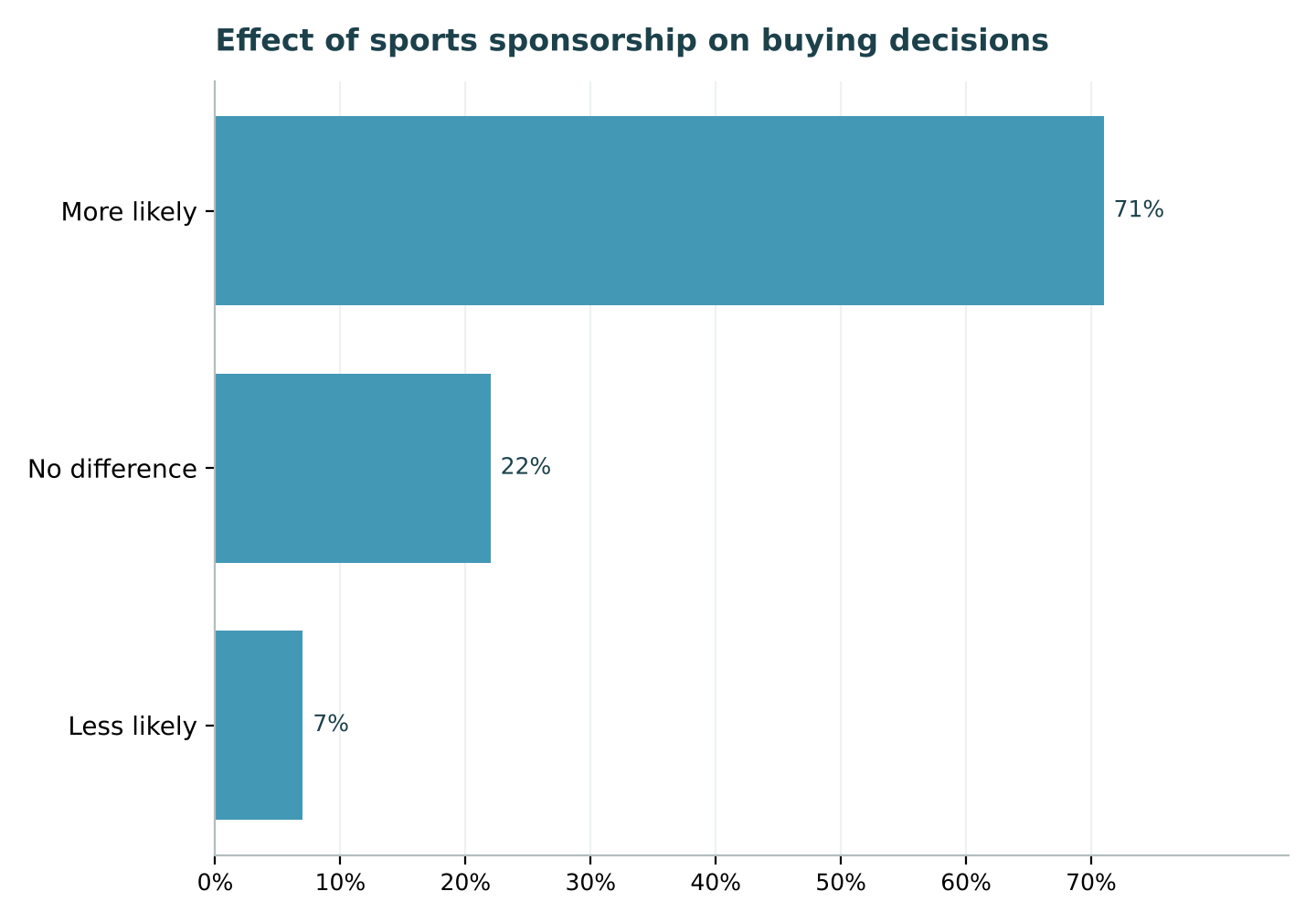
Receptiveness also varies by gender and age. Men (73%) are more likely than women (67%) to say sponsorship would make them buy, and that gap holds after controlling for country and age. Age makes less difference, but the over-45s stand apart at 62%, against 74% of 18 to 24 year olds.
Asked which brand comes to mind first for sports advertising and sponsorship, respondents mostly named global sportswear brands. Nike and Adidas lead across the sample, with Nike ahead in Nigeria and Kenya and Adidas ahead in Ghana. Local brands stand out in specific markets, especially betting companies: SportPesa in Kenya, SportyBet in Ghana and Nigeria, and Betway in South Africa and Ghana. Visit Rwanda, the national tourism brand, is the most recalled local name in Rwanda.
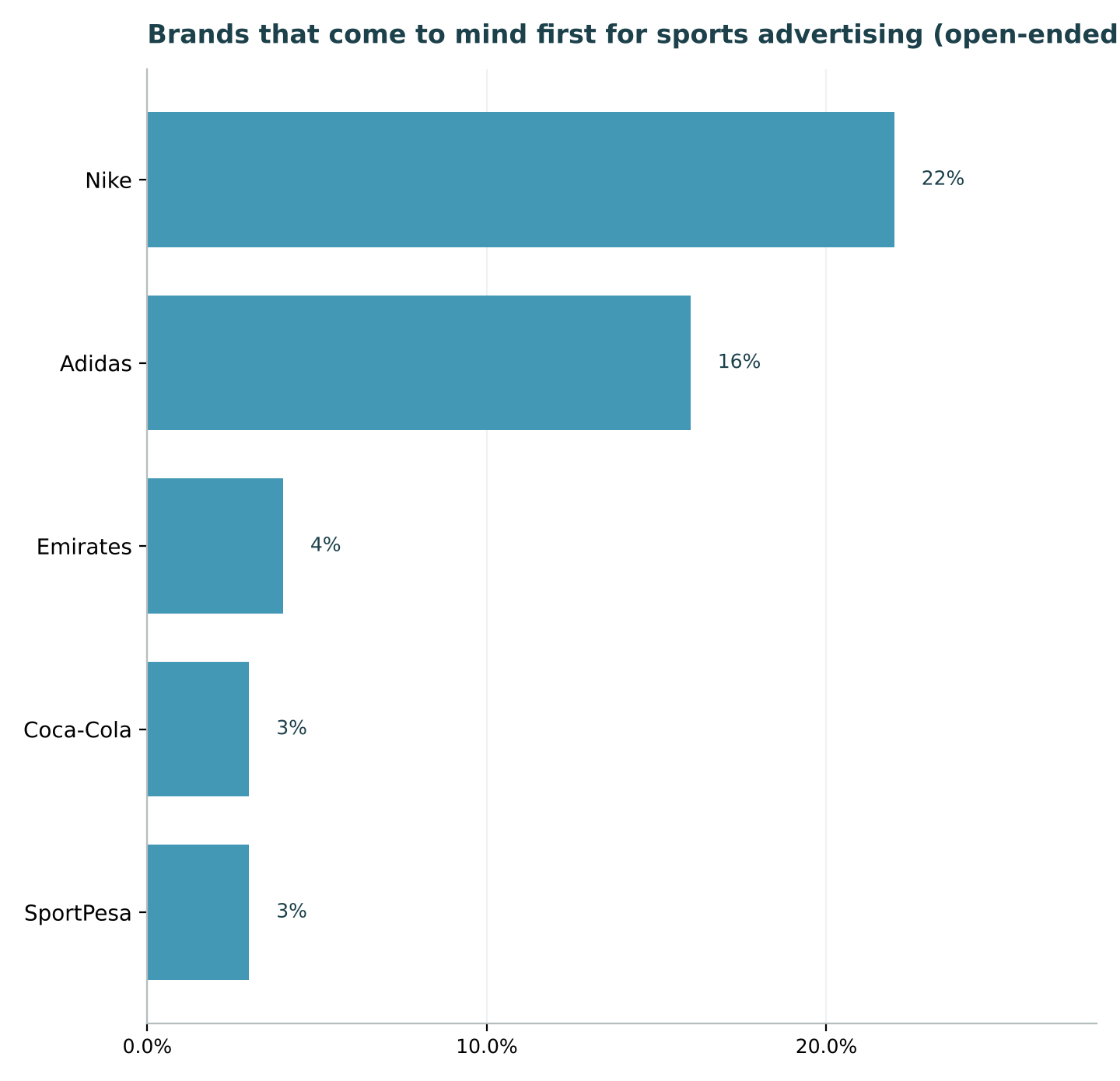
When asked which brand comes to mind first for sports advertising and sponsorship, respondents mostly named global sportswear brands. Nike (22%) and Adidas (16%) lead across the sample, with Nike ahead in Nigeria (32%) and Kenya (19%) and Adidas ahead in Ghana (20%), while the two are level in South Africa at 21% each. Local brands stand out in specific markets, especially betting companies: SportPesa in Kenya (10%), SportyBet in Ghana (11%) and Betway in South Africa and Ghana (4% each). Visit Rwanda, the national tourism brand, is the most recalled local name in Rwanda (10%).
Favourite athletes
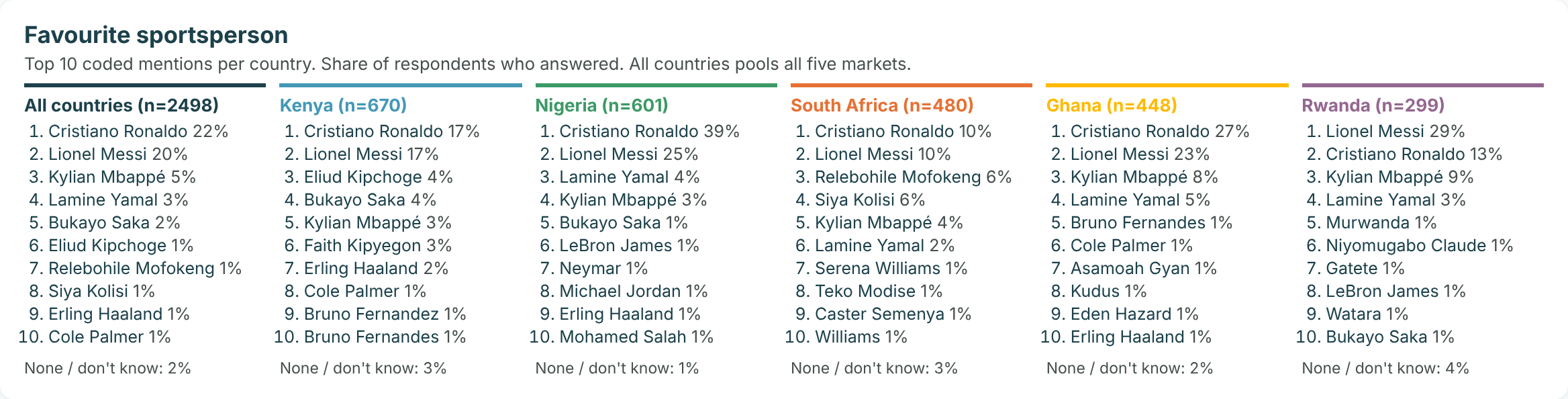
Cristiano Ronaldo (22%) and Lionel Messi (20%) are the most named athletes overall, and they are well ahead of the rest of the field. Kylian Mbappé is next at 5%, followed by Lamine Yamal (3%) and Bukayo Saka (2%). The two veterans dominate the answers in most markets.
The country picture is more mixed. Ronaldo leads in Nigeria (39%, with Messi on 25%) and Ghana (27%, with Messi on 23%). Messi leads in Rwanda (29%), well ahead of Ronaldo (13%). Kenya and South Africa are level at the top, with Ronaldo and Messi each on 17% in Kenya and 10% in South Africa.
Local heroes appear further down the list. In Kenya, marathon runner Eliud Kipchoge is the most named local athlete, on 4%, level with Saka. In South Africa, Relebohile Mofokeng and Springbok captain Siya Kolisi each get 6%, behind Ronaldo and Messi but ahead of the other names. That fits South Africa’s strong interest in rugby, which is covered earlier in this section.
Basketball and the NBA
The NBA has built a presence in Africa through youth development and local partnerships. It opened an office in Nairobi to support basketball in Kenya and the wider region, and it has extended a long-term youth partnership with the Royal Bafokeng Nation in South Africa. The BAL gives African players a professional league, and its 2026 season was announced with 12 teams and a group phase schedule.
Basketball is a niche interest at 17% overall. It is strongest in Nigeria (23%) and Ghana (20%) and weakest in South Africa (7%).
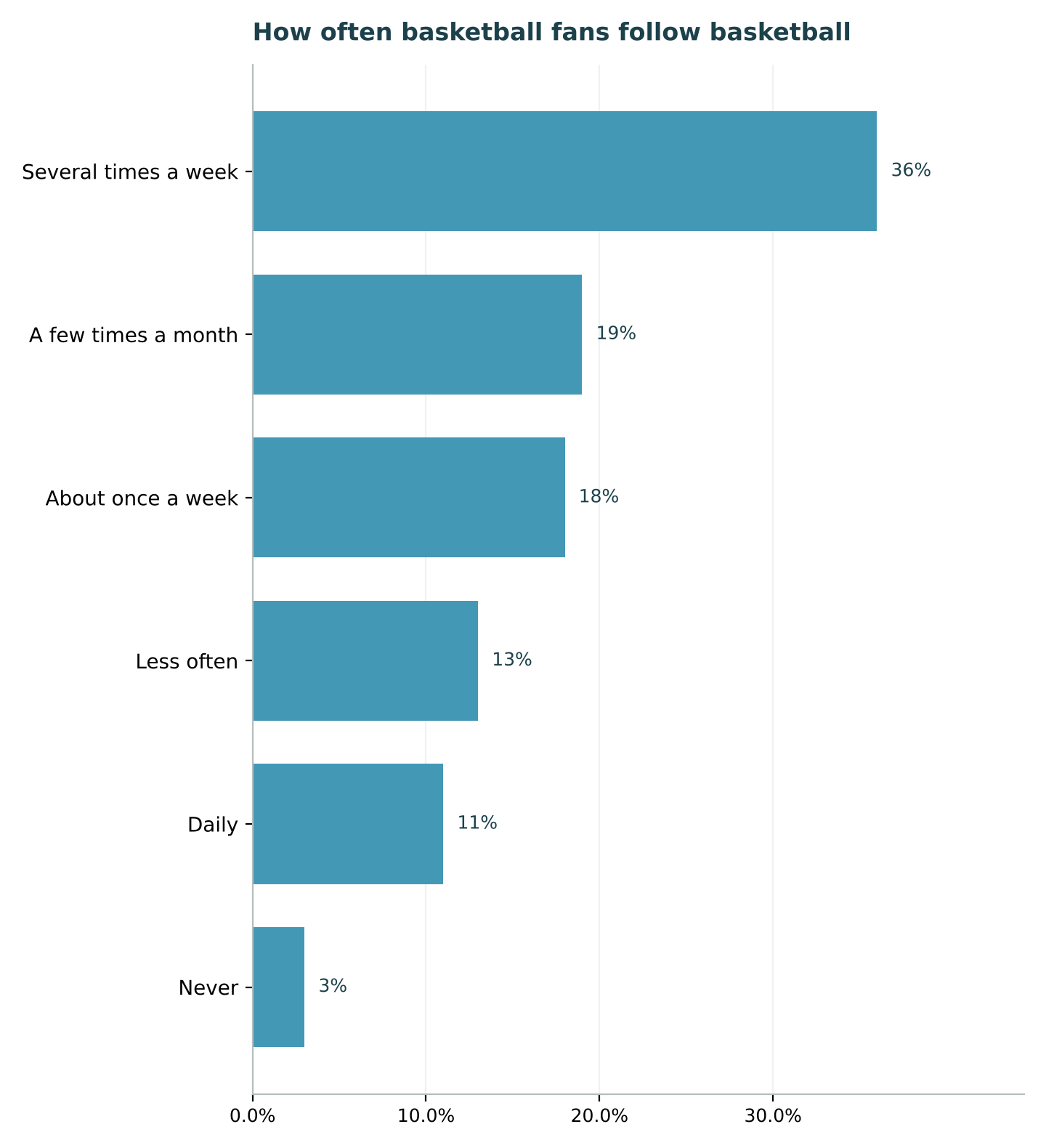
Among basketball fans, 65% follow the sport at least weekly. Nigeria (74%) leads, significantly ahead of Rwanda, where weekly following is lowest at 42%.
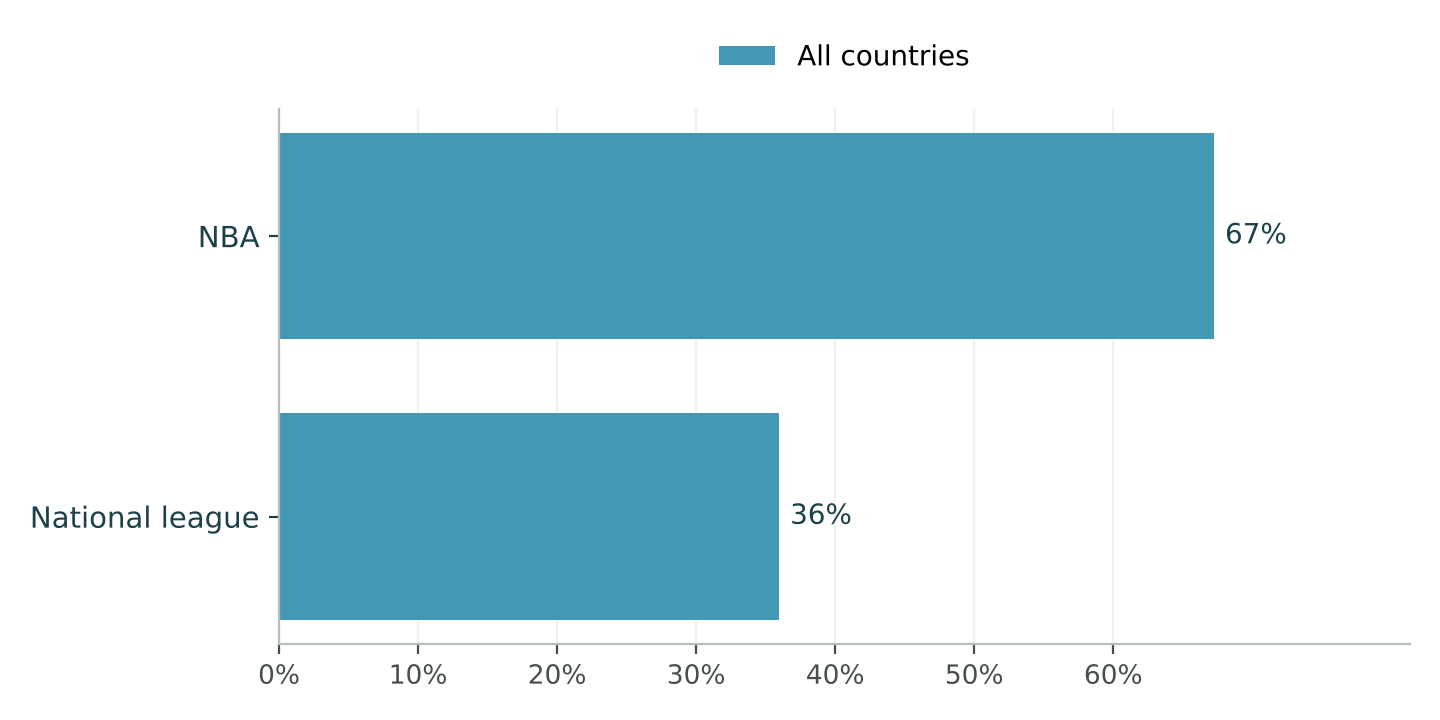
The NBA is the most followed competition among basketball fans (67%), especially in Ghana (78%) and Nigeria (75%), both significantly ahead of Kenya and Rwanda. South Africa (70%) is significantly ahead of Rwanda. Rwanda is the exception on the national league. Fans there are much more likely to follow the Rwanda Basketball League (58%) than the NBA (42%). Rwanda’s basketball fan base is small, so this is directional.
National leagues have a smaller following overall (36%). The Rwanda Basketball League stands out at 58%, significantly ahead of Nigeria, South Africa and Ghana. Kenya’s KBF Premier League (45%) is next, followed by Nigeria’s NPBL (34%), South Africa’s BNL (27%) and Ghana’s ABL (20%).
How NBA fans watch and follow the NBA
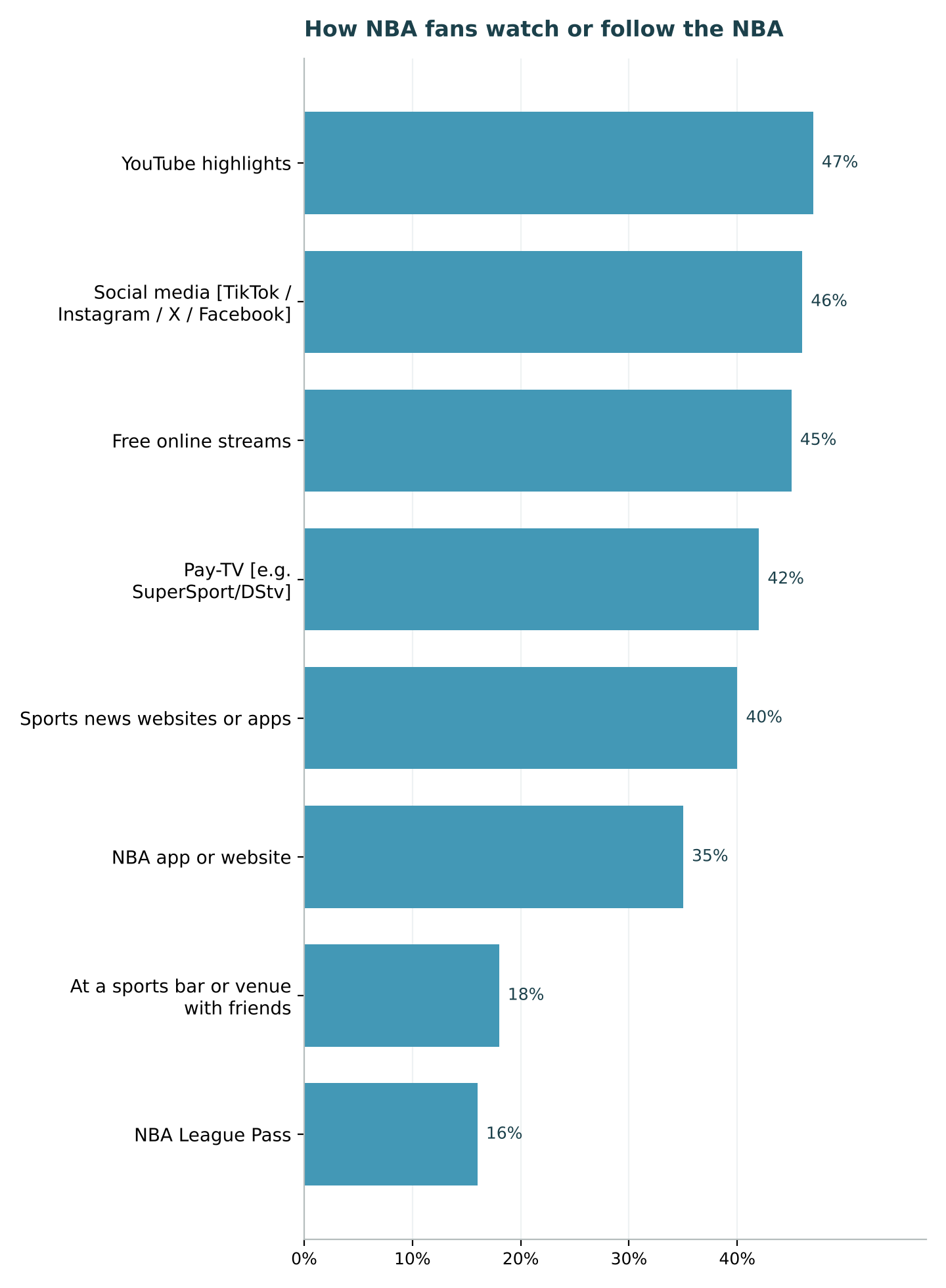
NBA fans use a mix of free and paid channels. YouTube highlights (47%), social media (46%) and free online streams (45%) lead overall. Free online streams are strongest in Kenya (61%), while Pay-TV is the main route in South Africa (81%) and Rwanda (68%). Those two markets have very small bases, so treat those figures as directional. Social media is the most common route in Nigeria (45%), and sports news websites and apps lead in Ghana (50%).
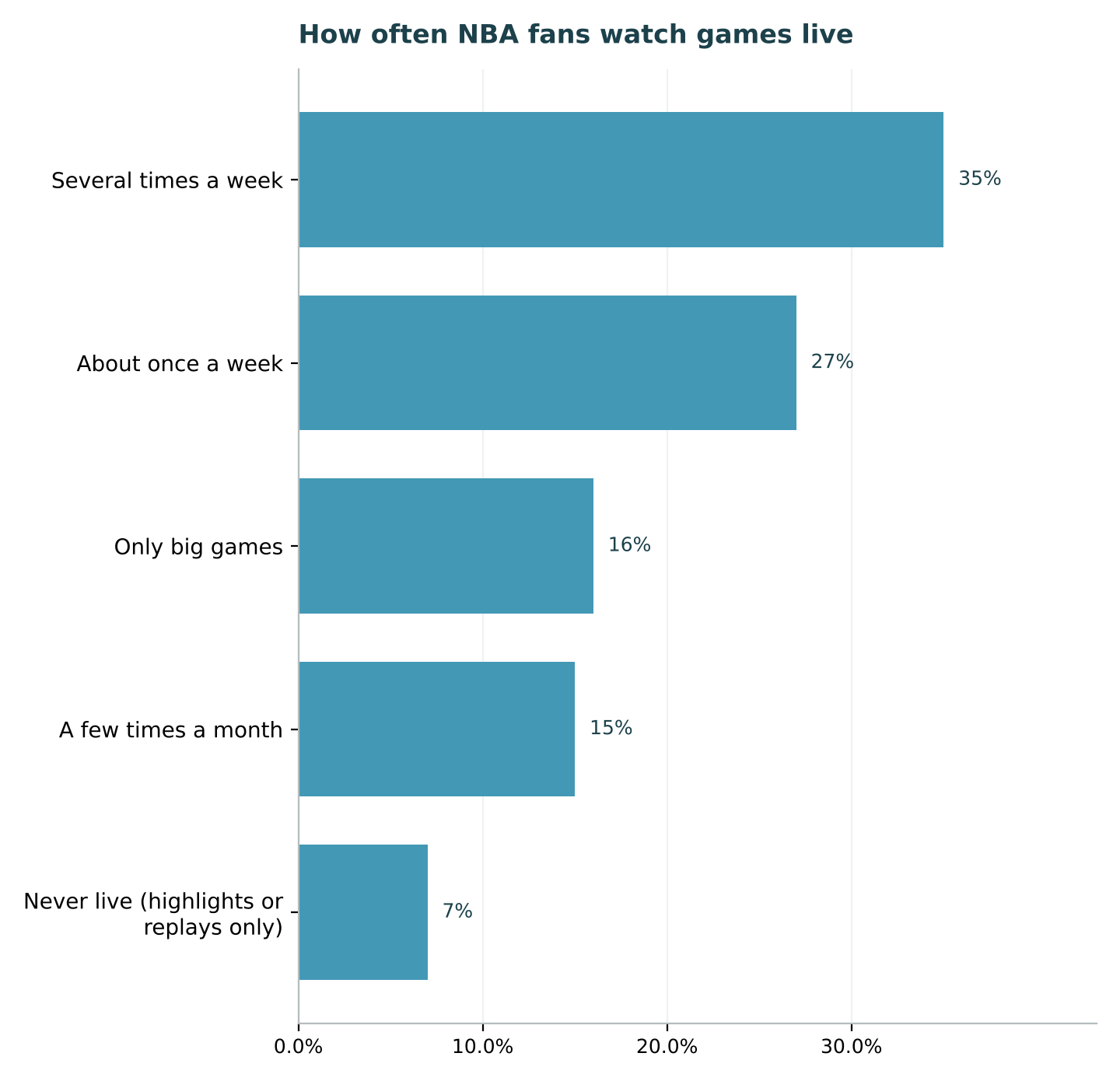
Live viewing is frequent. 35% watch NBA games live several times a week, and a further 27% do so about once a week. Nigeria leads on several times a week (41%). Ghana (15%) and Rwanda (16%) have the largest shares who never watch live and follow only highlights or replays.
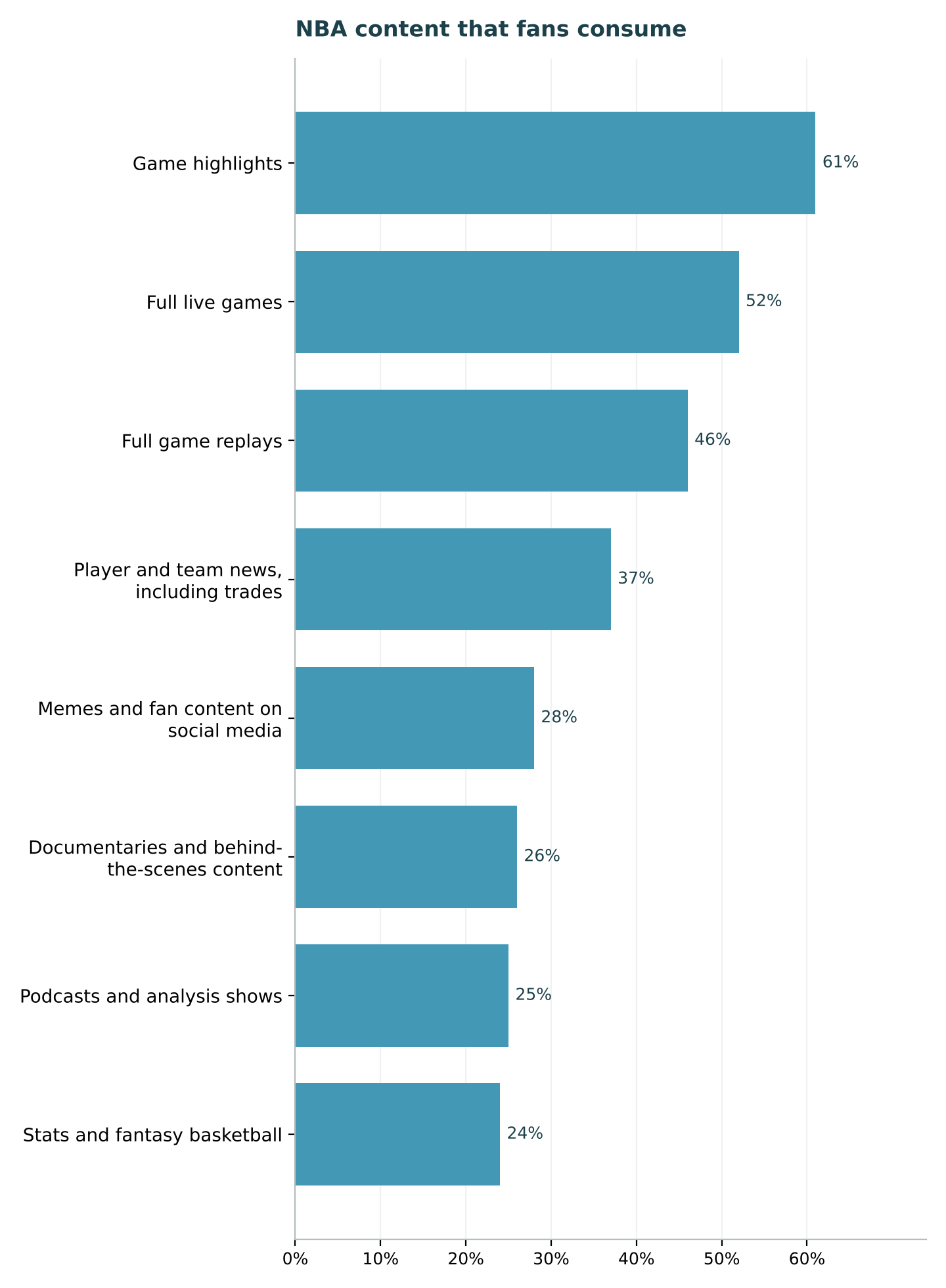
Game highlights are the most consumed NBA content (61%), followed by full live games (52%) and full game replays (46%). Rwanda is the least likely to watch full live games (21%), against 50% to 57% elsewhere. Ghana has the highest share following memes and fan content on social media (37%), while Rwanda has the lowest (11%).
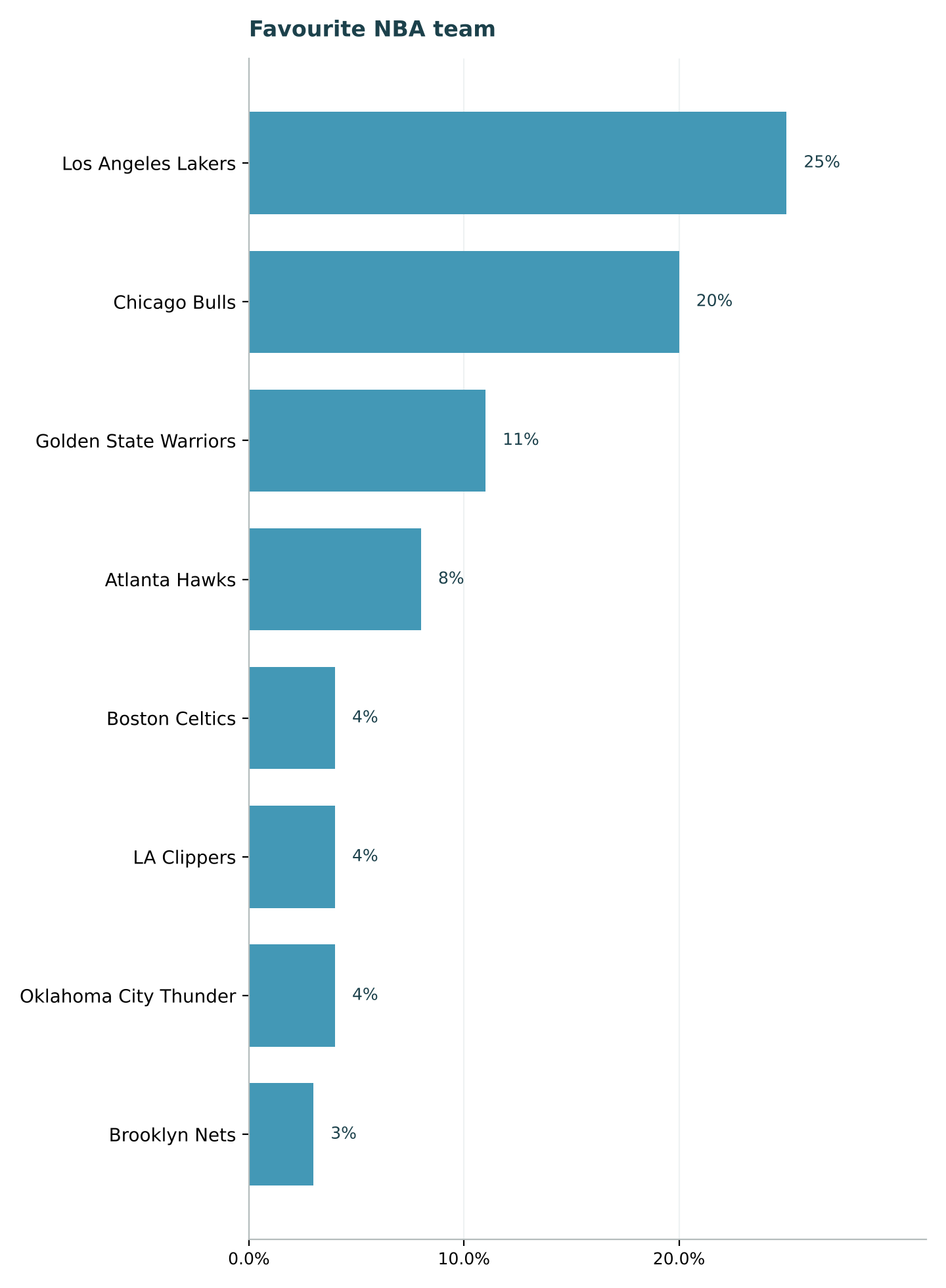
The Los Angeles Lakers (25%) and Chicago Bulls (20%) are the most supported NBA teams among NBA followers. The Lakers are strongest in South Africa (57%), while Kenya favours the Bulls (26%). The Golden State Warriors are the favourite in Rwanda (32%).
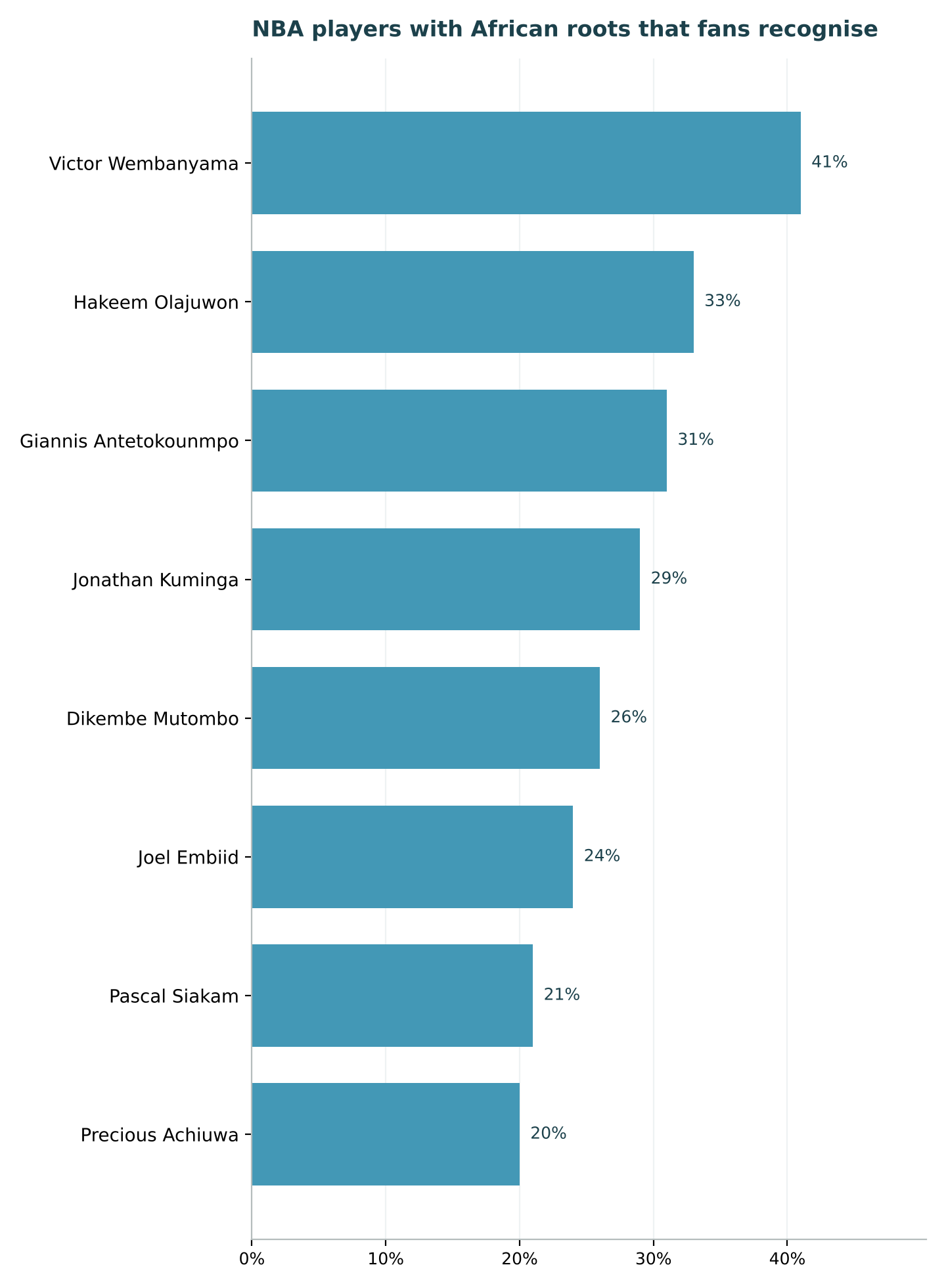
Recognition of NBA players with African roots varies by market. Victor Wembanyama is the most recognised (41%), and is named by 55% of NBA followers in Kenya and 53% in Rwanda. Hakeem Olajuwon is recognised by 42% in Nigeria, and Dikembe Mutombo by 57% in South Africa. Nigeria has the lowest recognition of Mutombo (15%) and Pascal Siakam (14%).
A highly engaged NBA core
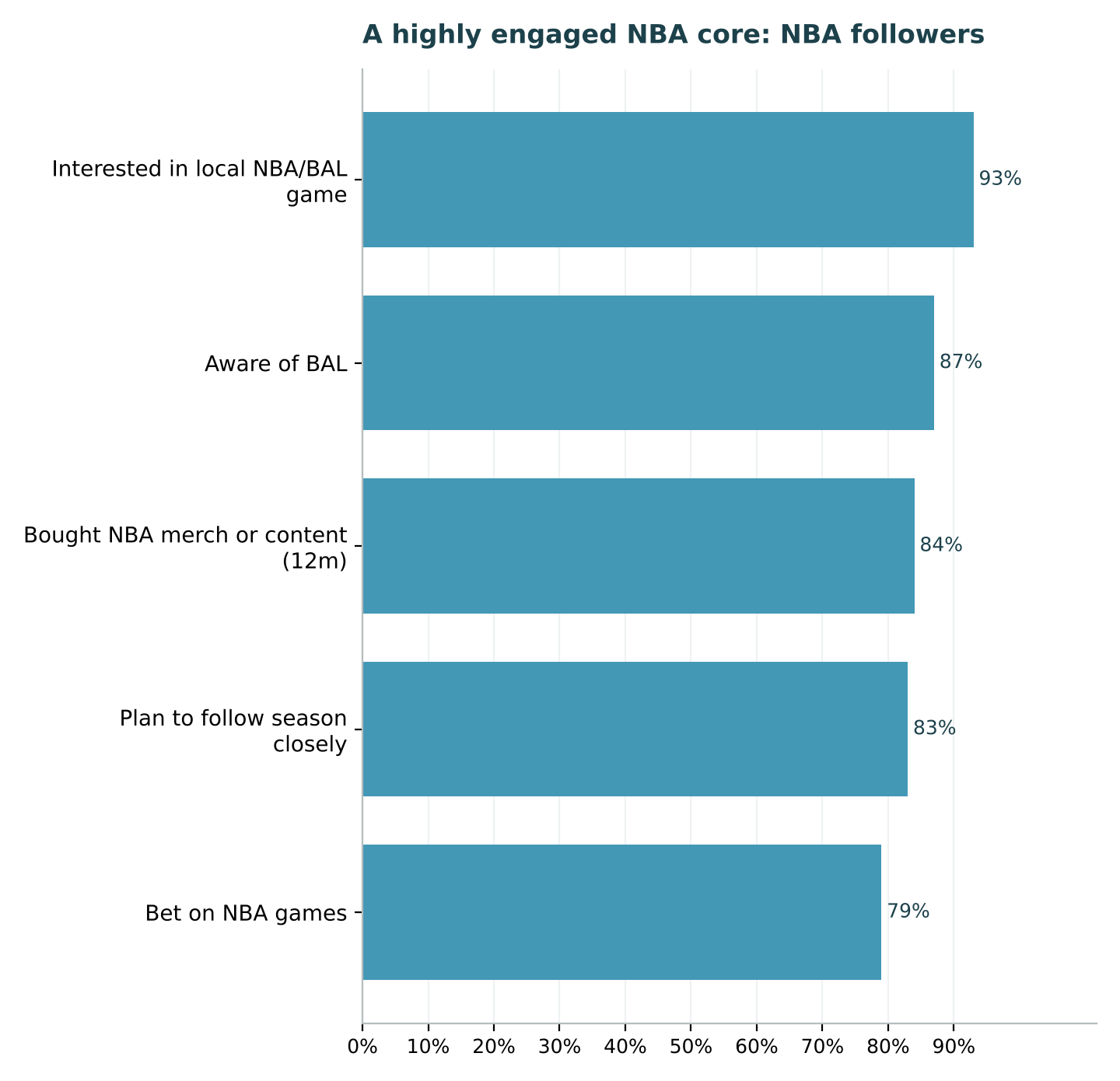
Respondents who follow the NBA are an intense, commercially active group. 83% plan to follow the new season closely, and 93% would attend a local NBA or BAL game. 79% bet on NBA games, and 84% have bought NBA merchandise or content in the past year. Country differences are limited. Kenya stands out on awareness of the BAL (94%) and on NBA purchases (95%), both significantly above Ghana.
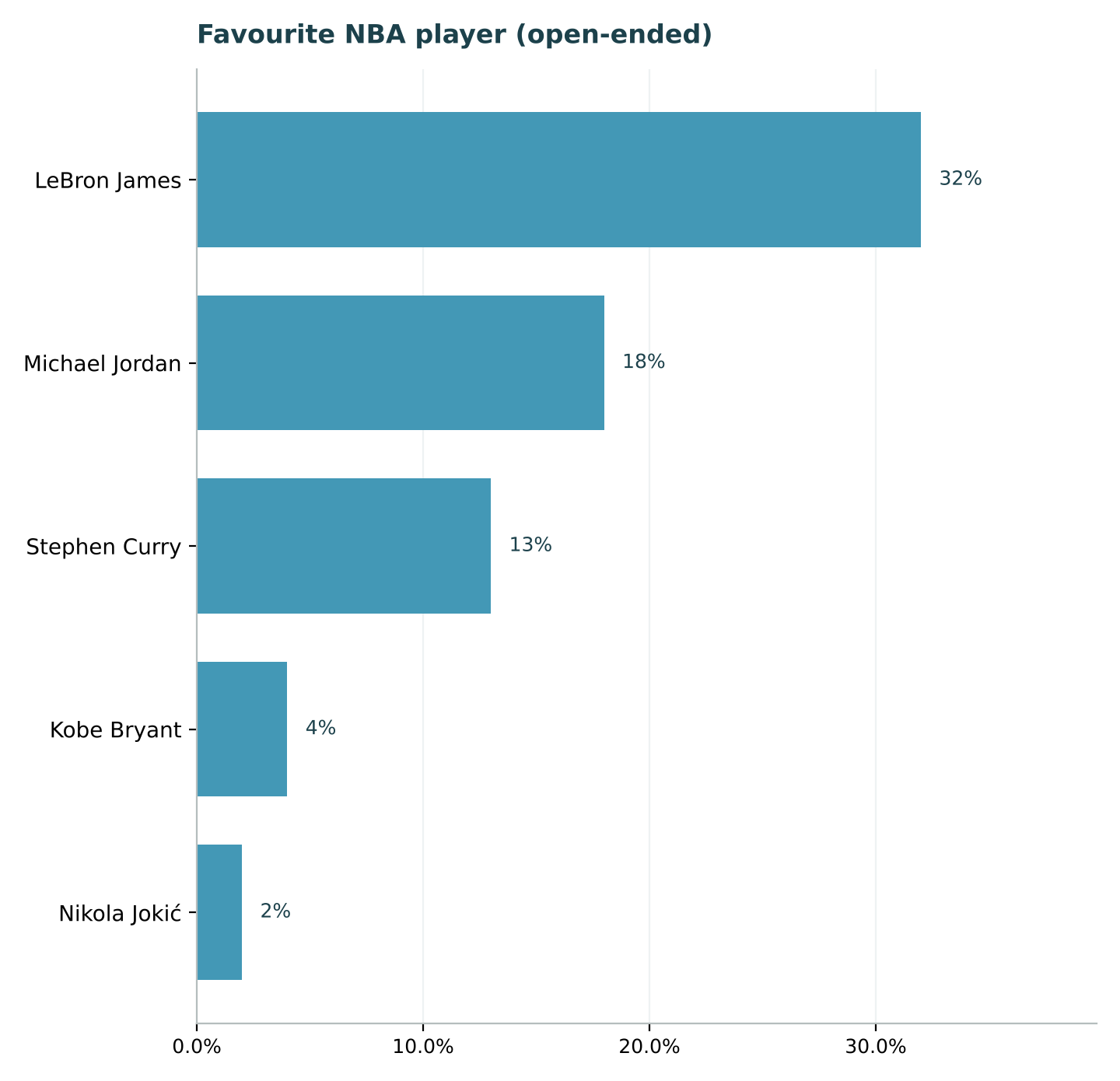
LeBron James is the most named NBA player among NBA followers (32%), and he leads in every country: 48% in South Africa, 36% in Nigeria, 29% in Kenya, and 26% in Ghana and Rwanda. Michael Jordan is second (18%), and is named more often in Nigeria (21%) than in Kenya (10%). Stephen Curry is third (13%) and is most popular in Kenya (16%).
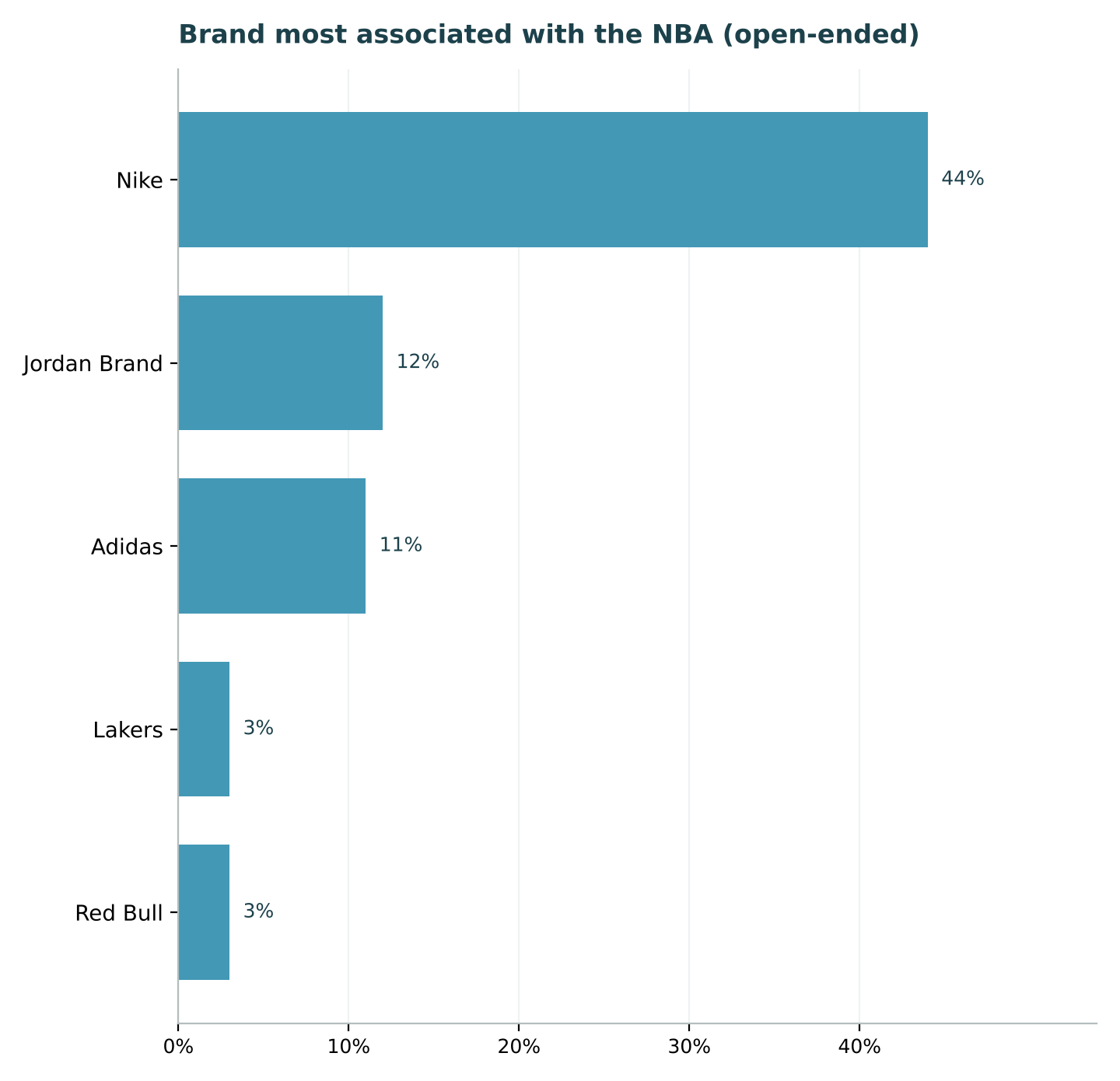
Asked which brand is most associated with the NBA, 44% of NBA followers named Nike, followed by Jordan Brand (12%) and Adidas (11%). Nike leads in every country, from 35% in Kenya to 52% in South Africa. Jordan Brand is named by 21% in Rwanda, its highest share. Jordan Brand is a Nike brand, so Nike-linked mentions total 56%.
Formula 1
Formula 1 has not raced in Africa since 1993, and the sport is now working to change that. A long-term deal confirmed a race in Rwanda for the early 2030s, as reported by KSL. South Africa is not on the 2026 calendar, as reported by TopAuto. F1 chief executive Stefano Domenicali has said Africa is not on hold, though plans are not yet finalised, as covered by Motorsport.com.
Familiarity with F1
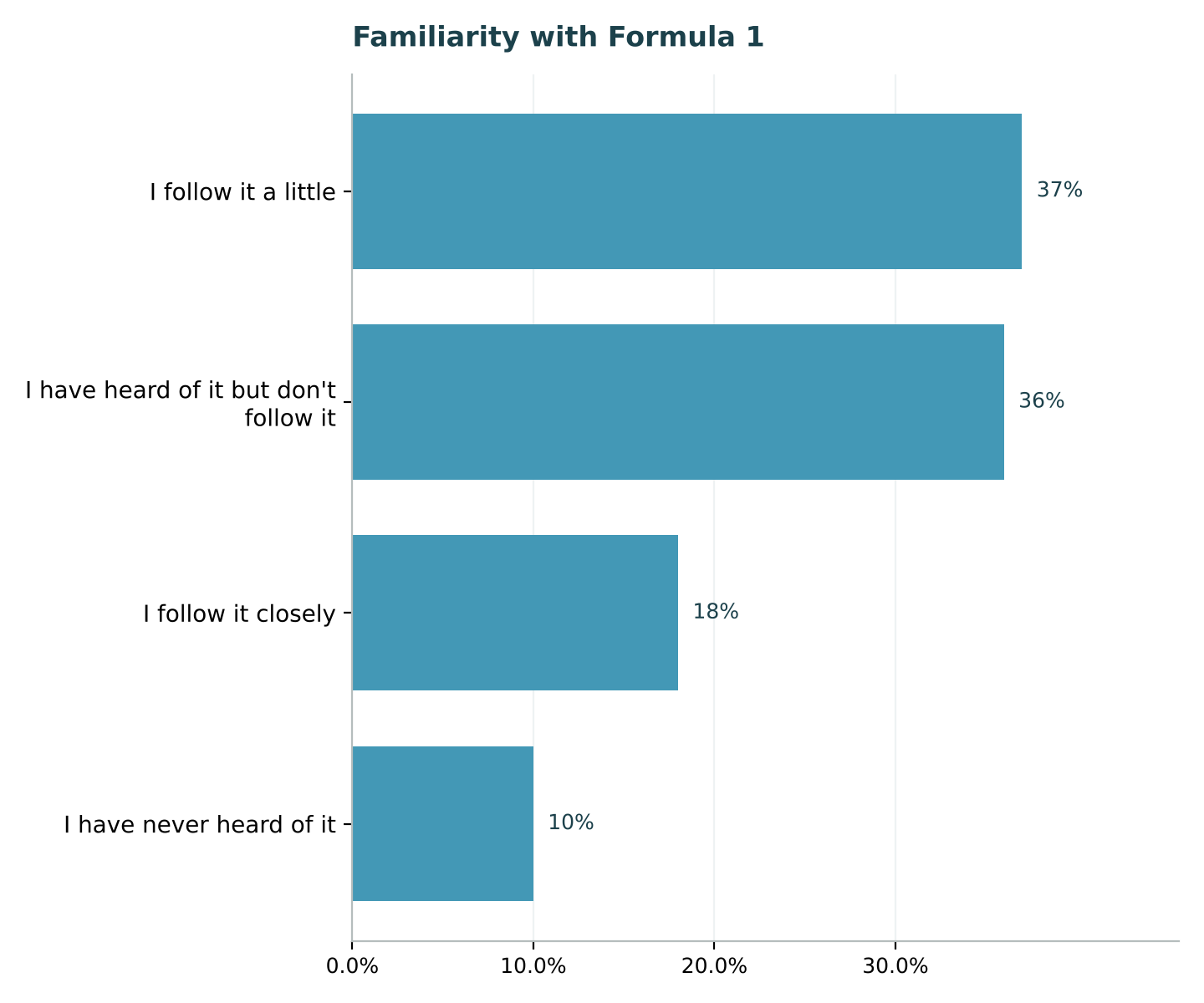
Most respondents know F1. 54% follow it at least a little, and a further 36% have heard of it but do not follow it. Only 10% have never heard of it. Rwanda has the largest group who know F1 but do not follow it (53%). Ghana has the highest share who have never heard of F1 (12%), significantly above Nigeria. Women are far more likely than men to say they have never heard of it (15% against 7%).
How closely people follow F1
Nigeria has the largest F1 audience. 64% of Nigerians follow F1 closely or a little, significantly ahead of all other countries. Kenya (56%) and South Africa (57%) come next, while Ghana (47%) and Rwanda (39%) have the smallest audiences. Men are more likely than women to follow F1 (58% against 46%). The chart above shows the full split by country.
Race weekend viewing
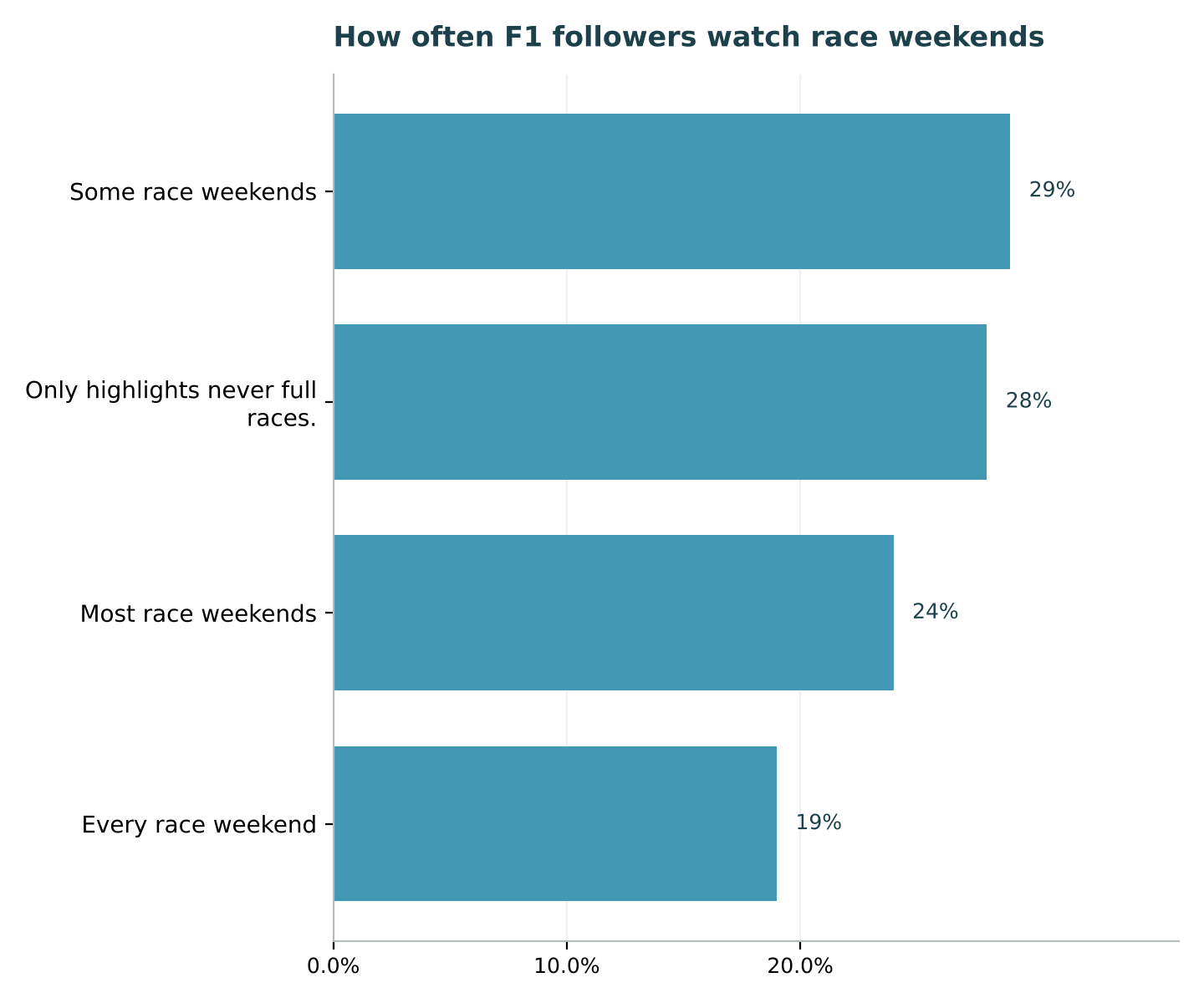
Among F1 followers, 43% watch most or every race weekend. Nigeria (47%) and Kenya (45%) lead, and both are significantly ahead of Ghana. Rwanda (39%) and Ghana (38%) have the largest shares who follow only highlights and never full races. Younger fans watch more often, with 41% of 18 to 24 year olds watching most or every race weekend, against 34% of those aged 45 and over.
Interest in an F1 race in Africa
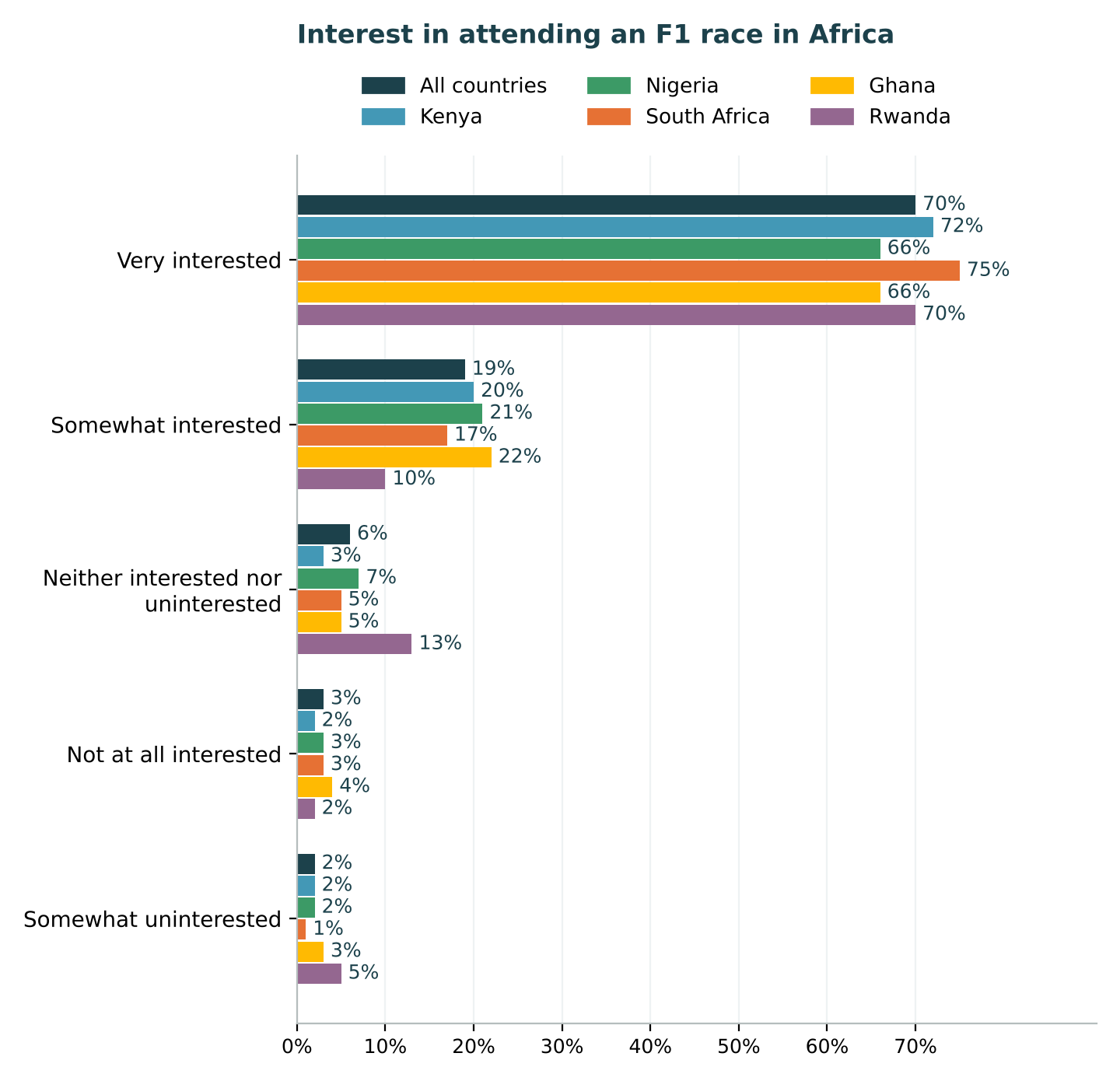
Interest in a race on the continent is very high. 89% of F1 followers are interested in attending an F1 race in Africa, and 70% are very interested. Kenya (92%) is significantly ahead of Nigeria and Rwanda, and South Africa (92%) is significantly ahead of Rwanda, which is lowest at 80%. South Africa has the most committed group, with 75% very interested, significantly above Nigeria and Ghana. Men (90%) are slightly more interested than women (86%).
How fans watch F1
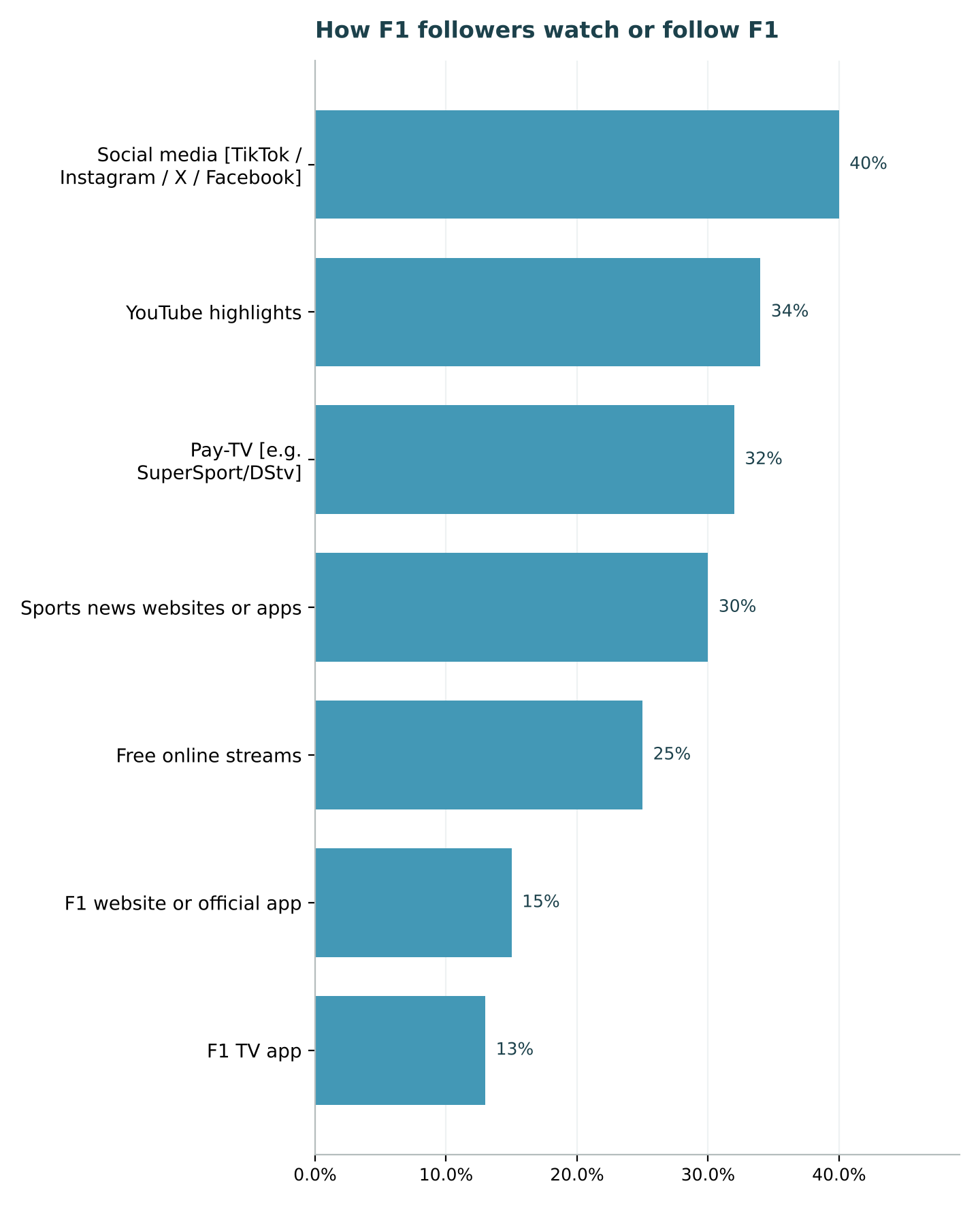
Among F1 followers, social media is the most popular channel for following the sport (40%), ahead of YouTube highlights (34%) and Pay-TV (32%). However, viewing habits vary across markets. Pay-TV is the leading channel in Rwanda (48%) and South Africa (42%), while social media takes the lead in Ghana (50%) and Nigeria (45%). This highlights the importance of digital platforms in keeping fans engaged, alongside traditional broadcast options. Despite the sport’s growing digital presence, official F1 platforms remain relatively underutilised, with just 15% using the F1 website or app and 13% accessing content through the F1 TV app.
Favourite F1 teams
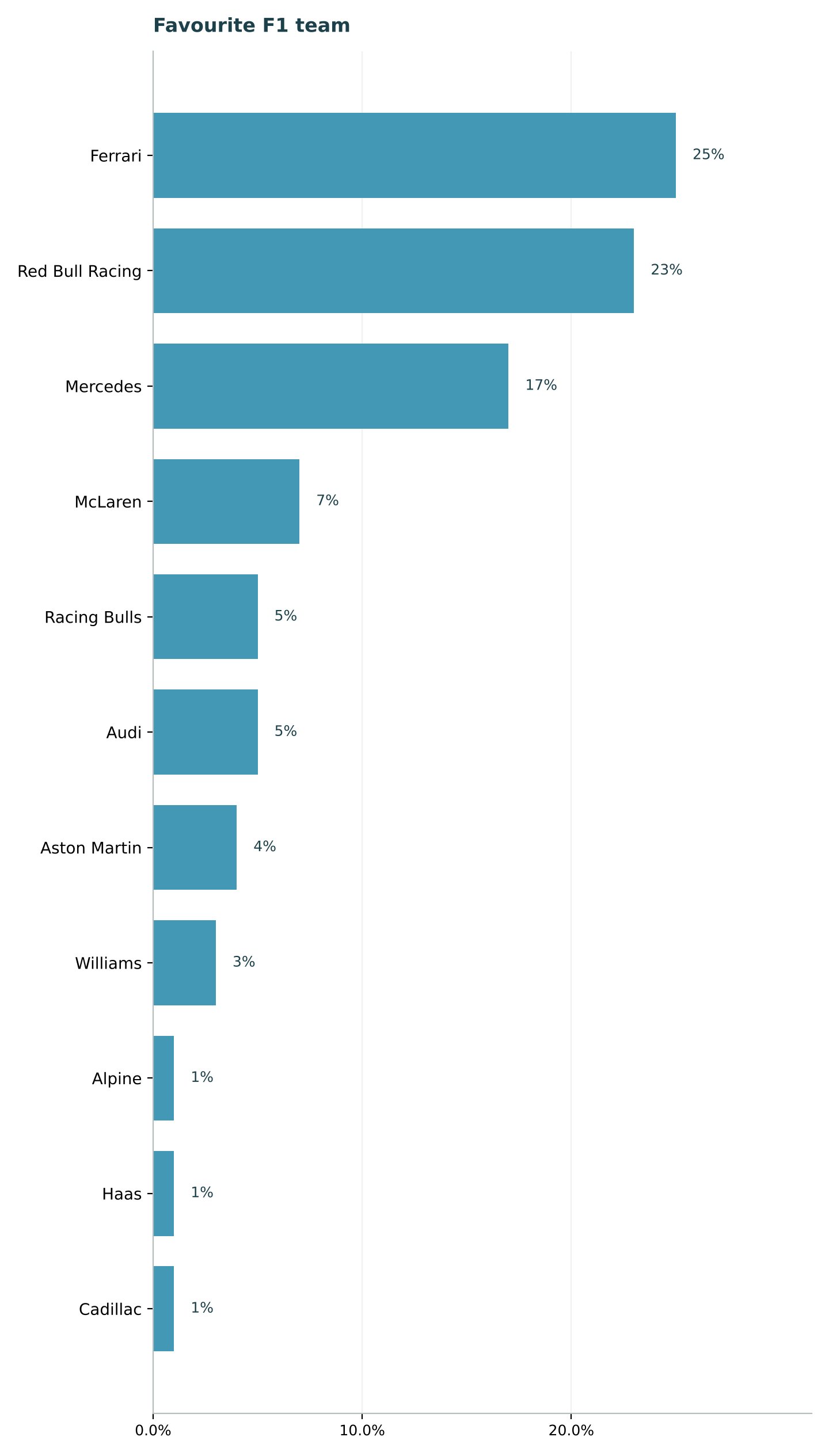
Ferrari (25%) and Red Bull Racing (23%) are the most supported teams among F1 followers, followed by Mercedes (17%). Ferrari is strongest in Kenya and Rwanda (29% each), and Red Bull is strongest in South Africa (27%). In Rwanda, 17% have no favourite team, compared with 4% in Kenya.
Favourite drivers
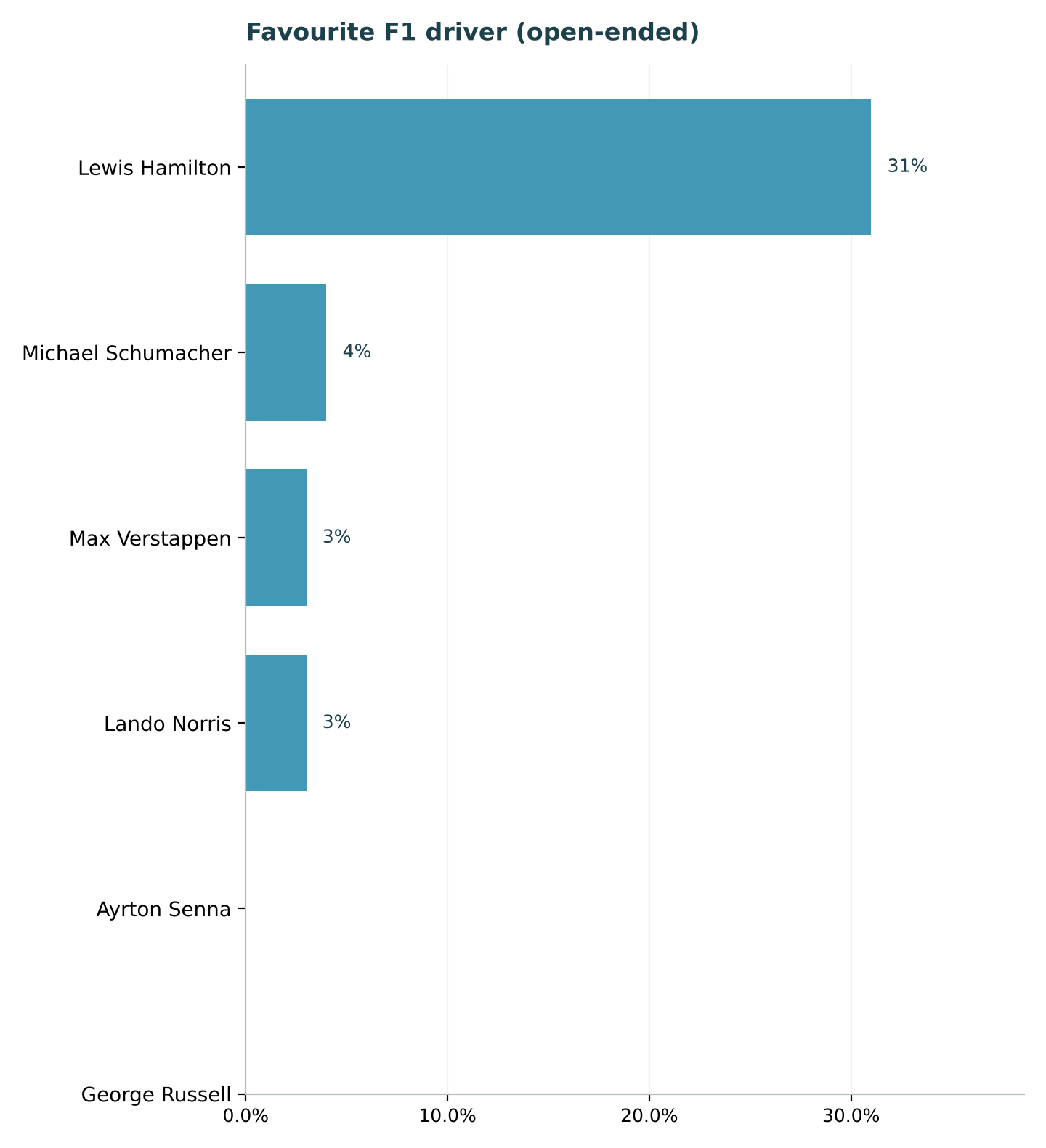
Lewis Hamilton is by far the most popular driver, named by 31% of F1 followers, and he is strongest in Rwanda (37%). Michael Schumacher ranks second in South Africa (9%). Max Verstappen and Lando Norris are each named by 3% overall.
Brand association
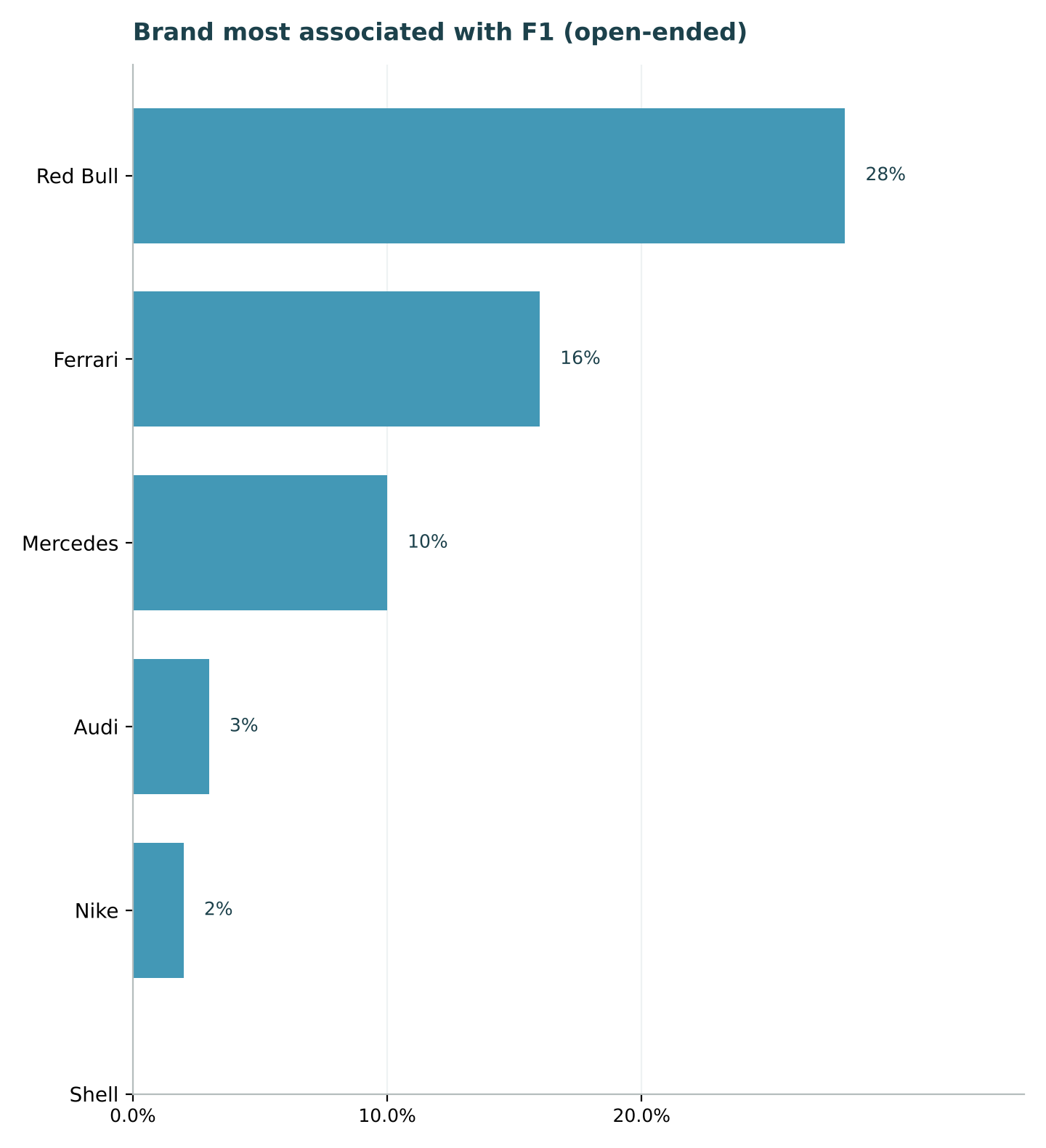
Asked which brand comes to mind first for F1, Red Bull is named by 28% of F1 followers, followed by Ferrari (16%) and Mercedes (10%). Red Bull leads in South Africa (36%), Kenya (29%), Ghana (27%) and Nigeria (26%). Rwanda is the exception, where Ferrari (18%) is named ahead of Red Bull (15%).
What would grow the F1 audience
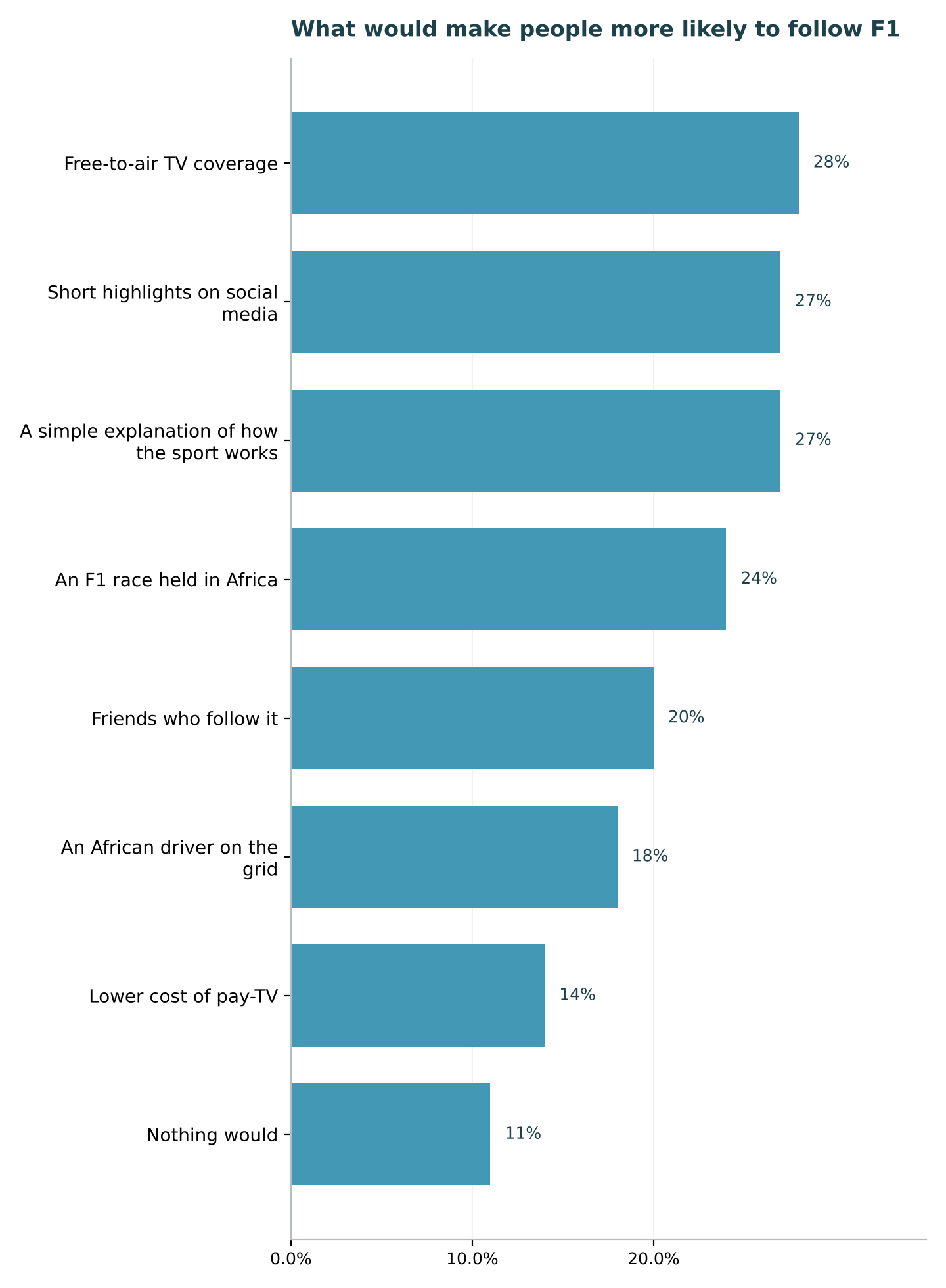
Among people who know F1 but do not follow it, free-to-air TV is the strongest lever overall (28%). It matters most in Rwanda (40%) and Ghana (36%), both significantly above Kenya, Nigeria and South Africa.
A race held in Africa would raise interest for 24% overall. Kenya is the clear case at 33%, significantly above Nigeria, South Africa and Ghana. An African driver on the grid would raise interest for 18% overall. Kenya and Ghana are the highest at 21% each, and the gap between countries is small.
Short highlights on social media (27%) and a simple explanation of how the sport works (27%) are the next most common answers. Ghana (31%) and Nigeria (30%) are the most responsive to social media highlights. Friends who follow the sport (20%) matter in Nigeria and Ghana (24% each). Lower pay-TV costs would matter most in Rwanda (20%), and 11% say nothing would change their view, with South Africa highest on that answer (21%).
Spending on sport
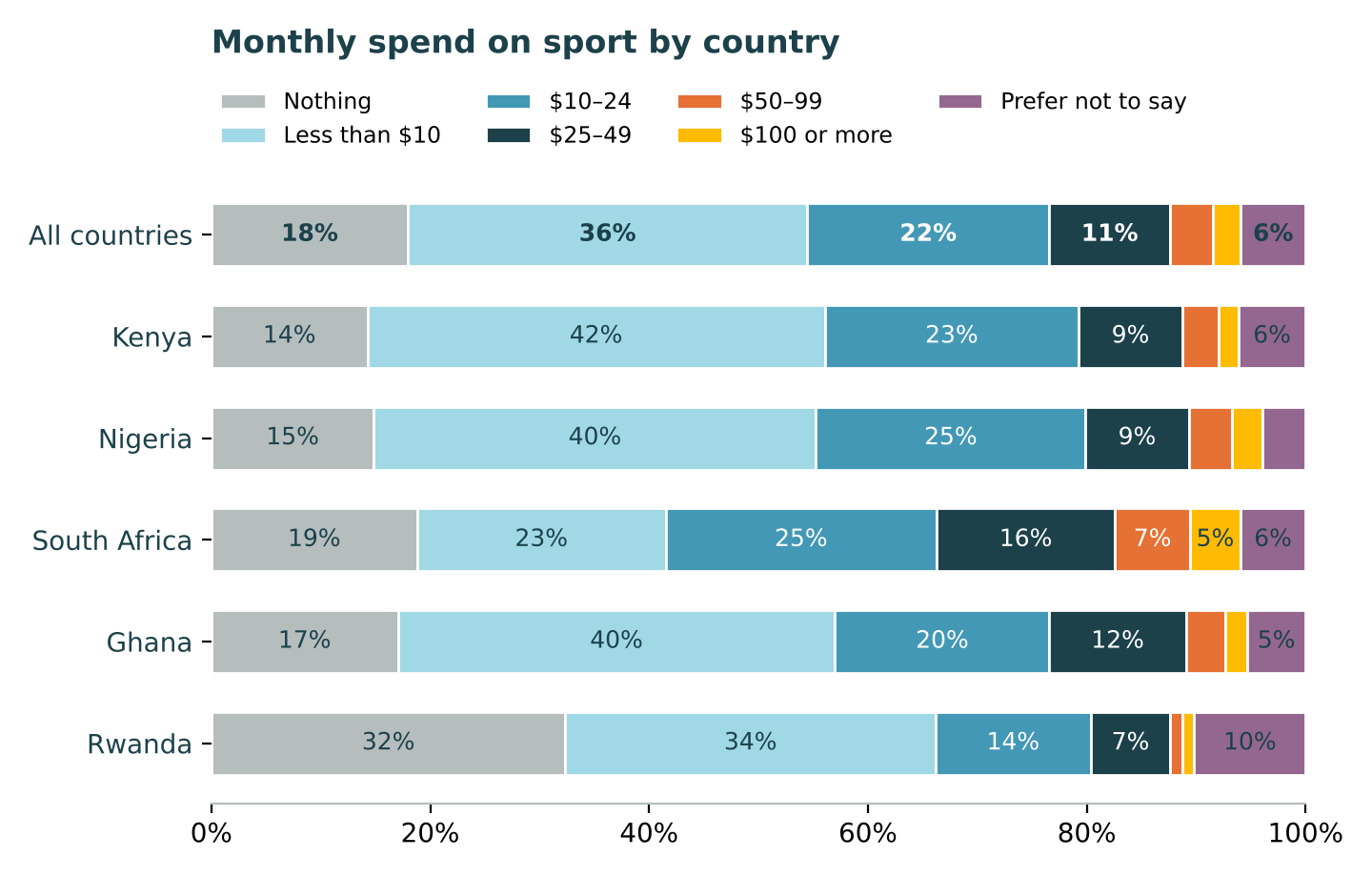
Spending on sports-related activities and products varies considerably across markets, with 40% of fans spending $10 or more per month. South Africa has the highest-spending fan base, at 53%, significantly ahead of all other countries. Nigeria (41%), Kenya (38%) and Ghana (38%) fall within a middle tier, while Rwanda records the lowest proportion of higher spenders (24%).
Rwanda also has the largest share of fans who spend nothing on sport (32%), significantly higher than in every other country, suggesting lower overall spending engagement in this market. Spending also tends to increase with age: only 29% of 18–24-year-olds spend $10 or more per month, compared with 39% of those aged 45 and above. Men are also more likely than women to be higher spenders (41% versus 36%), and this difference persists even after controlling for country and age.
What this means
- Football is the shared language of sport. 79% of respondents are interested in it, and it is the highest-interest sport in every country, peaking at 90% in Ghana.
- Sport is a daily habit in West Africa but not in Rwanda. Half of respondents follow sport regularly, led by Nigeria (59%), Kenya (56%) and Ghana (56%). Rwanda stands apart at 13%, and its fans are more casual followers. TV is still the main window, but the mix changes by market and age.
- TV is the leading channel everywhere (55% overall), while radio matters most in Rwanda (36%) and TikTok is the channel of the youngest fans (27% of 18 to 24 year olds). Any single regional view of media will miss these differences.
- Sport is social as well as televised. 58% attend live events every few months, and watching at a bar or venue is a male pattern (18% of men against 8% of women), which points to group viewing as part of the experience.
- Sponsorship has real commercial weight. 71% say a sponsor makes them more likely to buy, with the strongest response in Rwanda (77%) and Nigeria (76%). The response is weakest among people over 45 (62%).
- Basketball is niche overall but has a committed core. Only 17% are interested in basketball, yet NBA followers are highly engaged, and the NBA leads among basketball fans in every market except Rwanda, where the national league is stronger.
- F1 has a wide audience with a clear path to growth. 54% follow it at least a little, and 89% of F1 followers would like to attend a race in Africa. Access, especially free-to-air TV, is the most-cited lever for people who know the sport but do not follow it.
- Gender differences run through most measures. Men are more engaged on sport, attend more, spend more and are more likely to follow the NBA and F1, while women lean towards their national basketball league.
- Spending is modest and varies sharply. 40% spend $10 or more a month, from 53% in South Africa to 24% in Rwanda, where 32% spend nothing.
GeoPoll conducted this rapid dipstick survey through its mobile platform between 13 and 30 October 2026. The results combine seven polls across five markets, Kenya, Nigeria, South Africa, Ghana and Rwanda, yielding 2,498 completed interviews with adults aged 18 and over. Rwanda was fielded in Kinyarwanda and the other four markets in English. The results are unweighted and reflect a natural fall-out sample rather than strict demographic quotas. The sample is skewed male and younger: 69% of respondents are men, and 25 to 34 year olds are the largest age group at 47%. Samples in Nigeria, Ghana and Rwanda are mostly male, while South Africa is close to balanced. The findings should therefore be considered indicative of mobile-connected adults in each market and should not be interpreted as nationally representative of any country’s adult population. Differences between countries are tested at 95% confidence, but small subgroups, such as South Africa and Rwanda among NBA followers, are directional only. For a scientific study on sport, media or consumer behaviour across Africa, Asia or Latin America, please contact GeoPoll.
Source: www.geopoll.com