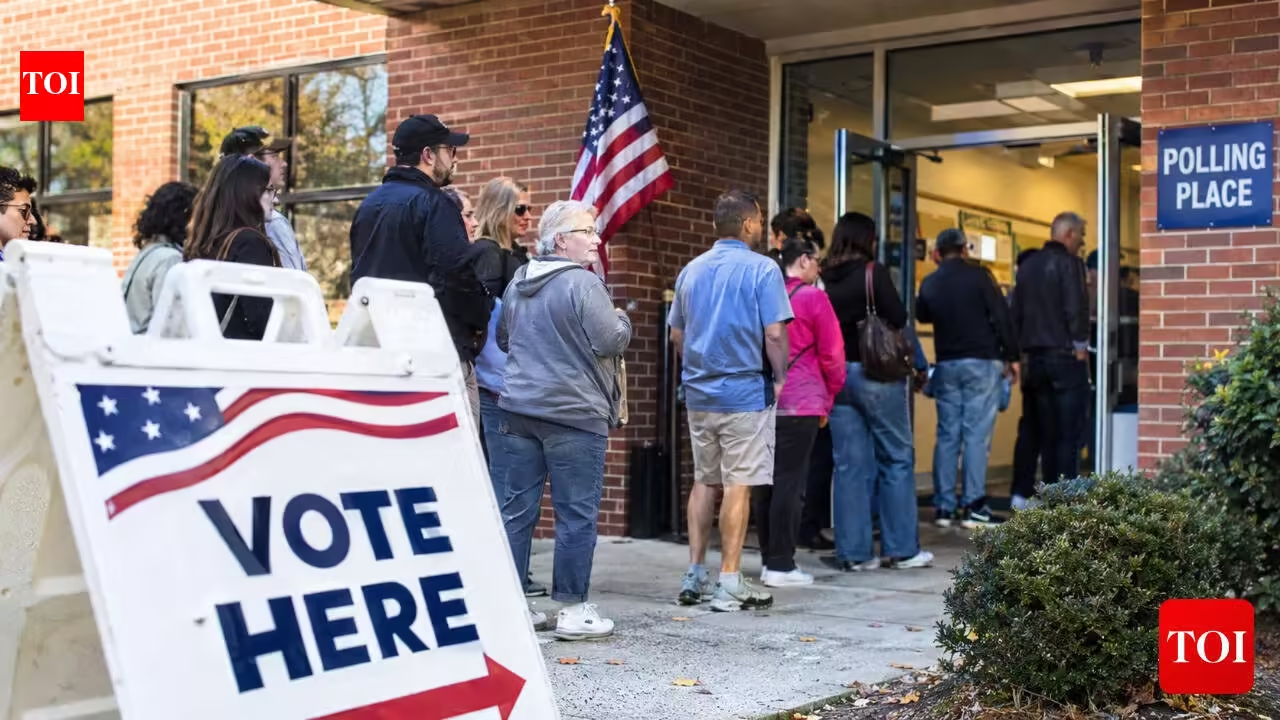

The battle for control of the US Congress is under way, and Republicans have reason to be nervous.As millions of Americans head to polling stations on November 3, the latest surveys point to a difficult electoral environment for President Donald Trump’s Republican Party, with Democrats building a substantial lead in the national congressional preference polls and gaining ground in several traditionally Republican states.The elections are shaping up as a referendum on Trump’s second presidency, with voters weighing the administration’s handling of the economy, the cost of living, immigration, tariffs and the war involving Iran.
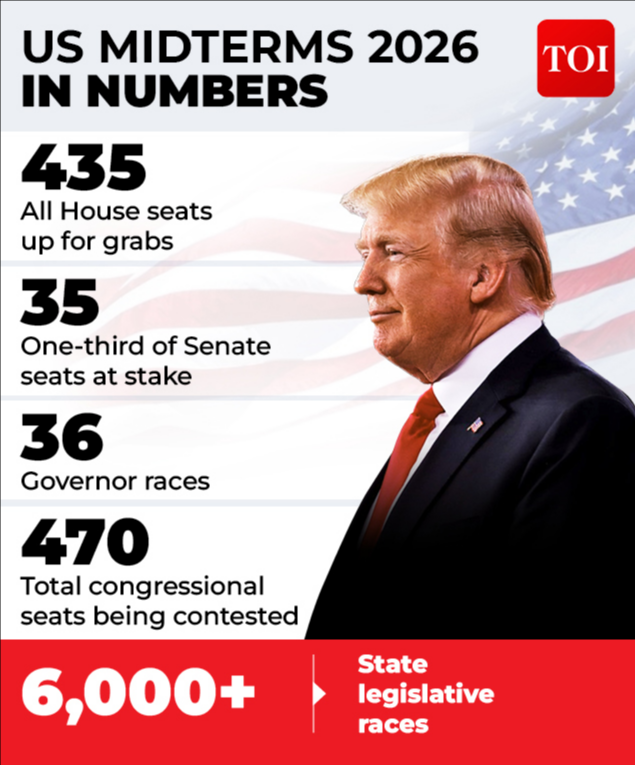
All 435 seats in the House of Representatives, 35 Senate seats and 36 governorships are being contested.
For Democrats, the midterms offer an opportunity to turn dissatisfaction with the White House into control of Congress. For Republicans, the challenge is to prevent a midterm backlash from becoming a decisive repudiation of Trump’s political agenda.All 435 seats in the House of Representatives, 35 Senate seats and 36 governorships are being contested.The outcome will determine not only who controls the legislative agenda for the remaining two years of Trump’s presidency but also how much political leverage the president retains heading into the 2028 presidential election.
The numbers
The national polling picture has shifted considerably in the Democrats’ favour in the final stretch of the campaign. A polling aggregation updated on November 3 puts the Democratic advantage on the generic congressional ballot at approximately 8.4 percentage points.The figures represent national preferences for congressional elections, rather than predictions of individual seat outcomes. Nevertheless, a Democratic lead of this magnitude is significant, particularly given how narrow the Republican majority in the House is.An earlier RealClearPolling average, cited by Al Jazeera on October 31, had Democrats ahead 51.4% to 43.2%, an 8.2-point advantage. An Economist/YouGov survey also found that 44% of registered voters expected Democrats to control the House after the election, against 31% who expected Republicans to retain it.The Senate picture was less settled in that survey: 39% expected Democrats to win control, while 36% anticipated a Republican majority.Perhaps the most consequential development is the latest forecast from election analyst Nate Silver’s Silver Bulletin. Its final November 3 forecast says a Democratic House majority now looks almost certain and that Democrats have also moved into a strong position to capture the Senate.The model’s polling averages show Democrats ahead in practically every major Senate battleground, including Texas, Ohio, Michigan, Maine and Iowa. Even states that Republicans would ordinarily expect to defend comfortably have become competitive.The figures are especially striking in Texas, Ohio and Kansas, where Democrats are attempting to break through in states that have traditionally leaned Republican in federal elections.However, polls are not predictions. A lead of three or four percentage points can disappear within the margin of error, and turnout, undecided voters and differences between likely-voter and registered-voter samples could still change the outcome.
Why the Democrats believe a blue wave is possible
Historically, the party occupying the White House tends to lose ground in midterm elections. The president’s party has lost House seats in 18 of the last 20 midterm elections over the past 80 years, making the November vote particularly uncomfortable for Trump.
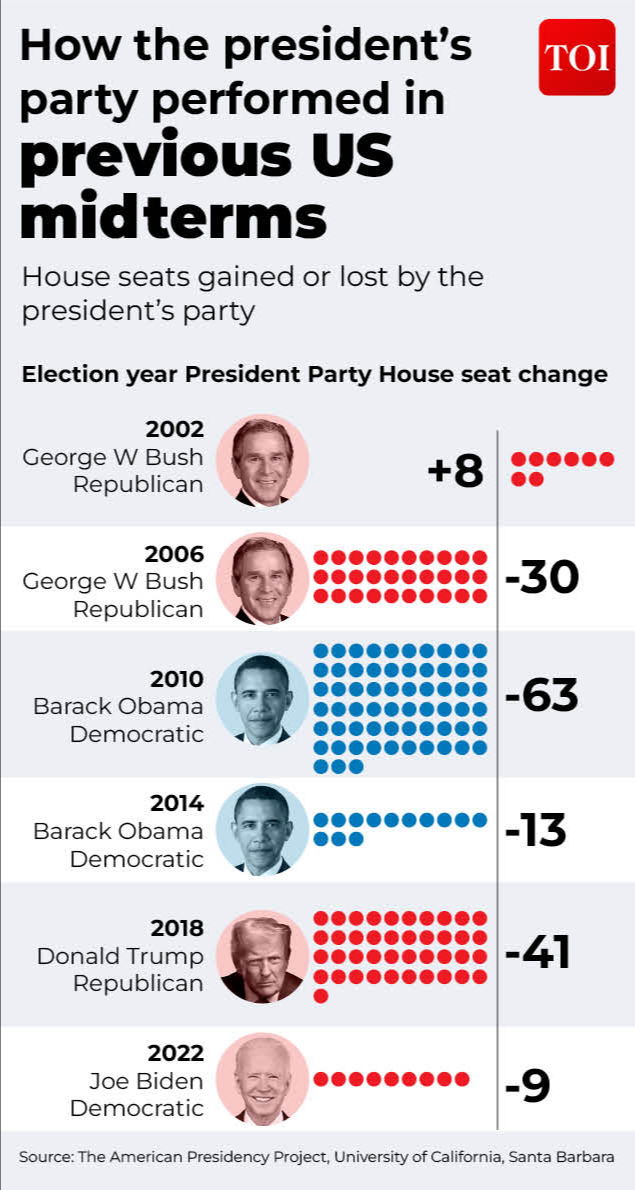
Historically, the president’s party often loses congressional seats in these elections
But this election is also being shaped by a combination of issues that Democrats believe have created an unusually difficult environment for Republicans.
- The economy and cost of living: Affordability has emerged as a central campaign issue. Voters are concerned about everyday expenses, energy prices, healthcare costs and the pressure on household budgets. Republicans are facing questions about whether Trump’s economic policies have delivered the relief promised during the 2024 presidential campaign. Democrats have sought to connect tariffs and the Iran war to higher costs for consumers, farmers and businesses. In Iowa, for instance, the impact of tariffs and the rising cost of diesel and fertiliser have become central to the campaign. Rural voters, traditionally an important Republican constituency, are being targeted by Democrats with an affordability message.
- The Iran war: The war involving Iran has become another major political vulnerability for the administration. Republicans are facing criticism over its economic consequences, particularly energy prices and the wider uncertainty surrounding American military involvement. The issue has also created a difficult balancing act for GOP candidates who must defend the president’s foreign policy while attempting to keep the focus on domestic concerns.
- Trump’s approval ratings: Trump’s popularity is another major concern for Republicans. The New York Times polling average put his approval rating at approximately 37% ahead of Election Day. Democrats have sought to turn dissatisfaction with the president into votes against Republican candidates, even in constituencies that Trump won comfortably in 2024.
- Early voting and turnout: More than 43 million Americans had already voted early, either in person or through returned mail ballots, five days before Election Day, according to an Associated Press analysis. That was nearly 10 million more than at the equivalent stage before the 2022 midterms. Texas had recorded more than 6.3 million early ballots by October 28, against 4.2 million at the corresponding stage in 2022 — an increase of around 50%. Georgia had also crossed 2.5 million early ballots by October 30, surpassing its 2022 early-voting figure of 2.3 million. The numbers indicate heightened electoral engagement, although early voting figures alone cannot establish which party will benefit.
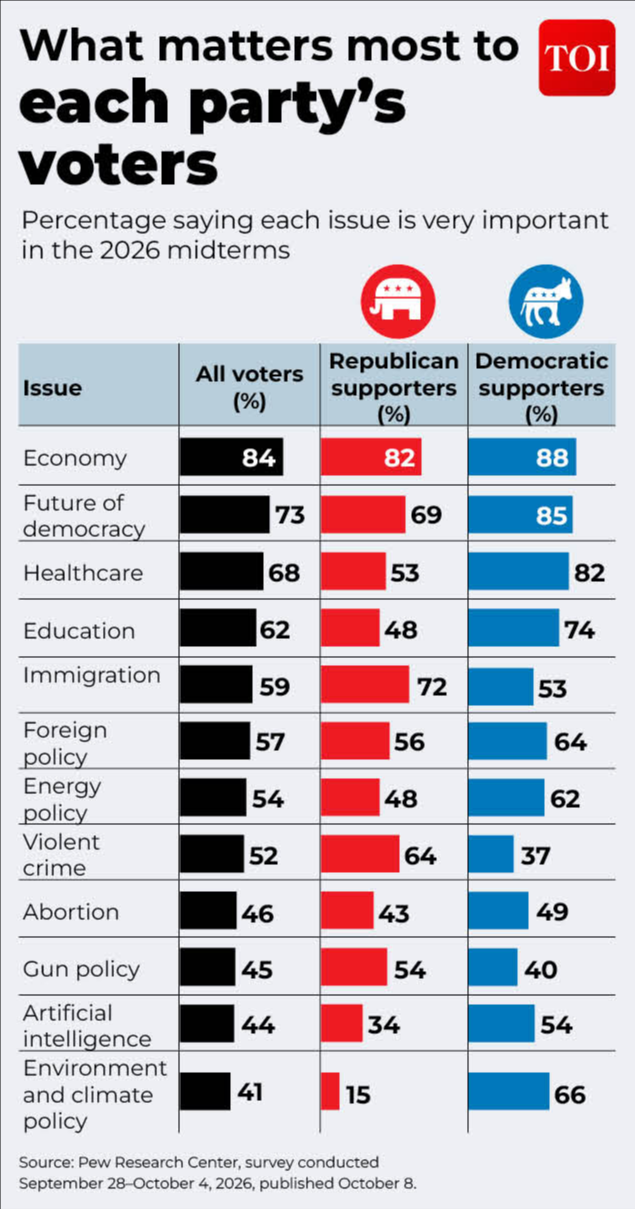
Economy, democracy, healthcare, education and immigration are the top concerns of US voters.
The House: Republicans’ biggest vulnerability
The party entered the election with 219 seats against the Democrats’ 214, with two vacancies. Democrats therefore need a net gain of just four seats to secure a majority.
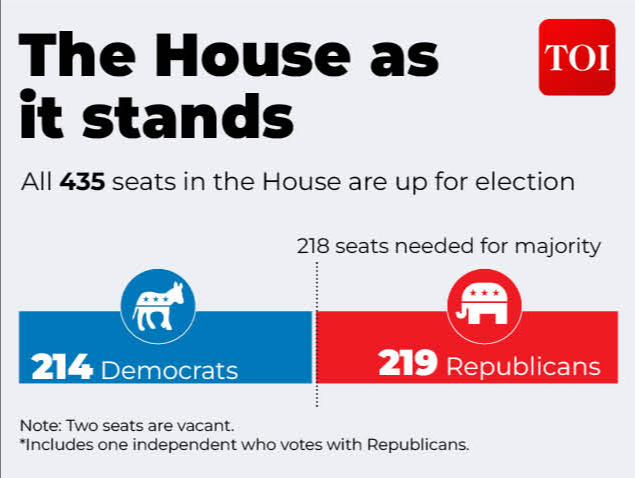
The House balance at 219 Republicans to 214 Democrats, with two vacancies
That relatively small hurdle has made dozens of districts competitive, including several that Trump carried in 2024.The challenge for Republicans is compounded by the fact that the president’s party generally faces a midterm disadvantage. Democrats, meanwhile, have been encouraged by the national polling advantage and their performance in a number of special elections.The Cook Political Report and other election forecasters have identified a broad collection of Republican-held seats that could become vulnerable.Among the most important House contests are:
- NEW YORK Republican Congressman Mike Lawler faces Democrat Cait Conley in New York’s 17th Congressional District. The constituency is particularly important because it is among the few Republican-held districts that Kamala Harris carried in the 2024 presidential election. Lawler has built his political identity around appealing to moderate voters, but the national political environment could make his re-election considerably more difficult. Conley is attempting to capitalise on dissatisfaction with Trump and turn the district’s Democratic lean in the presidential election into a congressional victory. The latest polling aggregation puts Conley approximately two percentage points ahead, making this one of the most closely watched Republican-held seats.
- IOWA Iowa’s first congressional district is another important test of whether Democrats can win back voters in traditionally Republican territory. Republican Congresswoman Mariannette Miller-Meeks faces Democrat Christina Bohannan, who has unsuccessfully challenged her in previous elections. The contest has become more competitive amid concerns about tariffs, farm costs and the wider economic outlook. Democrats have also invested heavily in the district. Reuters reported that they had spent approximately $11 million compared with $7 million by Republicans. The latest polling aggregation showed Bohannan with a substantial lead, although the district’s Republican lean and the history of Miller-Meeks’ victories make this a race worth watching closely.
- TEXAS Texas has become a particularly important battleground because of the Republican effort to redraw congressional boundaries to improve the party’s chances of retaining its House majority. Republicans hoped the redistricting exercise would create additional favourable seats. But Democrats are attempting to turn the backlash against the process into an electoral advantage. Several Texas districts are now being closely monitored, including the 9th District, where the polling aggregation shows Democrat Alex Mealer narrowly ahead of the Republican incumbent. The 15th District is another contest to watch, with Republican Monica De La Cruz facing a challenge from Democrat Bobby Pulido. The outcome will help establish whether Republican efforts to reshape congressional boundaries have delivered the expected advantage.
Other House races to watch
- Arizona’s 1st District: Democrat Amish Shah is challenging Republican Jay Feely in a competitive open-seat contest. Shah’s campaign has attracted significant outside spending, and the latest polling aggregation gives him a four-point advantage.
- Florida’s 22nd District: Democrat Pia Dandiya is challenging Republican Casey Askar in a seat that has been rated a toss-up by major election forecasters.
- Pennsylvania’s 7th District: Republican Ryan Mackenzie faces Democrat Ryan Crosswell in another closely watched contest.
- Michigan’s 10th District: Democrat Christina Hines and Republican Michael Bouchard are competing for an open seat after John James entered the gubernatorial race.
- Montana’s 1st District: Democrat Sam Forstag is attempting to unseat Republican Aaron Flint in a district Trump won comfortably in 2024.
- New Jersey’s 7th District: Democrat Rebecca Bennett is challenging Republican Tom Kean Jr., who has faced criticism over his absence from congressional votes.
These contests are part of a much larger battle. CBS News identified 42 House races that could determine which party controls the chamber.
Senate: Could Democrats pull off an even bigger upset?
The Senate battle is more complicated.Republicans currently hold 53 seats against the Democrats’ 47. Democrats need a net gain of four seats to reach a majority, assuming the existing chamber alignment.
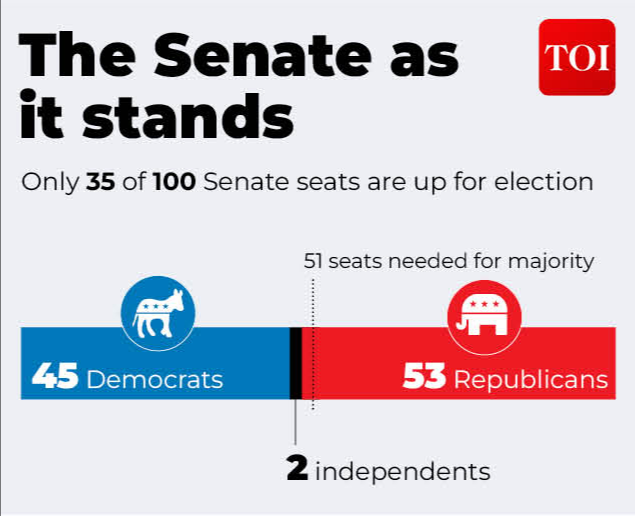
The Senate is arguably the more consequential prize in terms of appointments and the long-term balance of power in Washington.
This is a considerably more difficult proposition than winning the House because Republicans are defending seats in a number of states Trump carried by comfortable margins in 2024. But the latest surveys have given Democrats fresh hope.Five Senate contests deserve particular attention.
1. Texas: James Talarico’s opportunity to make history
Texas is emerging as one of the biggest potential Democratic breakthroughs of the election.Democrat James Talarico is challenging Republican Ken Paxton, the state’s attorney general, for a Senate seat.Paxton defeated incumbent Republican Senator John Cornyn in the GOP primary, but his nomination has raised questions about whether Republicans have selected the strongest possible candidate for a general election contest.His history of personal and political controversies has given Democrats an opening.Talarico, a state representative and former teacher, has sought to build a campaign around economic issues, healthcare and a broader appeal to voters dissatisfied with the political establishment.The November 1 New York Times/Siena poll put Talarico ahead 50% to 43%.A polling average also showed him leading by approximately three points. A Democratic victory would be particularly significant: the party has not won a Texas Senate election since 1988.
2. Michigan: Abdul El-Sayed takes on Mike Rogers
Michigan is another state where Democrats are hoping to make a significant gain.Democrat Abdul El-Sayed is challenging Republican Mike Rogers for an open Senate seat following the retirement of Senator Gary Peters.El-Sayed, a progressive former Michigan health official, won a divisive Democratic primary against a more moderate opponent.Rogers, a former congressman, is attempting to return to the Senate after losing his previous election battle against Elissa Slotkin.The latest New York Times/Siena survey gave El-Sayed a commanding 53%-42% lead.This is particularly important because Michigan is a major battleground state where the Democratic candidate’s performance could help establish whether the party’s national polling advantage is translating into votes.
3. Ohio: Sherrod Brown attempts a comeback
Former Democratic Senator Sherrod Brown is attempting to reclaim his seat after losing his re-election bid in 2024.He faces Republican Senator Jon Husted, who was appointed to the seat vacated by JD Vance after Vance became vice-president.Brown has sought to position himself as a champion of working-class voters, an important constituency in a state that has moved increasingly towards Republicans in recent elections.His campaign is attempting to make the election about manufacturing jobs, economic insecurity and the cost of living.The New York Times/Siena poll put Brown ahead 49%-44%, suggesting that Ohio could become one of the biggest Democratic surprises of the night.
4. Maine: Susan Collins faces a serious challenge
Republican Senator Susan Collins is fighting to retain her seat against Democrat Troy Jackson.Collins has survived several difficult election campaigns and has often benefited from her ability to attract support beyond the Republican base.But the political environment is different this time. Maine voted for Kamala Harris in 2024, and Democrats believe the state’s electorate could turn against Republicans in the midterms.The November 1 Siena poll showed Jackson leading Collins 51%-45%.A Democratic victory here would be particularly consequential because Collins has been a prominent Republican figure in the Senate for decades.
5. Alaska: Mary Peltola threatens another Republican seat
Former Democratic Congresswoman Mary Peltola is challenging Republican Senator Dan Sullivan in Alaska.Alaska is not an obvious Democratic pickup opportunity. The state has a strong Republican voting history and has not elected a Democrat to the Senate since 2008.But Peltola has demonstrated an ability to appeal to voters beyond the traditional Democratic base.The latest Siena poll showed her leading Sullivan 48%-46%.Even a narrow victory would be a major breakthrough for Democrats and could prove decisive in the battle for Senate control.
Other Senate contests that could decide control
| State | Democratic candidate | Republican candidate | Latest polling picture |
| Kansas | Adam Hamilton | Roger Marshall | Hamilton +5 |
| Iowa | Josh Turek | Ashley Hinson | Turek +1 |
| Georgia | Jon Ossoff | Mike Collins | Ossoff +9.2 |
| North Carolina | Roy Cooper | Michael Whatley | Cooper +10.9 |
| New Hampshire | Chris Pappas | John Sununu | Pappas +7.3 |
| Nebraska | Independent/Democratic-aligned candidate | Pete Ricketts | Ricketts +0.9 |
Kansas is especially interesting. Democrat Adam Hamilton is attempting to become the first Democrat to win a Senate election in the state since 1932.The race against Republican Senator Roger Marshall has become competitive because of concerns over affordability, energy costs and the Iran war.Georgia, meanwhile, is a test of whether Republicans can unseat Democratic Senator Jon Ossoff. Republican Mike Collins is challenging him, but the latest polling averages suggest Ossoff has a substantial advantage.North Carolina is another important opportunity for Democrats. Former governor Roy Cooper is running against Republican Michael Whatley in an open-seat contest. Cooper’s popularity and statewide political experience have made him a formidable challenger.Together, these races could determine whether Democrats can overcome the unfavourable Senate map and take control of the chamber.
Governor races: Democrats eye a historic breakthrough
While congressional control is the biggest national prize, the gubernatorial contests could produce a political realignment of their own.A total of 36 states are electing governors, representing approximately 80% of the US population. Nineteen of those contests involve open seats.
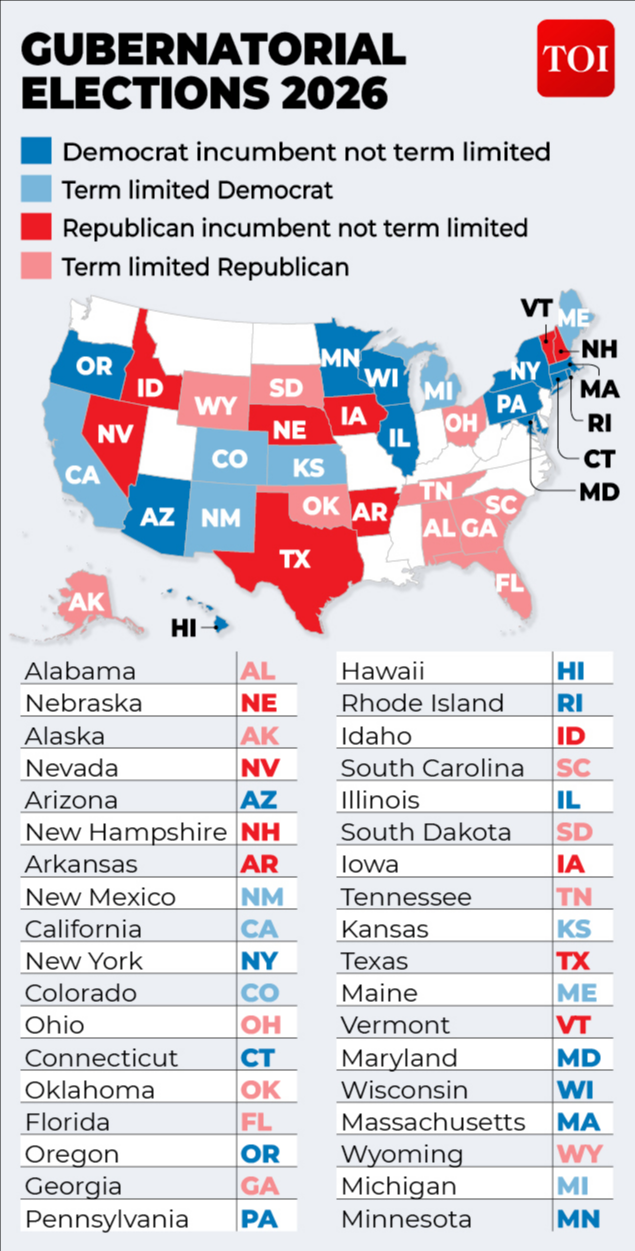
Gubernatorial contests could produce a political realignment of their own.
Democrats are hoping to win control of a majority of governors’ offices for the first time in two decades. Their last such breakthrough came in 2006, when they flipped six governorships during the midterm elections of George W Bush’s presidency.The most closely watched races include:
1. Ohio: Vivek Ramaswamy vs Amy Acton
This is arguably the most closely watched gubernatorial contest from an Indian-American perspective.Republican Vivek Ramaswamy, backed by Trump, is running against Democrat Amy Acton, the former Ohio health director.Ramaswamy entered the campaign with considerable national visibility, having previously contested the 2024 Republican presidential nomination and later worked with the Trump administration’s Department of Government Efficiency initiative.
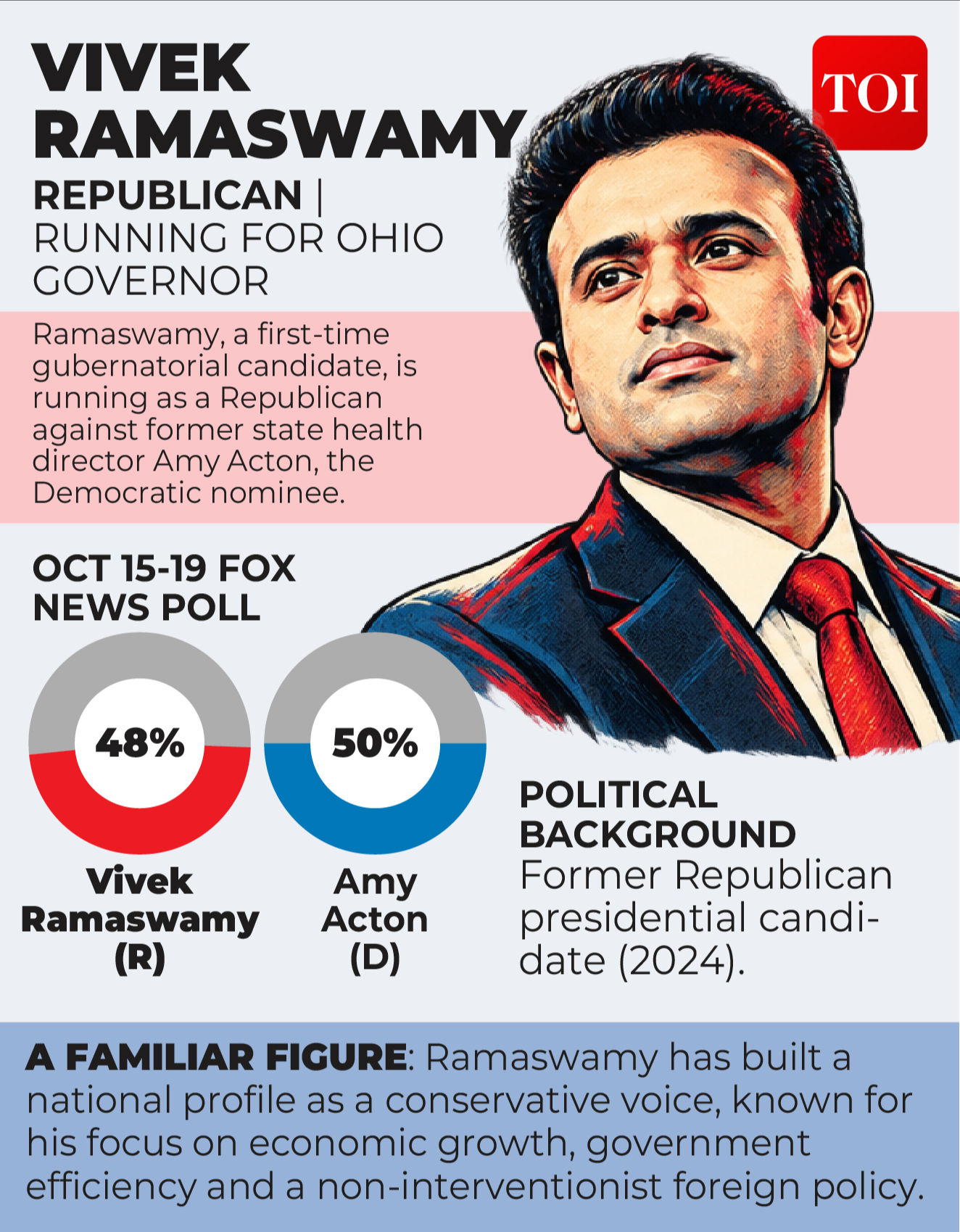
Vivek Ramaswamy entered the campaign with considerable national visibility
Acton, meanwhile, is seeking to make the race a referendum on Republican leadership in the state.The latest New York Times/Siena survey put Acton ahead 49%-43%. Another November 1 survey by Survey 160 showed her leading 51%-44%.The polling average on November 2 gave Acton a lead of approximately 3.8 points.The campaign has also been marred by controversy over a political advertisement involving Acton’s family, which attracted criticism from both Democrats and some prominent Republicans.A Democratic victory would be a significant setback for Trump, who has publicly backed Ramaswamy.
2. Texas: Gina Hinojosa vs Greg Abbott
Democrat Gina Hinojosa is mounting a challenge to Republican Governor Greg Abbott, who is seeking another term.No Democrat has won a statewide election in Texas since 1994, making the contest particularly significant.Hinojosa has sought to make affordability, healthcare and economic opportunity central to her campaign.The New York Times/Siena survey showed her narrowly ahead 48%-47%, putting Abbott under unusual pressure in a state where Republicans have dominated statewide politics for decades.
3. Georgia: An opening for Democrats
Georgia has not elected a Democratic governor since 1998.The open-seat contest has therefore attracted considerable national attention, with Democrats believing that the wider political climate could help them overcome the state’s Republican lean.
4. Iowa and Alaska: Testing Republican strongholds
Both states have competitive open-seat gubernatorial contests.In Iowa, Democrat Rob Sand is challenging Republican Zach Lahn, while in Alaska Democrat Jonathan Kreiss-Tomkins is facing Republican Bernadette Wilson.The Siena survey gave the Democratic candidates leads of 51%-43% and 54%-46%, respectively.
5. Florida: Can Democrats make another breakthrough?
Republican Byron Donalds, a prominent Trump ally, is challenging Democrat David Jolly.Florida has become increasingly Republican in recent elections, but Democrats believe the economic environment could make the contest more competitive than expected.
Indian-Americans in the fray: A growing political footprint
The 2026 elections are also important for the Indian-American community, with candidates of Indian origin contesting positions ranging from the US House of Representatives to governorships, attorney-general offices and local government.Read also | Indian-American candidates in 2026 US midterms: Key races, profiles, latest polling & what’s at stakeThe growing presence of Indian-Americans in American politics reflects a broader shift in the country’s political landscape. Their participation is no longer confined to a handful of congressional constituencies. Candidates are competing in states across the country, representing both major political parties.Among the prominent candidates are Democratic lawmakers Ro Khanna, Pramila Jayapal, Ami Bera and Suhas Subramanyam, all seeking another term in Congress.Republican Vivek Ramaswamy is the most high-profile Indian-origin candidate contesting a gubernatorial election.
Other Indian-origin candidates to watch
The election also features several Indian-American candidates seeking to expand their political representation beyond the traditional congressional contests.
- Amish Shah — Arizona: The Democrat and former Arizona state legislator is challenging Republican Jay Feely in the 1st Congressional District. The race has attracted significant outside spending and could become an important Democratic pickup.
- Pia Dandiya — Florida: Dandiya is contesting Florida’s 22nd Congressional District against Republican Casey Askar. The race has been rated a toss-up by several election forecasters.
- Saritha Komatireddy — New York: The Republican candidate is challenging Democratic Attorney General Letitia James. A former federal prosecutor, Komatireddy has worked on national security and organised-crime cases. Polls have shown James with a lead.
- Nithya Raman — Los Angeles: The Indian-origin Los Angeles City Council member is challenging incumbent Mayor Karen Bass. Her campaign adds another prominent South Asian face to the American political contest.
- Pooja Sethi — Texas: A Democrat contesting Texas House District 47, Sethi is a lawyer who previously served as chief of staff in the Texas Legislature.
- Sandeep Srivastava — Texas: Srivastava is challenging Republican Matt Shaheen in Texas House District 66. He previously contested a congressional election in 2024.
There are also Indian-origin candidates contesting other state-level positions and legislative seats, reflecting the expanding reach of the community in American politics.
Why the outcome matters
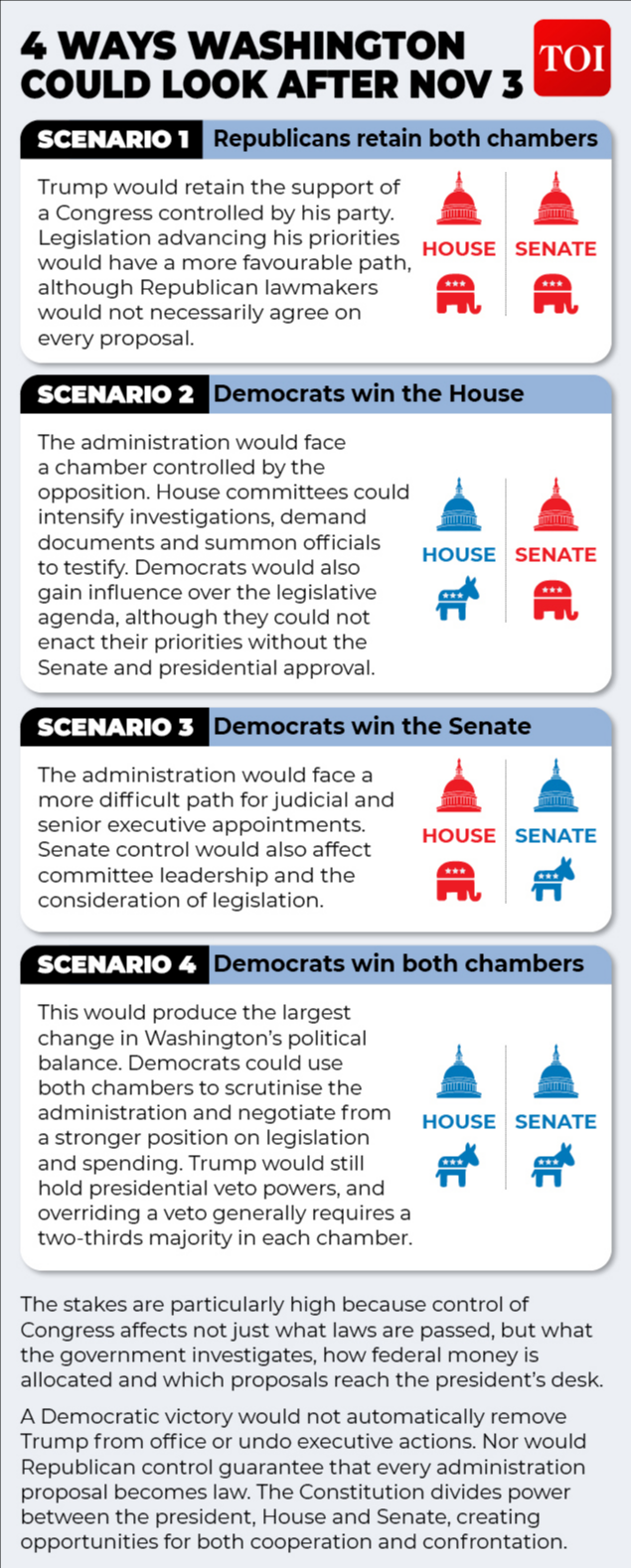
The midterms are not just about which party controls Congress. They could determine the political trajectory of Trump’s remaining two years in office.A Democratic takeover of the House would give the opposition control over committees, investigations, legislative priorities and congressional oversight.It could also complicate the administration’s ability to pass major legislation, particularly on immigration, taxation, federal spending and foreign policy.
The midterms determine the political trajectory of Trump’s remaining two years in office.
A Democratic Senate majority would have even greater consequences. It could influence confirmations of senior administration officials and federal judges, while giving Democrats control over a chamber that has been central to Trump’s legislative agenda.A Republican victory, on the other hand, would allow the president to continue governing with support from both chambers and would weaken the argument that voters have rejected his second-term agenda.There is also a longer-term political calculation.Read also | US midterm elections 2026: Why it’s a do-or-die fight for Trump & the Democracts – explained in 10 chartsPotential Democratic presidential contenders, including governors and senators, will be closely watched. Strong performances could establish them as credible candidates for 2028, while Republican candidates will be judged on their ability to maintain Trump’s coalition.The gubernatorial elections are particularly important because state governors exercise considerable authority over election administration, a matter likely to become increasingly significant as the country approaches the next presidential election.
What happens next?
Polling stations are opening across the country on November 3 (from 3.30pm IST) with voting hours varying by state and local jurisdiction.The first results will emerge after polling closes in individual states. However, the Senate and House contests are likely to produce different timelines for a clear picture, particularly where margins are narrow and mail ballots take longer to process.For Indian audiences, the first substantial results are expected to emerge during the morning and afternoon of November 4, India time.The biggest immediate indicators will be the early returns from competitive House districts, followed by the Senate battlegrounds in states such as Texas, Ohio, Michigan, Maine and Iowa.A Democratic victory in the House is increasingly anticipated by polling models. The real question is whether the party can go further and capture the Senate as well.For Trump, the stakes are considerable. A midterm defeat would not remove him from office, but it could transform the remainder of his presidency into a prolonged battle with an opposition-controlled Congress. For Democrats, the election offers an opportunity to turn public dissatisfaction into institutional power. And for Indian-Americans, it offers another chance to establish that their political presence in the United States is becoming increasingly difficult to overlook.
Source: timesofindia.indiatimes.com