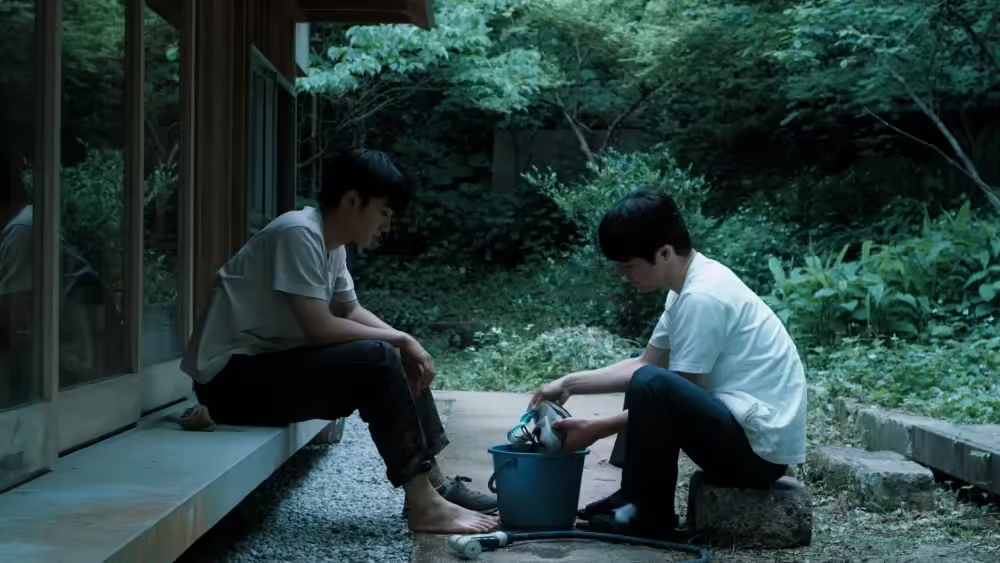

The early moments of “Hinotama: Ball of Fire,” the debut feature from young Japanese director Yaza Takenoshin (who graduated from Harvard this past summer), almost move like clockwork, finding a pleasing rhythm in everyday mundanities — matching the repetition of numbers being called out for test papers to a mother having groceries counted at the checkout.
Showing in the Nippon Cinema Now selection — a space for new and upcoming Japanese filmmakers — at the Tokyo Film Festivalthe film follows young Takeshi (Riku Onishi) as he watches his parents’ marriage crumble. It’s a slow but clearly inevitable process, the warning signs understated but clear to see. Takeshi is getting worn down by glimpses of his parents’ flaws, and becomes fascinated with the “ball of fire” that his old friend Akari (Himena Irei) tells him about — perhaps in the hope that seeing it will restore his childlike wonder about the world.
Yaza has spoken of his admiration for filmmakers such as Ryusuke Hamaguchi, which is evident in his film’s neat and steady (but never inert or emotionless) camerawork and its patient observation of characters as they navigate fracturing relationships. The inspiration is rather direct: “Himotama” is indeed shot by Hamaguchi’s sometime cinematographer Yoshio Kitagawa, who offered to shoot the film when the student reached out for advice. Often, Kitagawa’s cinematography embraces symmetry, emphasizing the clean geometric lines of Takeshi’s home, picking an object or person to place at the centre of the frame. A lot of these orderly compositions soon give off the impression of a cage — if Mari Kusu’s performance as Takeshi’s mother, bristling with frustration, didn’t already imply as much.
Some terse dialogue soon cuts through that visual neatness, as Takeshi’s father hints at his dissatisfaction or frustration in a small aside — which then turns into a bigger fight, not long after as he “demands respect” and laments his children never thanking him. It all comes back to that earlier rhythm, a discontent from living as though on a factory line, where everything progresses with a subtle sense of automation and no feeling or passion. Takeshi drifts through all of these scenes without giving away his own dissatisfaction, until the dam bursts; destroying a pristine pair of sneakers by jumping in a muddy puddle, the moment all the more startling because of the stillness of the camera, and the length of Yaza’s takes to this point.
Takeshi’s father is a petty and proud man, in ways continually expanded upon throughout the film’s runtime, though how he’s actually framed never truly changes. Rather, Yaza patiently accumulates small details about him. He isn’t plainly a terrible, angry person, at least not right away anyway: The beginning of a propagandist campaign to his children for the eventual split comes with the leveraging of memories clearly meaningful to them. Yaza seeks subdued performances from his actors in general, particularly in the case of Onishi as the increasingly insular but troubled Takeshi, whose frustrations with his parents mostly manifest in questions about that titular ball of fire, when he’s not gazing into space.
Sometimes that muted approach can become a little overbearing — as in the shots of children standing in an orderly line as they watch Takeshi’s younger brother Kento (Koe Odani) walking to a new house. In moments, it feels a little unnatural, even compared to the deliberately uncomfortable family dynamic built in the film’s first third. A sudden jump forward to three months later destabilises the film to a greater extent, but there are still moments of pathos to be found, particularly as Kento is forced to grow up fast, taking initiative to try and alleviate the suffering of his family.
“Hinotama” eventually ends up taking one step further into a more allegorical tone, which doesn’t fit with the film’s stronger elements — notably, its gradual observation of the increasingly visible cracks in a traditional family unit. Still, it’s an incredibly promising first feature.
Source: variety.com