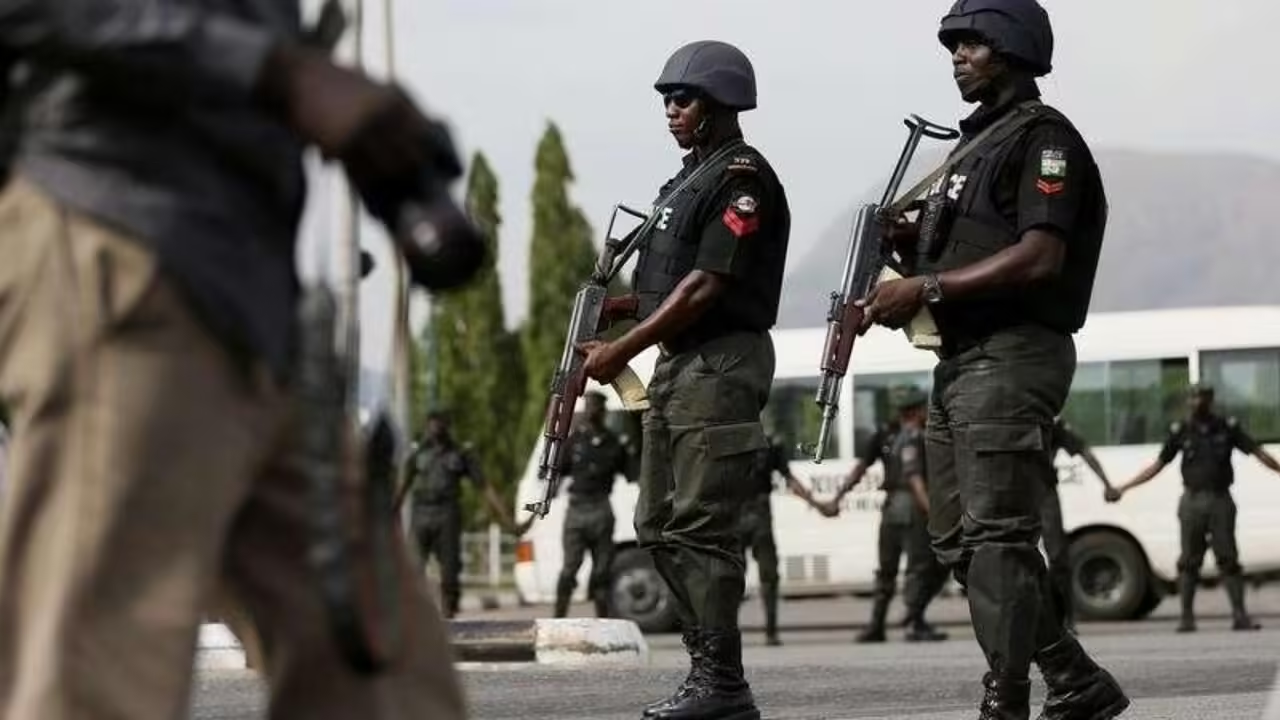

Nigeria this week took a step closer to a major overhaul of its security system after 28 of its 36 states approved a constitutional reform that would allow individual states to establish their own police forces. Supporters of the move say it will better protect against insecurity on a local level, but concerns have also been raised about the risk of abuse by state governors.
Issued on:
3 min Reading time
Nigerian police and military forces have long been overwhelmed – battling a protracted jihadist insurgency, as well as kidnappings, banditry and attacks by armed groups, which have been increasing for several years.
In June, the Nigerian Senate adopted a proposed reform of the police system, paving the way for each of the 36 states to have its own force in addition to the federal police.
Until now, the country had only one national police force, based in Abuja.
On Tuesday, 28 state legislatures approved the reform, meaning it can now be put forward for presidential approval.
The goal is to improve security by putting officers on the ground who know local communities and speak their languages.
The federal police will not disappear. Instead, they will retain responsibility for national security matters and have the power to intervene when a state is no longer able to manage a crisis, or in the event of serious misconduct by its police force.
Strengthening the police force and bringing them closer to communities has been “a long-standing demand of Nigerians”, Habib Oladapo, head of programmes at the Lagos-based Civic Media Lab, told RFI.
He said Nigeria is “desperately short of police officers”, with fewer than 400,000 officers for a population of over 200 million.
Nigeria’s security ‘has never been worse’ as coup trial opens
Officers who know the terrain
“In areas plagued by insecurity, the police presence is very weak,” Oladapo said. “This has necessitated military intervention, even though it would normally be the police’s responsibility to handle the situation.”
Communities have also formed self-defence groups. But these groups often struggle to fight off insurgents, he points out. The reform could allow for the integration of some of their members into a genuine police structure, with appropriate training, pay and equipment.
Additionally, under the current system, a police officer may be assigned to a state whose languages and local realities they don’t know. “He doesn’t speak the language, doesn’t know the area, and therefore cannot effectively perform his duties,” Oladapo said.
But recruiting and equipping these new forces will come at a cost. Some states are already struggling to pay their civil servants, he pointed out. How they will finance training, paying and operating a new police force remains unclear.
Nigeria declares security emergency after wave of mass kidnappings
Abuse of power
The other challenge will be preventing state governors from using these forces as a tool to serve their own interests – to target political opponents, for example.
Lawmakers have sought to address this issue in the proposed amendment. “The Senate has put in place several safeguards to prevent governors from abusing their powers,” said Oladapo. “They are prohibited from using the police to serve partisan, ethnic, religious or group interests, or to further personal agendas.”
Governors would also be forbidden from directly ordering the arrest of opponents, obstructing investigations or interfering in elections, he explained.
The proposed system relies partly on police reporting unlawful orders to a new oversight body. “When a police commissioner deems a directive illegal, they can refer the matter to the National Police Council, which is to be established,” Oladapo said. The Council’s decisions would be binding.
Nigerian armed groups net nearly $6m in ransoms: study
How effective these safeguards will prove in practice remains to be seen. There is also a further risk: that state police forces could replicate the failings of the federal police.
“The current federal system has serious flaws,” Oladapo warned. “It suffers from numerous problems with corruption and a lack of oversight. If we import this model directly into the states, it will pose a major problem: we will multiply, at the state level, the flaws that already exist at the federal level.”
If, on the other hand, each state creates its own model, “this could offer a different approach to law enforcement in Nigeria”, he said.
The reform still requires approval from President Bola Tinubu, who is expected to sign it into law shortly. Each state wishing to create its own police force will then have to adopt legislation to govern its operations.
While acknowledging that many questions remain unanswered, Oladapo is positive. “This reform addresses a major need for Nigeria today,” he said.
This article has been adapted from the original in French by RFI’s Christina Okello.
Source: www.rfi.fr