
The new federal budget sets Canada on a path to spend slightly more than four per cent of its gross domestic product on defence per year — roughly $157 billion — by the end of the decade.
The roadmap forecasts annual direct spending on the military will amount to $99.2 billion by 2030-31, with an additional $58.3 billion for defence infrastructure in the same year.
Prime Minister Mark Carney’s government has been under pressure to outline how the country will meet the NATO target of spending five per cent of GDP on defence (3.5 per cent on the military and 1.5 per cent on defence-related expenses) by 2035.
Finance Minister François-Philippe Champagne’s fiscal plan is heavy on details about how the Liberal government intends to build up the country’s defence industry, but light on specific rearmament plans for the Canadian military.
The budget references the already planned purchase of up to 12 submarines, airborne early warning jets, armoured vehicles and drones, but doesn’t address other urgent equipment shortfalls and operational pressures.
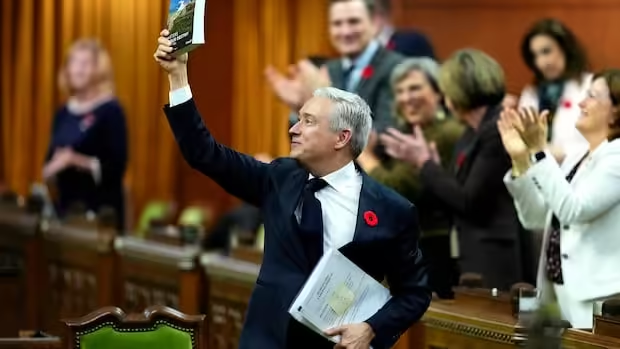
“We are investing in the capabilities we need to defend our country, particularly in our North and Arctic,” Champagne said in his budget speech.
“We are strengthening our defence industry here at home, so that Canada makes more of what our Forces, and our allies, need to do the job. We are taking greater responsibility for our own security, just as we are for our economic future.”
Direct spending on the military in the ongoing budget year is expected to ring in at $75 billion (with an additional $50 billion for defence infrastructure). In the coming budget year (2027-28), it is expected to rise to $89 billion (and $52 billion).
Analysts are skeptical the federal government will remain on the path toward five per cent after 2029. That’s the year NATO has set for a review of the commitment, which was insisted upon by the Trump administration.
Will Canada meet NATO’s spending target?
When asked on a couple of occasions prior to the budget about the five per cent commitment, Carney reaffirmed Canada’s commitment but hedged somewhat and pointed to the review year.
“I think there’s some other indicators in here that the current government’s commitment to national defence is not fiscally limitless,” said Dave Perry, a defence analyst and president of the Canadian Global Affairs Institute.
The commitment to five per cent of GDP, made at the 2025 NATO summit in The Hague, envisions a gradual rise and Perry said “Canada is basically living up to that mark exactly,” but there’s no plan for growth beyond 2030 when the fiscal lifting will be harder.
Sahir Khan, an executive vice-president at the University of Ottawa’s Institute of Fiscal Studies and Democracy, said as the Trump administration winds down between now and 2029, there could be less pressure on allies to hold fast on the target.
“For those that were incredibly optimistic about where that defence envelope could go in the future, three-and-a-half, five per cent, I think we are going to find it will start to get tempered a bit,” Khan said.

On Tuesday, Prime Minister Mark Carney said Canada is on a path to spend four per cent of its GDP on defence by 2030. Could this investment summit help the country secure the capital it needs to raise its defence profile and capabilities, and meet new NATO spending targets? Power & Politics hears from David McGuinty, Canada’s minister of national defence.
Khan said he believes that there will be less of an appetite among Canadians for higher defence spending in five years’ time.
“As this starts to eat up more and more of the federal budget, it’s going to mean rationing” of federal funds, Khan said. “If you ask Canadians after the Trump administration ends, you know, whether they want more in defence versus health care, the answer is going to be health care, right?”
The budget puts a figure on an important previously announced defence drone initiative, setting aside $2.3 billion over five years, starting next year, to accelerate “the discovery, acquisition and deployment of uncrewed and counter-uncrewed capabilities.”
It also puts more money — $25 million — into military health services in order to support victims of the fire at the training range in Wainwright, Alta., and their families. And another $3 million will go directly to the Wainwright Military Family Resource Centre.
The federal government recently extended the deployment of Canadian troops in Latvia to 2031. The fiscal plan puts a figure of $7.1 billion on that NATO mission. The money, however, will come out of the Defence Department’s annual budget.
In the past, during the Afghan war for example, the federal government would top up defence through supplementary appropriations.
Perry said, outside of the investments to build up the defence industrial base and create the Defence, Security and Resilience Bank (DSRB), there’s little clarity about which specific direction the federal government intends to take the Canadian military.
He said he suspects the public might get a better glimpse when the revised defence policy is released sometime in the next few weeks.

The federal budget lays out the Carney government’s plan to boost sovereignty and economic growth amid the U.S. trade war. Finance Minister François-Philippe Champagne joins Power & Politics to defend the government’s proposed billions in new spending.
Feds ‘very clear’ on plan to reach spending targets
In a media availability, Champagne defended the level of detail in the budget when it came to military spending.
There was, the minister said, “more transparency than most G7 and countries.”
The figures are all laid out.
“You can see the spending on a cash basis for every year until 2030,” Champagne said. “So, we’ve been very clear how we’re going to reach the four per cent target by 2030.”
Khan said he believes the government has been forthright in this budget about its plans for defence and that he hopes it will set the bar for disclosure on other major initiatives where the government has been less than transparent.
He also cautioned that five years — in this fiscal and political environment — is a long time and there is truism about defence being the single largest discretionary line item in the federal budget.
The challenge, Khan said, will be for the Defence Department to spend the money it is being given.
“We saw that when we had an incredibly ambitious initial defence agenda under the Harper government, as the procurements started to get delayed, that became a source of funds to allow the government to get back to balance sooner,” Khan said.
“The risk of not executing quickly is that the resources start to get very tempting for other purposes.”
Source: www.cbc.ca