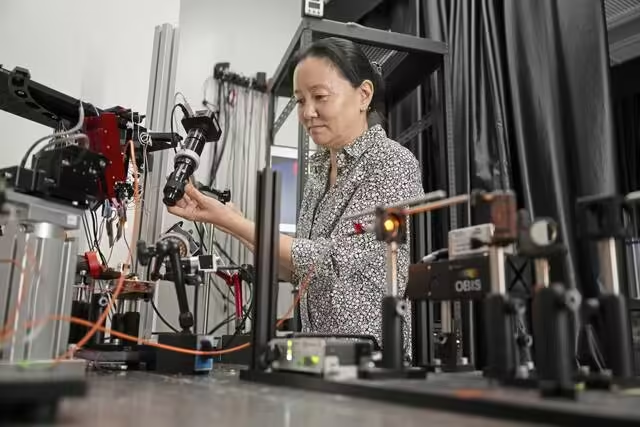

Breakthrough findings out of Carnegie Mellon University on how parts of the brain interpret touch, and the body’s reactions to it, can help scientists understand sensory processing and behavior changes after brain injuries or strokes.
The research was led by Kate Hong, an associate professor of biological sciences at CMU. She found that an evolutionarily ancient brain region — the superior colliculus — links interactions with the primary somatosensory cortex, which is the main touch-processing center of the brain.
Ultimately, the communication between those two parts of the brain helps someone determine if a sensation or touch existed.
“If somebody taps you on the shoulder, you’re probably going to turn your head without even thinking about what it was or who it was,” Hong said. “This sort of orienting behavior is mediated through the (superior colliculus).”
Hong worked with Alice Nam, who led the experiments and was then a Ph.D. student in Hong’s lab; she has since graduated. The research team studied how well something can distinguish between the presence or absence of a stimulus, and how likely it is to report that it felt something.
“We’re very interested in how we perceive sensory information in the environment, and then make decisions based on that sensory input,” Hong said.
The main conclusion of the study revealed how cortical and subcortical brain regions work together to shape perceptual decisions, Hong said. Rather than just simply receiving information, the brain weighs incoming signals, context and a person’s state of mind before deciding what deserves attention.
The findings could help future researchers understand how sensory processing and behavior change after brain injury, or with neurodevelopmental conditions like autism.
Scientists have known for decades that when neural activity is disrupted by injury in one part of the brain, other connected brain regions can also be disrupted.
But Hong’s study identified the superior colliculus as an area that can be disrupted to change behavior when cortical activity is disrupted.
That leads her lab to a new research direction. They are investigating how an ischemic stroke in the somatosensory cortex changes activity in the superior colliculus, and whether sensory recovery depends on restoring the balance of activity across interconnected brain areas.
Differences in sensory processing are common in neurodevelopmental conditions such as autism, Hong said. For example, some autistic individuals can be unusually sensitive to touch, while others may be less sensitive. In future labs, scientists could study how the coordination of cortical and subcortical areas underlie tactile hypersensitivity in animal models of autism.
“We hope that understanding how cortical-subcortical coordination shapes sensory perception will help us better understand how perception is altered — and may recover — following brain injury or during atypical brain development,” Hong said.
Source: triblive.com