
HERSHEY, Pa. — When Robert Johnson, 61, arrived at Penn State Health Holy Spirit Medical Center for his first pulmonary rehabilitation session, he was afraid to exercise. He couldn’t take the trash out to the curb at his Mount Holly Springs home without running out of breath, he said.
Johnson’s outlook began to change when another patient noticed his Wounded Warriors T-shirt and thanked him for his military service.
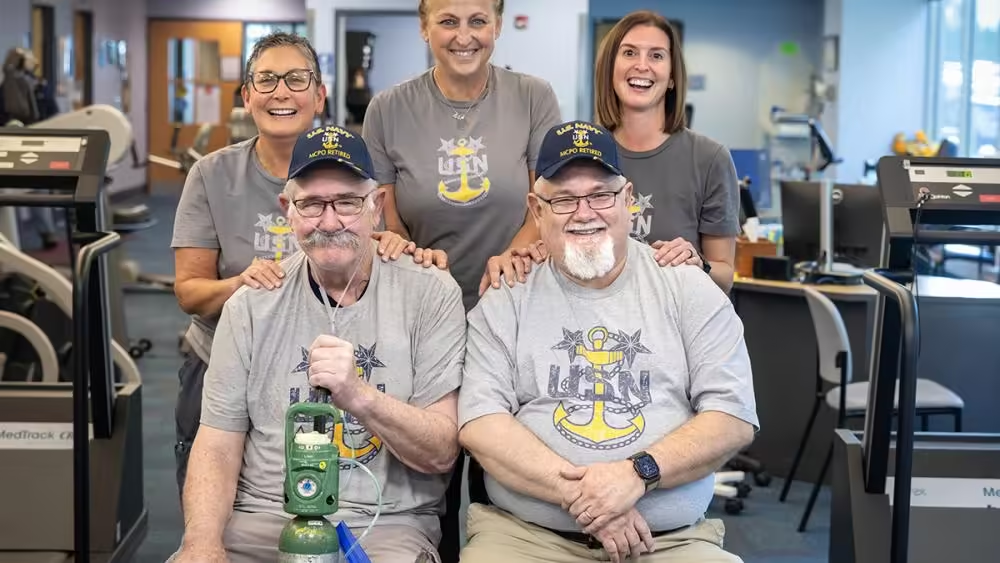
The patient, Gary Rosema, 75, of New Bloomfield, wore a U.S. Navy hat, and the two soon discovered they had both served as Master Chiefs in the U.S. Navy, the highest enlisted rank. Fewer than 1% of Navy personnel become Master Chiefs, which are technical experts and advisors to commanding officers.
“We come from different times, but we’re still brothers because of our service,” Johnson said. “The ability to lead, and to have led, brings people together.”
Through the pulmonary rehabilitation program, Johnson and Rosema drew on the courage, discipline and commitment they learned in the Navy to improve their health and inspire fellow patients.
Training for better breathing
Pulmonary rehabilitation is a medically supervised 18- to 36-week program for people with chronic lung diseases, such as asthma, bronchitis, chronic obstructive pulmonary disease, pulmonary fibrosis, pulmonary hypertension and post-COVID syndrome.
Guided by respiratory therapists, participants learn breathing techniques, exercises, nutrition strategies and proper use of respiratory medications.
“We help patients build strength and stamina that improves their quality of life and helps them get back to activities they used to enjoy,” said Stacey Cannon, Respiratory-Pulmonary Rehabilitation supervisor at Holy Spirit Medical Center.
While patients exercise together, their treatment plans are individualized based on their condition and personal goals.
Veterans and lung health
Lung care is an important part of veteran health care, especially for those with lung conditions or a history of smoking. Research published in the journal RAND Health Quarterly suggests that veterans aged 60 and older have higher rates of lung problems than civilians of the same age.
Johnson developed severe asthma after retiring from the Navy in 2009 for medical reasons following 29 years of service. First, he struggled with post-traumatic stress disorder (PTSD).
“My last duty station in active duty was in Iraq,” he said. “We got hit pretty hard, and I lost a lot of men.”
Research involving American combat veterans, published in the journal Military Psychology, shows a link between psychological distress after deployment and respiratory health. In Johnson’s case, weight gain, a common side effect of PTSD medication, put pressure on his lungs.
During his military career, Johnson exercised regularly, but for the last two years, shortness of breath kept him sedentary. When he told his doctor at a local Veterans Affairs clinic that he wanted to get active again, they referred him to pulmonary rehabilitation.
Rosema’s pulmonary disease physician at Penn State Health recommended pulmonary rehab to help him manage fibrosis, a disease that causes progressive lung scarring.
Rosema served two tours in Vietnam, placing him among the millions of veterans exposed to the herbicide Agent Orange. A Veterans Affairs study published in the journal JAMA Network Open found that veterans exposed to Agent Orange face an 8% to 14% higher risk of developing severe lung-scarring diseases like the one Rosema battles.
“I found out that the Agent Orange they had put into the soil had filtered into the rivers and the gulf,” he said. “We were drinking this stuff.”
After his 23-year career in the Navy, Rosema spent more than two decades working as a truck driver. Following his wife’s death in 2021, he said, he became less active. His lung function started declining fast, and he needed increasing amounts of supplemental oxygen just to walk.
Teamwork fuels recovery
Johnson and Rosema became fast friends, chatting to each other during exercises, such as pedaling arm bikes. In some ways, the structured program reminded the pair of military training. Their discipline and grit stood out to staff.
“They have a very different attitude,” Cannon said. “They push through.”
Much like their time in the military, Johnson, Rosema and their civilian comrades had each other’s backs during their pulmonary rehabilitation exercises. They encouraged each other and cheered when they hit new milestones, such as improving their times on a six-minute walk test.
“People tell me they enjoy coming to the rehab program because we truly care and treat each person as a person, and not just their disease,” Cannon said.
One participant brought homemade chocolate peanut butter cake for everyone on her last day in the program. Cannon and her team made “Master Chief” T-shirts to honor Rosema and Johnson, a gesture the veterans deeply appreciated.
“The camaraderie that you develop when you’re in the military is what makes you who you are,” Rosema said. “If you don’t work together, you’re not going to make it, and so you have to work together, just like the respiratory therapists do. Teamwork makes it happen.”
Source: www.psu.edu