
When news broke about the deadly training exercise at CFB Wainwright that killed four soldiers and sent dozens more to hospital with severe burns, Véronique Moulin knew she had to help.
Her research group is nearing the end of clinical trials on a ground-breaking process to reconstruct and manufacture a permanent, human-like skin substitute by taking a toonie-sized biopsy of the patient’s healthy skin and extracting the cells.
“If everybody can survive and [I] can help to treat some, I will be happy,” said Moulin, head of the regenerative medicine division at the CHU de Québec-Université Laval research centre.
Unlike other lab-grown skin technologies, Moulin’s method coaxes the patient’s own cells to create a completely natural skin tissue containing both the dermis and epidermis layers.
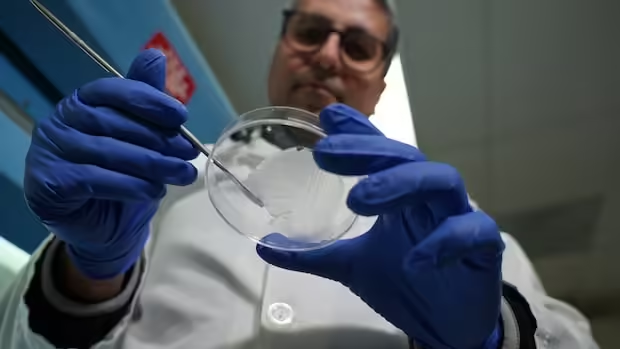
Véronique Moulin, head of the regenerative medicine division at the CHU de Québec-Université Laval research centre, is seen placing cells into liquid nitrogen for long-term preservation. (CBC)
While it’s not completely identical to the patient’s skin because it doesn’t have pigment and sweat glands, Moulin said it’s useful in cases where the burns cover too much of the body to harvest skin for grafts.
Clinical data on 50 Canadian burn patients treated since 2005 shows that, unlike grafts from cadavers, their body doesn’t reject the skin substitutes. The tissue grows, fuses and stays flexible, which means less scarring and reduces the need for repetitive surgeries as the patient heals, she said.
Lab now growing skin from wounded soldiers
As of Nov. 4, the Canadian Armed Forces (CAF) said 25 soldiers remain in hospital. Four have been moved to health-care facilities in British Columbia and Ontario to continue treatment closer to their home communities and families.
Skin biopsies from several of the hospitalized soldiers have been taken, and cells are now growing in Moulin’s lab.
But it takes up to eight weeks to grow the first batch of skin substitute grafts from the initial biopsy — which is only enough to cover part of a torso — and her lab is already running at capacity.
“Usually we have three, sometimes four, but it’s very rare that we have so many patients at the same time,” Moulin said.
“But at least we can start, and after the first one, we can continue and send them every two weeks, we can send the same surface area.”

The family of a Canadian soldier severely burned during the deadly fire at CFB Wainwright in Alberta tells CBC News they’re just as worried about his mental health as they are about his physical trauma. With catastrophic burns over much of his body, Pte. Liam Ramage can barely move or speak.
Burn research advancing across the country
Moulin is just one of the Canadians on the front lines of research meant to help burn patients heal faster, with less pain and fewer scars.
Halfway across the country, in a University of Manitoba lab, an interdisciplinary team of researchers is also developing skin substitutes that mimic the features of human skin, including its layers, blood vessels, nerves and different skin colors.

A close-up of the skin substitute that an interdisciplinary team of researchers is developing in a University of Manitoba lab. It mimics the features of human skin, including its layers, blood vessels, nerves and different skin colors. (Rudi Pawlychyn/CBC)
“Currently, we are working on one type of skin substitute that we are planning to test on animals. So that is the first step. You test on animals, then if it works, we will go to clinical trials,” said Hamed Alizadeh Sardroud, a postdoctoral fellow and researcher in biomedical engineering and tissue engineering.
The lab is also exploring ways to engineer donor cells to be compatible with the recipient’s immune system and avoid rejection. They’re using a 3D printer to create patches that would be used for burn wounds.
“Those cells are live and they can grow. And when you implant it, transplant [it] on the skin, they will just regenerate,” Alizadeh Sardroud said.

Researchers at the University of Manitoba are fabricating skin substitutes that mimic human skin, including its different layers, blood vessels, nerves, and different skin colors. They are also exploring ways to engineer the substitutes using donor cells in a way to be compatible with the recipient’s immune system and avoid rejection.
Just a few doors down, one of his colleagues is testing a biosensor that can detect bacteria causing infection in a wound.
“You can see it’s yellow and then as soon as it’s in contact with bacteria and their enzymes, it becomes green,” said Farinaz Jonidi Shariatzadeh, a post-doctoral researcher, as she did a demonstration.
“It’s like an early warning system that shows you that the bacteria are present in the wound and … infection is going to start soon.”

Researchers at the University of Manitoba are creating biosensors that can detect bacteria and the start of infections in wounds, and smart dressings that will release antibiotics to start treating the infection.
The postage stamp-sized nanofibre membrane can be placed in the top layer of a dressing so it doesn’t have to be removed to keep an eye on the wound. A patient can monitor it at home, and contact their doctor when they see the colour change.
It has already been licensed by an American medical technology company that has begun clinical trials, Jonidi Shariatzadeh said.
“Compared to what’s commercially available, it is groundbreaking because none of the available biosensors can actually show the colour change in real time that can be observed with the naked eye.”
The University of Manitoba team is also developing a smart dressing that will release an antibiotic as soon as an infection is detected, said Dr. Sarvesh Logsetty, a burn surgeon and director of the Manitoba Firefighters Burn Unit at Winnipeg’s Health Sciences Centre.
“The science fiction of yesterday is the treatment of today,” he said.
“The goal is to decrease the pain and suffering and improve the quality of life and the quantity of life of individuals that have burns and also injuries of any kind.”

Dr. Sarvesh Logsetty, a burn surgeon and director of the Manitoba Firefighters Burn Unit at Winnipeg’s Health Sciences Centre, leads a multi-disciplinary team of researchers that’s become a hub for clinical innovation. (Rudi Pawlychyn/CBC)
‘The journey is a long and painful one’
It’s welcome news for Tyler Pelke, who survived third-degree burns over 25 per cent of his body more than 35 years ago.
“The journey is a long and painful one,” said Pelke, a former firefighter who is now a CAF reservist and head of Alberta’s Emergency Health Services. He spoke as a burn survivor, not on behalf of those organizations.
“So yeah, some pretty amazing advancements, but it’s a pretty impactful and horrific injury, especially when a large burn.”
Pelke said he was lucky because doctors were able to take skin grafts from his own legs, but he dreaded the bandage removals and dressing changes.
Anything that can help ease the physical and mental suffering for burn patients is welcome, he said.
Source: www.cbc.ca