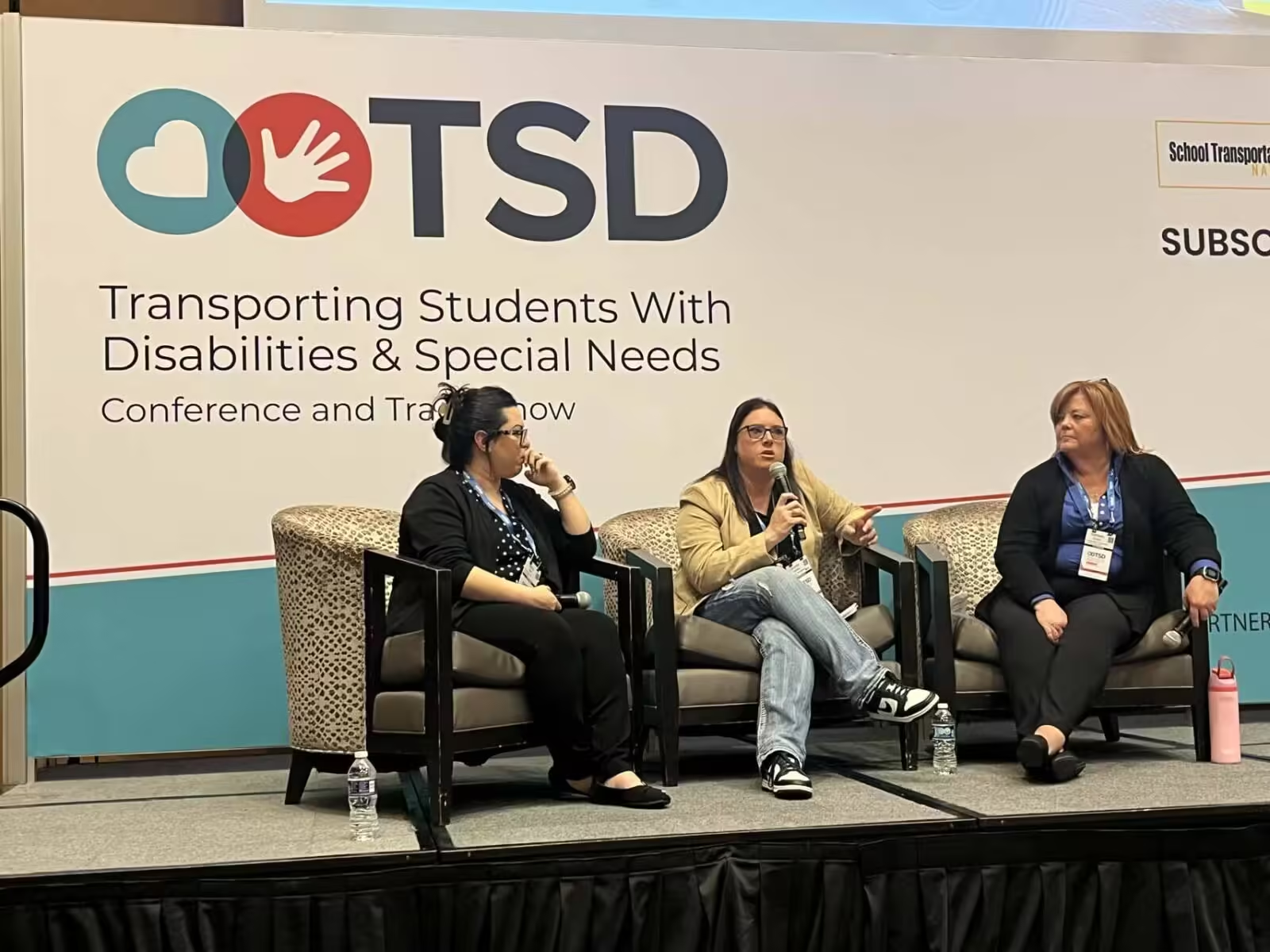

FRISCO, Texas – During a Saturday lunchtime session at the TSD Conference, three pupil transportation leaders discussed the benefits of technology for transporting students with special needs as well as lessons learned during implementation.
Technology Assists with Daily Transportation Changes
“There’s things changing every day with special needs routes,” noted Zachery Moren, sales engineering lead for session sponsor Transfinder.
Sierra Elliot, route supervisor for Garland Independent School District near Dallas, Texas, transports 1,100 students with special needs students using 77 routes. She utilizes strategies like a team Google Sheet and a dedicated email address for staff, so nothing is missed.
Jennifer Gardella, director of transportation for neighboring Rockwall Independent School District, transports 8,000 students overall and has 28 special education routes. She confirmed that corralling changes across schools, staff and drivers is tedious. She said it’s important to have a seat at the table so transportation can proactively weigh in on the availability of monitors or safety equipment assigned in Individualized Education Programs.
Virginia’s Loudoun County Public Schools, located about half an hour outside Washington D.C., uses 170 routes to transport 3,000 students with special needs. Making changes using seven routers and sending updated PDFs to drivers is “very complicated, very cumbersome,” Transportation Coordinator Kathleen Guarini said.
A 72-hour notice period and thorough information sharing processes has helped streamline aspects like wheelchair lift bus requests and joint custody households, she shared. She also urges campus administrators to log into the school bus driver app Wayfinder to verify the accuracy of information there.
Garland ISD and Rockwall ISD heavily promote the parent app Stopfinder using billboards and even QR code-bearing T-shirts so families can stay updated.
Overcoming Challenges When Implementing School Bus Technology
Loudoun County required its technology-hesitant drivers to use onboard navigation after discontinuing paper route sheets, which Guarini said streamlined both parent communications and employee timesheet processes. Transfinder customer care further makes drivers feel supported, she added.
Gardella at Rockwall ISD stressed that driver training was imperative for all the technology pieces to fit together. “Not only did I add the technology in for them, I worked with them and I didn’t leave them behind. I kept working with them until they got it,” she said.
Additionally, she said, onboard technology catches issues like drivers dropping students at unofficial stops, thus leading to training opportunities.
Elliot, who is also Garland ISD’s hiring manager, makes it part of her onboarding process to tell drivers that they will be using onboard technology and said it improved buy-in. She acknowledged that too much information can be a problem as parents watching Stopfinder sometimes call in with nitpicky questions on bus timing or location.
Guarini and Elliot gave advice gleaned from their experiences in rolling out various Transfinder components.
“Your staff, your drivers, everyone needs to know that they are supported,” Elliot emphasized.
“Roll it out at a pace that makes sense to be really successful,” Moren agreed.
Elliot pointed out emergencies or even broken school HVAC necessitate buses moving students en masse, which highlights how important it is for drivers to use assigned onboard navigation technology and students to use RFID scanning cards. Partnering with local businesses and restaurants to give discounts to students who bring in their badges boosts adoption, she shared.
Related: Technology Webinar Tackles the School Bus Driver Shortage
Related: How Technology Can Assist the 2026 State of Student Transportation
Related: (STN Podcast E302) Technology Tools for Bus Drivers: No More Struggling with Paper Route Sheets
Related: How Technology Powers Daily Student Transportation Operations
Moving Forward with Transportation Technology to Success
While initial technology implementation at Loudoun County was rocky, Guarini confirmed that lessons were learned. Now, she specified, keeping pertinent student information viewable for relevant admin and staff improves service.
“So, if I need to know what your medical conditions are, or if a parent has to meet you at the bus stop or not, or if you have a seizure problem, all of that is shared electronically through the tablet at the driver’s fingertips,” she said. “And we’re not running around like chickens with our heads cut off anymore.”
She said she first learned to become more technology proficient herself and agreed with Gardella that making sure the technology is tailored to the district’s unique needs has refined operations.
Guarini underscored that technology is beneficial, but relationships are more important since roadblocked knowledge sets up transportation teams for failure.
“We’re going to continue to see escalations and people getting hurt that we could prevent in simple sharing of information,” she explained.
During the Q&A, panelists shared how the technology smoothly handles issues like one driver substituting for another in an emergency, students getting dropped at a friend’s house instead of their normal home stop, merging bus routes when drivers call out and automatically sending parents notifications on changes.

Source: stnonline.com