
Unlock the Editor’s Digest for free
Roula Khalaf, Editor of the FT, selects her favourite stories in this weekly newsletter.
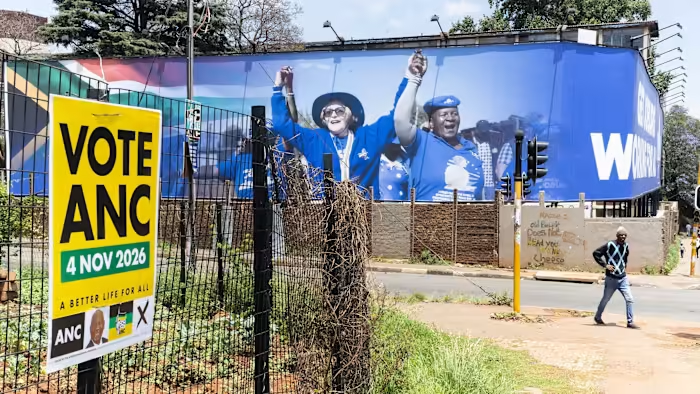
South Africa’s African National Congress became a rural party this week. That may overstate the liberation movement’s electoral shellacking in six of the country’s eight biggest metropolises, but not by much. The only place it can still reliably get the vote out is in the country’s rural heartlands.
Though not all votes have been counted, it is clear the ANC will be beaten in Johannesburg and Pretoria. In Durban, the Zulu nationalist MK party, led by ANC defector and disgraced former President Jacob Zuma, looked set to win easily.
In Johannesburg, the country’s commercial heartland, defeat is all the more bitter for the ruling party because of the identity of the victor. The ANC has been thrashed by an outspoken 75-year-old white woman, Helen Zille, who has spent her political career attacking the liberation party from her Cape Town base. Zille’s Democratic Alliance looks likely to get above 35 per cent, opening up an embarrassingly wide gap with the ANC, which is currently on 20 per cent or less, in a city whose decline she has compared to that of ancient Rome.
“The metros are the future,” said Moeletsi Mbeki, a political economist and brother of former president Thabo Mbeki, referring to the ANC’s pummelling in the biggest cities. “That’s where the industrialists are; that’s where organised labour and civil society are. If the population there rejects you, you’re finished.”
The ANC is a diminished, if not a spent, electoral force. Its national share of the vote — which is likely to fall to the low 30s in this election — is its lowest ever, and compares poorly with the 46 per cent it got in the previous local elections in 2021 and the nearly two-thirds majority that President Cyril Ramaphosa inherited going into the 2019 national election.
The party’s slide looks inexorable. Disaffected voters in the townships are either staying at home or casting their vote for a plethora of smaller parties, some of them ethnicity based and increasingly shrill.
The question for the ANC is how it responds. Broadly speaking, it could choose to take what Simon Freemantle, senior political economist at Standard Bank, calls the “high road or the low road”. The high road would see Ramaphosa-aligned moderates at the national level take control of the messy business of coalition-building in the cities. The crucial test will come in Johannesburg. If Ramaphosa is able to exert his authority there, the ANC may seek a coalition with the DA under a Zille mayorship. That would mirror the Government of National Unity at the national level with one crucial difference. In the national coalition, the ANC is the biggest party and calls the shots. In Johannesburg, the roles would be reversed.
That would be a bitter pill to swallow — so much so that ANC officials at city level may spit it out. In Johannesburg, they could refuse to participate in any such arrangement, seeking instead to do a deal with Zuma’s MK or Julius Malema’s Economic Freedom Fighters.
Both of those parties are progeny of the ANC. To reconstitute the party as it was before it split would be the political equivalent of putting the band back together. One person familiar with the inner workings of the ANC called it “the looting option”, the last resort of a desperate party seeking one more turn at the trough — in other words, the low road in Freemantle’s scenario.
Investors in South Africa, both domestic and international, clearly favour the high road. It may not happen. The DA has limited leverage in negotiations in a proportional representation system where the ANC is the only sizeable party with which it can work. Its nuclear option — one that its business backers fear most — would be to walk away from the national unity government altogether.
How the ANC handles the aftermath of these elections will also influence the identity of its next leader and the prospect of the unthinkable: outright defeat in the general election of 2029.
If Ramaphosa cannot exert authority, he will have less influence over who succeeds him as ANC leader at the party’s national conference next December. That would probably give pole position to his deputy, Paul Mashatile, an uninspiring choice who would do little for the ANC’s electoral appeal.
Ramaphosa is not known for sticking his neck out. But, if he fights his corner in coalition talks, then he would have more sway.
There’s even a scenario, talked about excitedly by ANC revivalists, in which Patrice Motsepe, a tycoon and Ramaphosa’s brother-in-law, can be persuaded to head the party and mend its fortunes. It’s a long shot. But the ANC is fast running out of options.
Source: www.ft.com