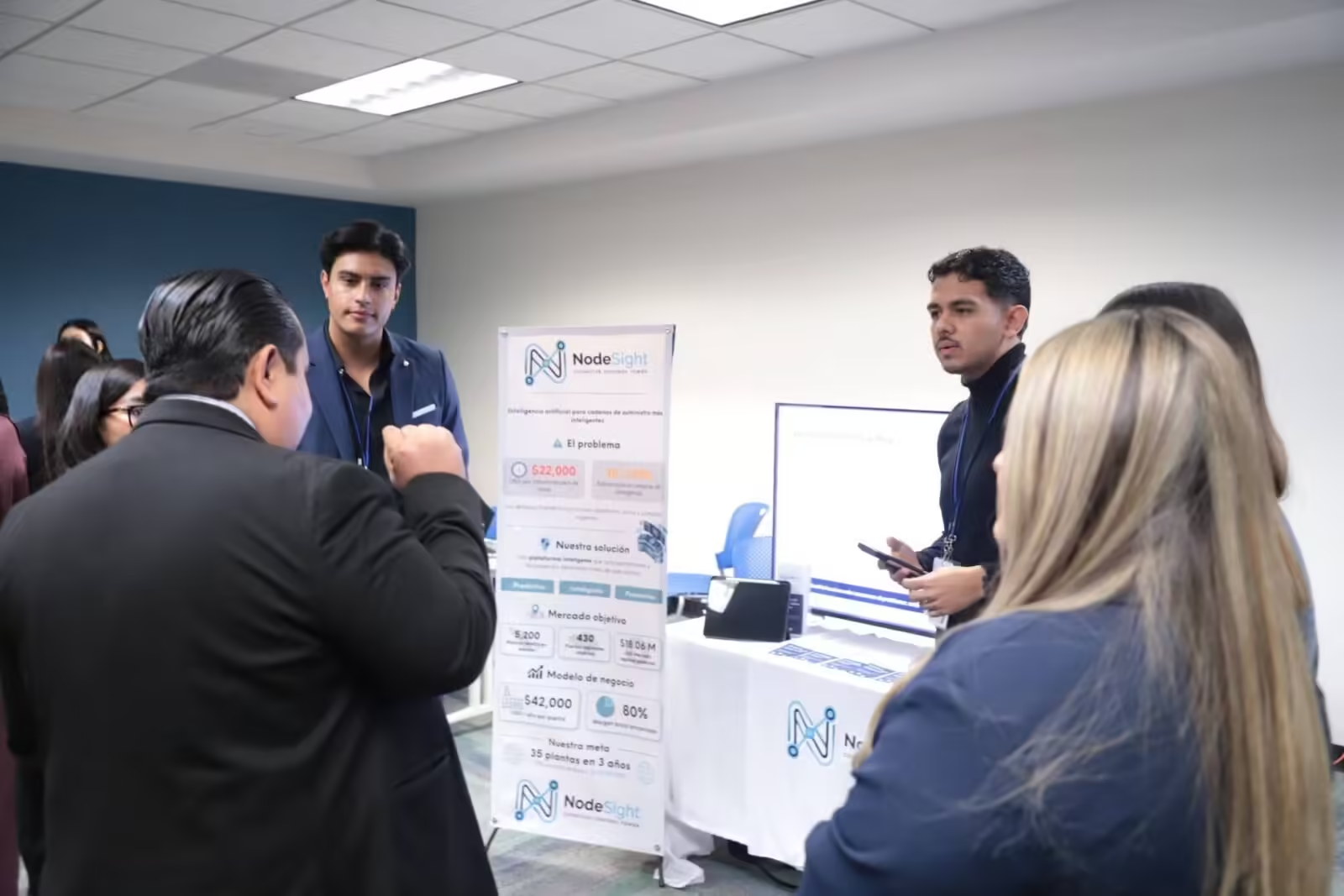

For a day, the border was not a dividing line, but a work table.
He November 6, at 9:00 in the morningwas carried out in the CITE building of Tec de Monterrey, Ciudad Juárez Campusthe second edition of businessthe Binational International Business Competition.
Its format broke with the traditional logic of these contests: here no university competed against another.
20 binational teams were formed with 102 students. Each team had five students, one from each participating university.
The universities were:
- Mexico: Tec de Monterrey, Ciudad Juárez Campus, the Autonomous University of Ciudad Juárez (UACJ) and the Autonomous University of Chihuahua (UACH)
- United States: New Mexico State University (NMSU) and The University of Texas at El Paso (UTEP)
The idea that was born outside the classroom
business It was not born in a classroom or a curriculum. It was born from an observation of its creator, Alejandro Lima Juárez, director of the International Business Program at Tec de Monterrey, Ciudad Juárez Campus.
In January 2005, the campus director invited him to an awards ceremony to recognize important people from both sides of the border. There he saw firsthand the binational dynamics, camaraderie, pride and regional identity of Juárez-El Paso.
He saw, naturally, how people from both sides coexist, celebrate, grow and come together, beyond the tension that the media sometimes shows between the two countries.
“Not here, here it is totally communion, totally building”was the idea that summed up that moment.
From there arose the question that gave rise to the project: how to bring this dynamic to the university world?
At that same award ceremony he coincided with UTEP directors, with whom he spoke about the idea for the first time. The name was chosen in Latin, businesswhich means business, so as not to lean towards either English or Spanish. It was a symbolic and practical decision: that no one felt that the project was about a single language, a single country or a single university.
The first edition was held at UTEP, with four universities: Tec de Monterrey and UACJ, from Mexico, and NMSU and UTEP, from the United States.
The second edition was held in Ciudad Juárez, with the incorporation of the UACH.
The headquarters, by design, is alternate. The next edition will be at NMSU, in New Mexico. Then it will be the turn of the UACJ, which will host in 2028. Thus, the event will cross the border every year, as does daily life in the region.
It wasn’t just one day of competition: it was two months of work
What was seen on November 6 was only the final result. Behind it there were two months of work, interviews, research and six workshops. In them, students learned about value proposition, finances, business model and business discourse, that is, the business pitch.
The objective was not for the young people to memorize theory, but rather for them to learn to work with people from another university, another country, another language and another way of understanding business, to solve a border problem.
Therefore, for teacher Adriana Reyes Sánchez, coordinator of the UACJ Marketing Program and coordinator of business For the second time, the value of the event was not only in winning.
““It helps us foster ties”he explained.
Reyes Sánchez, who is attached to the Department of Administrative Sciences of the Institute of Social Sciences and Administration (ICSA), stressed that the students worked for two months, attended workshops and prepared for a challenge that forced them to leave the classroom and think like professionals.
He also highlighted the institutional support. He mentioned Dr. Daniel Alberto Constandse Cortez, rector of the UACJ; Dr. Jesús Meza Vega, director of the ICSA, and Dr. Jesús Alberto Urrutia de la Garza, head of the Department of Administrative Sciences, as authorities who have promoted these links and the participation of the UACJ in strategic alliances.
For the UACJ, he added, it is not just about university agreements. This is so that students can, in the future, inspire with professionalism in business.
Two juries, two different demands
One of the best decisions business is that they were evaluated by two groups:
1. Academic jury. Made up of professors from the five universities. Their feedback was academic: depth, feasibility analysis, business structure and coherence of the proposal.
2. External jury. Made up of three types of profiles:
- Industry. Representatives of companies that experience binational dynamics in the real world, such as Arca Continental, Coca-cola, UPS y Johnson & Johnsonfrom both sides of the border. They evaluated with the perspective of someone who hires, invests or buys.
- Trade and economic development organizations. Representatives of institutions such as Coparmex and Canacintra, as well as economic development institutions from Chihuahua, New Mexico and Texas, focused on collaboration between companies and regional unity.
- Diplomacy. The two consuls: the Mexican consul in El Paso, Texas, and the United States consul in Ciudad Juárez. Their presence gave the projects an international and global reading, and reminded the students that their ideas not only compete in a classroom, but can have an impact on national and international dynamics.
In this second edition, an investor with experience in entrepreneurship, with links between Tec de Monterrey and UTEP, also joined.
Its incorporation was not accidental: the organizers wanted to bring the feedback closer to the real world of entrepreneurship, where a good idea is not enough if there is no model, market and investment possibility.
In addition, companies from the region joined in with prizes, food and materials. This support, although it seems secondary, allowed the event to be sustained as a collective project and not just a university one.
What was achieved and what is missing
The organizers know it and say it openly. Their vision for the future is not to remain in the competition, but to turn it into a hotbed of entrepreneurship. They want to celebrate soon that the first NEGOTIUM project already exists in the real world.
That is the point where the event will stop being a good university experience and become a true economic engine for the region.
To achieve this, the organizers announced two growth routes:
First, grow in headquarters. Maintain the binational rotation: UTEP, Tec de Monterrey, NMSU, UACJ, and so on, so that no university takes ownership of the project.
Second, grow up in universities. The intention is to add Arizona, in the United States, where there are important institutions that could be integrated. On the Mexican side, growth has already begun: students from Sonora and Tec de Monterrey, Campus Chihuahua participated in this edition, which turned the event into a regional project, not just a local one.
The stated objective is that business becomes the flagship international business project for the region.
A border that wants to do business, not just cross them
In a context where the relationship between Mexico and the United States is usually told through tension, competition and conflict, NEGOTIUM told another story: that of communion, construction and collaboration.
But it also left an open question, which is what will give meaning to the third edition: how many of those 20 projects will still be alive in six months? How many will find a client, an investor, an ally? How many will become more than a well-rated presentation?
The border, as the event’s motto summed it up, wants to go From the Border to the World / De la Frontera al Mundo. He has already shown that he can organize himself, that he can work as a team and that he can think big. Now it’s your turn to show that you can undertake.
Source: comunica.uacj.mx