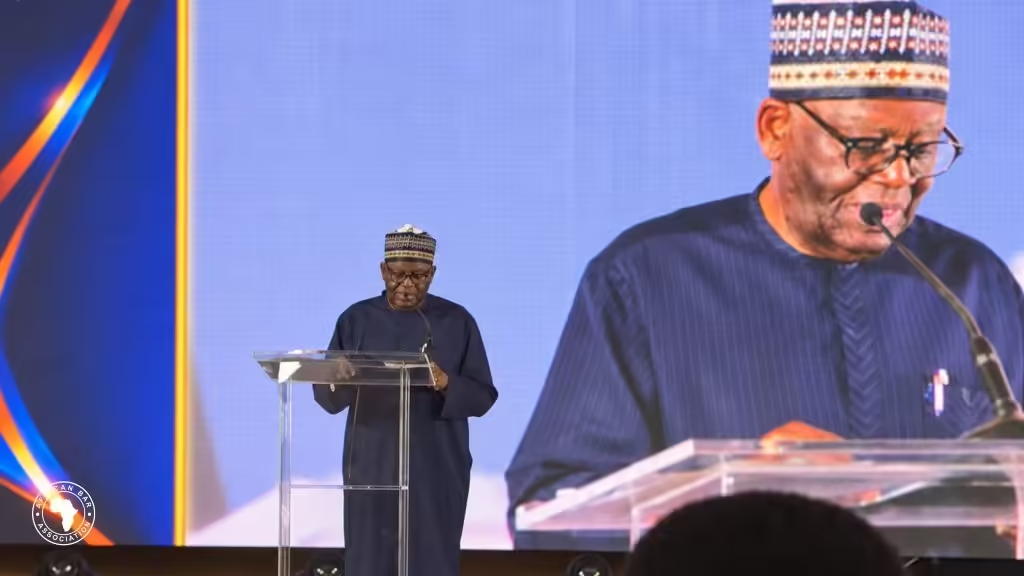

Veteran Nigerian diplomat challenges African leaders to confront military rule, terrorism, mounting debt and weak institutions while advancing democracy, judicial independence and continental economic integration.
By Ajong Mbapndah L
Africa must confront the resurgence of military coups, worsening insecurity, mounting debt and persistent governance failures if it is to achieve sustainable development and secure a stronger position in global affairs, veteran Nigerian diplomat Professor Ibrahim A. Gambari has warned.
Delivering the keynote address at the African Bar Association’s 2026 Annual Conference in Sal Island, Cabo Verde, on September 21, Gambari challenged governments, regional institutions and legal professionals to address the political and economic weaknesses holding back the continent. He argued that Africa had the resources and talent to prosper but continued to suffer from failures of leadership, weak institutions and an inability to translate ambitious policies into meaningful results.
Speaking on the theme, “Resilient Africa’s Roadmap for Sustainable Development: Addressing and Strengthening Issues of Military, Security and Economic Stability,” the former senior United Nations official and Founder and Chairman of the Savannah Centre for Diplomacy, Democracy and Development warned that the continent could not build lasting prosperity without political stability, credible institutions and respect for the rule of law.
Gambari was particularly concerned about the resurgence of military rule, describing it as a return to a failed political experiment. He noted that Africa had experienced at least eleven successful unconstitutional changes of government since 2020, with Mali, Guinea, Burkina Faso, Chad, Sudan, Niger and Gabon among the countries affected.
Drawing on his experience of Africa’s earlier waves of military intervention in the 1960s and 1970s, Gambari recalled how soldiers had repeatedly promised to restore order, eliminate corruption and return power to civilians, only for many to become entrenched in office. The current generation of military rulers, he suggested, was following a familiar path.
“To be frank, these coups did not occur in a vacuum,” he told delegates, acknowledging that widespread frustration with corruption, insecurity and ineffective leadership had created conditions in which military takeovers could attract public support. The failure of elected governments to meet citizens’ expectations, he argued, had gradually undermined confidence in democratic institutions.
For Gambari, however, public dissatisfaction with civilian leadership did not justify military intervention. Africa’s challenge was to strengthen democracy and make governments more accountable, rather than replace one failing system with another that offered even fewer guarantees of constitutional restraint.
Sahel Crisis Exposes Africa’s Security Failures
The worsening security situation across the Sahel featured prominently in Gambari’s address. Citing international security assessments, he noted that the region accounted for 51 percent of terrorism-related fatalities worldwide in 2024, compared with 48 percent the previous year, while five of the ten countries most affected by terrorism globally were in the Sahel.
He drew attention to the expansion of Jama’at Nusrat al-Islam wal-Muslimin, an al-Qaeda-affiliated organisation, and the continuing activities of Islamic State-linked groups across the Sahel and Lake Chad Basin. The persistence of these threats, despite repeated military interventions, raised serious questions about the effectiveness of governments that had seized power promising to restore security.
In Mali, Gambari noted, armed conflict events had increased by more than 400 percent between 2020 and 2025. He also expressed concern about the growing involvement of foreign military actors, including Russia-linked forces, and reports of human rights violations against civilians during counterterrorism operations.
The crisis was particularly troubling because military rule, extremist violence, humanitarian emergencies and competition over natural resources were increasingly reinforcing one another. Rather than bringing stability, some of the responses to insecurity had further weakened institutions and deepened public mistrust.
Beyond the Sahel, Gambari highlighted the insurgency in northern Mozambique, Sudan’s devastating civil war, continuing violence in eastern Democratic Republic of Congo and fragile security conditions in the Horn of Africa. These conflicts, he warned, were destroying livelihoods, disrupting education, discouraging investment and preventing communities from participating in economic development.
“You cannot build a school where a bomb may fall,” he said, underscoring the close relationship between peace, justice and development. Security operations, he insisted, must remain subject to the law because lasting stability could not be achieved through coercion alone.
Military Rule Cannot Replace Democratic Institutions
Gambari questioned the growing acceptance of military governments as alternatives to flawed civilian administrations, warning that such thinking overlooked Africa’s painful historical experience.
He cited the establishment of the Alliance of Sahel States by Mali, Burkina Faso and Niger, following their withdrawal from the Economic Community of West African States, as a development with serious implications for regional cooperation and democratic governance.
Although the African Union and regional organisations had adopted instruments condemning unconstitutional changes of government, enforcement remained inconsistent. Gambari pointed to delayed elections, restrictions on political parties and the consolidation of military authority in several countries as evidence that constitutional transitions were becoming increasingly uncertain.
He argued that sanctions alone were unlikely to resolve these problems, particularly when poorly designed measures imposed additional hardship on ordinary citizens while allowing military authorities to exploit anti-foreign sentiment.
Instead, he advocated stronger continental mechanisms that combined diplomatic engagement, consistent constitutional standards and accountability for governance failures. The objective, he maintained, should be to restore credible civilian institutions and prevent the conditions that make military intervention attractive in the first place.
Rule of Law Is Essential to Africa’s Prosperity
Turning to the legal profession, Gambari rejected the idea that judicial independence and constitutional accountability were secondary concerns to be addressed after economic development had been achieved. Strong legal institutions, he argued, were indispensable to investment, political stability and public confidence.
He cited the 2025 Rule of Law Index, noting that 28 of the 35 African countries assessed had experienced deterioration in areas including judicial independence, government accountability and transparency. Improvements recorded in Rwanda, Namibia and Mauritius nevertheless demonstrated that progress was possible.
Gambari urged African governments to protect judicial independence, guarantee judges’ security of tenure, improve court funding and strengthen institutions responsible for investigating corruption and abuses of power. He also emphasised the importance of affordable legal services, public education on constitutional rights and improved access to justice for disadvantaged communities.
The consequences of weak legal institutions extended directly to economic development. Investors, he observed, were unlikely to commit substantial long-term capital where contracts could not be enforced, property rights were uncertain and courts were vulnerable to political interference.
He challenged African lawyers to become more active in defending constitutional principles, particularly where elected governments undermined democratic safeguards or military authorities restricted civic freedoms. Professional independence, he argued, carried responsibilities that extended beyond the courtroom.
Africa’s Debt Burden Demands Urgent Reform
Gambari also warned that Africa’s mounting debt obligations were limiting governments’ ability to invest in education, healthcare, infrastructure and employment creation.
He cited estimates indicating that the continent’s total foreign debt had exceeded $1.3 trillion in 2025, while 22 low-income countries in Sub-Saharan Africa were classified by the World Bank as being in, or at high risk of, debt distress. Average public debt in the region had approached 60 percent of GDP, almost double the level recorded at the end of 2013.
The veteran diplomat was critical of the high borrowing costs faced by African governments, noting that many paid interest rates exceeding ten percent while major industrialised economies accessed financing on substantially more favourable terms.
He argued that these disparities reflected structural inequalities in the international financial system and placed additional pressure on countries already struggling with limited fiscal resources.
The growing influence of private creditors had further complicated debt restructuring, leaving governments exposed to prolonged negotiations and litigation. Gambari called for stronger participation by private creditors in debt relief arrangements, reform of international restructuring mechanisms and improved legal protections against predatory financial practices.
Among his proposals was the establishment of an independent Pan-African Credit Rating Agency capable of providing assessments that better reflected African economic realities. He also urged governments to strengthen domestic resource mobilisation and reduce excessive dependence on external borrowing.
For Gambari, debt reform was ultimately a development imperative. Resources consumed by debt servicing represented money unavailable for schools, hospitals, employment programmes and the infrastructure needed to support productive economies.
AfCFTA Holds the Key to Greater Economic Integration
Despite his concerns, Gambari identified the African Continental Free Trade Area as one of the continent’s strongest opportunities for economic transformation.
With 49 countries having deposited their instruments of ratification at the time of his address, he said the agreement offered a historic opportunity to overcome fragmented markets, strengthen industrial production and expand commercial exchanges among African economies.
He cited projections indicating that full implementation could substantially increase intra-African trade by 2045, particularly in manufacturing, agrifood, energy and services.
However, Gambari cautioned that political commitments would achieve little unless governments removed the practical obstacles confronting businesses. Inconsistent customs procedures, divergent product standards, bureaucratic delays, non-tariff barriers and inadequate dispute-resolution mechanisms continued to discourage cross-border commerce.
He called for faster implementation of AfCFTA protocols covering investment, intellectual property, competition policy, digital trade and women and youth in trade. The Pan-African Payment and Settlement System, he added, could help reduce transaction costs and strengthen the use of African currencies in continental commerce.
Gambari urged African lawyers to develop greater expertise in commercial arbitration, cross-border transactions and investment regulation, arguing that successful integration required legal systems capable of supporting increasingly complex business relationships.
The agreement’s potential, he maintained, would be measured not by the number of treaties signed but by the extent to which African businesses, workers and consumers benefited from a more integrated continental market.
Africa Must Assert Its Interests in a Changing World
Gambari also addressed the shifting international order and the growing competition among major powers for influence in Africa.
He pointed to China’s expanding economic engagement, Russia’s military involvement in parts of the continent and changing approaches by the United States, France and other traditional partners as developments requiring careful African responses.
Rather than becoming dependent on external powers for military assistance, financing or diplomatic support, Gambari urged governments to pursue partnerships that strengthened domestic institutions, transferred skills, created employment and supported long-term economic development.
Africa’s mineral resources, agricultural potential, renewable energy reserves and expanding population gave the continent considerable leverage, he argued, but fragmented policies and weak negotiating positions continued to limit its influence.
He renewed calls for two permanent African seats on the United Nations Security Council, describing the continent’s exclusion from permanent membership as increasingly difficult to justify given Africa’s population and the prominence of African security issues on the Council’s agenda.
For Gambari, stronger representation in global institutions was not simply a matter of prestige. It was essential to ensuring that African countries had a meaningful voice in decisions affecting their security, economic interests and development prospects.
African Lawyers Must Become Agents of Change
Gambari reserved a substantial part of his address for the African legal profession, urging lawyers, judges, prosecutors and professional associations to take greater responsibility for defending constitutional governance and supporting economic transformation.
He outlined ten recommendations covering stronger African Union mechanisms against unconstitutional changes of government, judicial independence, accelerated AfCFTA implementation, debt reform, access to justice, protection of civic freedoms and greater investment in legal education.
Among his proposals was an African Bar Association Continental Judicial Independence Observatory to monitor threats to judicial independence and report on developments across the continent.
He also called for stronger continental legal networks, expanded training for young African lawyers and greater cooperation in emerging areas such as artificial intelligence, digital commerce, climate justice and international arbitration.
Gambari argued that Africa could not continue relying excessively on foreign institutions and legal expertise to address challenges that required African knowledge, leadership and institutional capacity.
He urged legal professionals to defend journalists, civil society organisations, political activists and other citizens whose rights were threatened, insisting that the independence of the legal profession was essential to democratic accountability.
The African Bar Association, he suggested, had an opportunity to become a more influential continental institution by linking its defence of human rights and constitutionalism with practical contributions to economic integration and governance reform.
A Call for Leadership and Institutional Renewal
Concluding his address, Gambari expressed confidence that Africa could overcome its present difficulties, pointing to the continent’s youthful population, entrepreneurial energy, natural resources and growing technological capabilities.
He cautioned, however, that these advantages would not automatically produce prosperity. The quality of political leadership, the credibility of public institutions and the willingness of governments to respect constitutional limits would determine whether Africa fulfilled its potential.
Invoking the legacy of Amílcar Cabral, the Guinea-Bissauan independence leader associated with Cabo Verde’s liberation struggle, Gambari reminded delegates that meaningful progress required action and sacrifice rather than declarations of good intentions.
His address challenged African governments to confront the failures that had weakened democratic institutions, regional organisations to enforce constitutional standards more consistently and legal professionals to defend justice even when doing so carried political or personal risks.
For Gambari, the continent’s most urgent task was to build institutions capable of surviving changes in political leadership, protecting citizens against arbitrary power and providing the stability needed for investment and development.
The message from Cabo Verde was that Africa possessed the resources and capabilities to shape its own future, but achieving that promise would require governments and institutions to break with practices that had repeatedly undermined democracy, security and economic progress.
The veteran diplomat left delegates with a challenge that extended well beyond the conference: Africa’s next chapter would be determined by the decisions its leaders made, the institutions they strengthened and the opportunities they created for future generations.
Source: panafricanvisions.com