
By Zach Cohen, Ph.D.
Editor’s Note: This is the next article in the “Standout ECPs” series contributed by the Entomological Society of America’s Early Career Professionals (ECP) Committee, highlighting outstanding ECPs that are doing great work in the profession. (An ECP is defined as anyone within the first five years of obtaining their terminal degree in their field.) Read past articles in the Standout ECPs series.

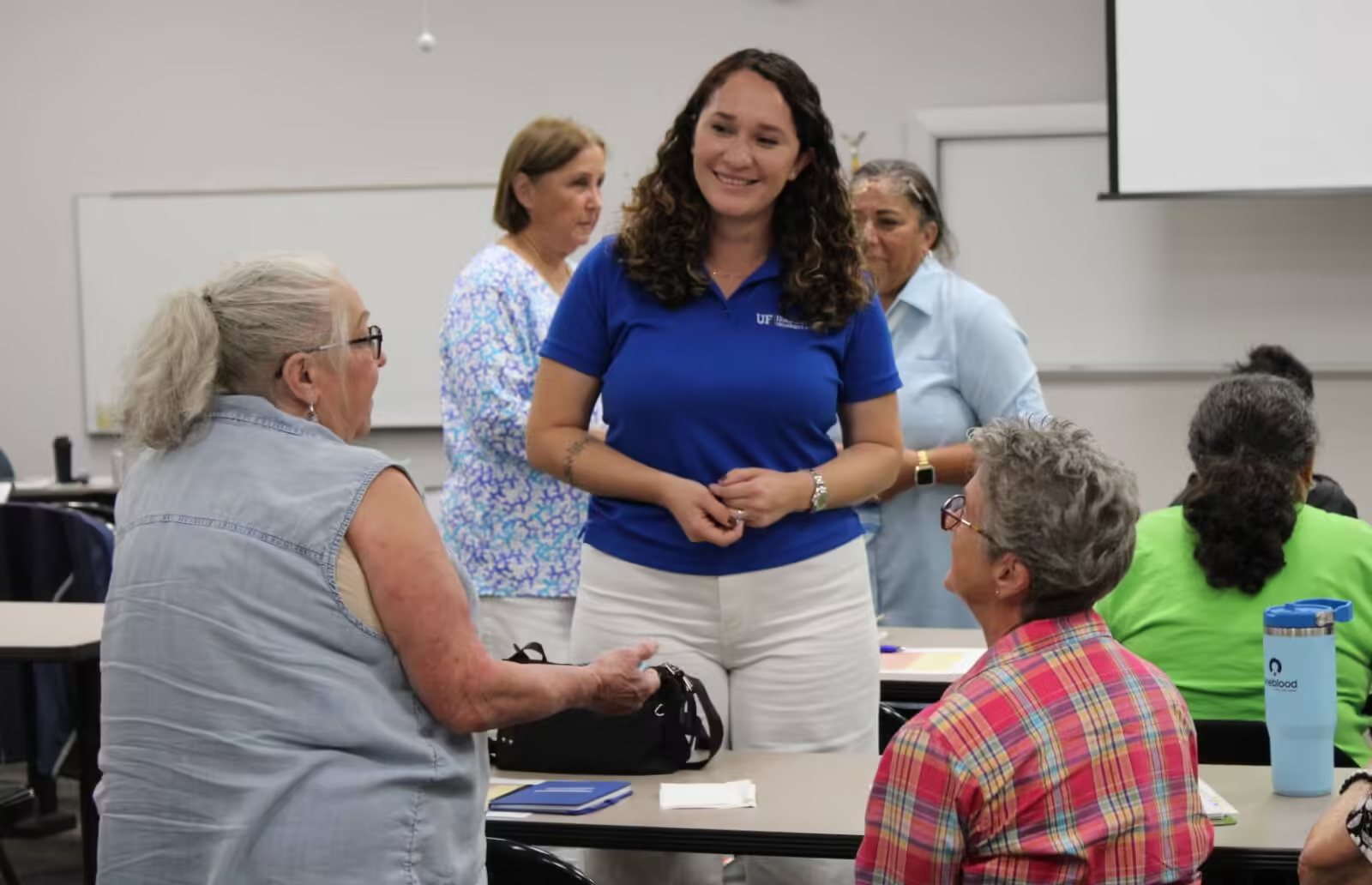
Sara Salgado MacDonald, Ph.D., is the urban horticulture extension agent and Master Gardener Volunteer coordinator with the University of Florida Institute of Food and Agricultural Sciences (UF/IFAS) Extension in St. Lucie County, Florida. She earned her Ph.D. in entomology from UF and her M.Sc. in entomology from Rhodes University in South Africa.
Originally from Ecuador, Salgado MacDonald’s career has taken her across Latin America, Africa, and the United States, giving her an international perspective on agriculture, invasive species, and sustainable landscape management. Her expertise in insect-plant interactions, invasive species, and biological control informs her extension work, connecting applied entomology with community education and environmental problem solving. Her work brings together entomology, urban ecology, and community engagement. She develops science-based educational programs on Florida-Friendly Landscaping, integrated pest management, water conservation, climate-resilient landscapes, and insect ecology while leading and mentoring Master Gardener Volunteers who extend research-based information throughout their communities.
How did you get into entomology?
My path into entomology began with my interest in nature and how ecosystems work. Growing up in Ecuador, I became interested in the connections between people, agriculture, and the environment. While studying agricultural engineering at Zamorano University in Honduras, I became especially interested in insects and their role in the environment, agriculture, and human well-being.
As I learned more about insect-plant interactions and biological control, I realized that entomology combined many of my interests, including ecology, problem solving, and applied science. I was fascinated by how insects, often overlooked, can have such an important impact on ecosystems and help us find more sustainable solutions.
Graduate school strengthened my interest in invasive species and biological control. Today, I use that background in my extension work, helping communities make informed decisions about insects, plants, and environmental issues.
What do you do in your current job?
My role combines education, leadership, and public service. I develop and lead science-based educational programs that help residents make informed decisions about their landscapes and the environment. My work includes Florida-Friendly Landscaping, integrated pest management, invasive species, water conservation, and environmentally responsible horticultural practices.
I also coordinate the St. Lucie County Master Gardener Volunteer program, recruiting, training, and mentoring volunteers who extend research-based information throughout the community. An important part of my job is working with community partners, identifying local needs, and developing educational opportunities that connect science with real-world challenges. Every day is different; one day I may be teaching a workshop, diagnosing insect or plant problems, collaborating with local organizations, or developing new educational materials.

What is the most rewarding part of your job?
Whether it’s a homeowner replacing unnecessary pesticide applications with integrated pest management, a volunteer confidently teaching others about beneficial insects, or a community adopting more sustainable landscaping practices, it is incredibly rewarding to see education translate into action.
One of the most meaningful parts of my work is helping people make informed decisions during moments of uncertainty. For example, a resident recently contacted extension concerned that they had found bed bugs in their home. After reviewing the samples, I was able to explain that the insects were more consistent with moth larvae rather than bed bugs and provide information to help them understand what they were seeing. The resident was relieved and shared how grateful they were to have accurate information before taking unnecessary control measures. Moments like this remind me that extension is not only about solving problems; it is also about reducing fear, building confidence, and helping people better understand the organisms around them.
Extension allows me to bridge the gap between research and the public. I believe science has its greatest value when it is understandable, accessible, and useful. Helping people see insects not simply as pests but as essential components of healthy ecosystems is one of the most fulfilling aspects of my career.
I also enjoy mentoring volunteers and helping them discover their own passion for lifelong learning and community service. Watching others grow in confidence and becoming educators themselves is one of the greatest rewards of leadership.
What is the most challenging part of your job?
One of the greatest challenges is communicating complex scientific information in ways that are both accurate and practical. Audiences have different backgrounds, experiences, and expectations, so I must make scientific information accessible without oversimplifying it.
Another challenge is balancing environmental stewardship with people’s immediate concerns. Homeowners often want quick solutions, while extension encourages long-term, science-based approaches that protect both people and the environment. Helping people understand those trade-offs requires patience, listening, and effective communication.
These challenges push me to continually improve how I communicate science and connect with the communities I serve.

What do you see yourself doing in the future?
I want to continue building a career at the intersection of applied entomology, extension, and environmental leadership. I am passionate about building collaborative programs that connect research, education, and community engagement to address emerging challenges such as invasive species, urbanization, and climate resilience.
Long term, I would like to lead multidisciplinary teams that develop innovative educational programs and partnerships with universities, government agencies, nonprofit organizations, and industry. I also hope to mentor the next generation of scientists and extension professionals.
Who inspires you to do what you do?
I have been fortunate to learn from outstanding mentors throughout my education and career, including Dr. Carey Minteer, Dr. Julie Peterson, Dr. Antonella Petruzzella, and Dr. Telmah Telmadarrehei. Each of them has played an important role in shaping who I am as a scientist and professional. Through their guidance and example, they have taught me not only about entomology but also about leadership, resilience, collaboration, and the importance of investing in others.
What I admire most about my mentors is that they encouraged me to think independently, ask meaningful questions, and recognize the importance of using science to make a difference beyond academia. They showed me that successful scientists are not only defined by their discoveries but also by their ability to collaborate, support others, and make a lasting impact.
I hope to follow their example by supporting others, building collaborations, and creating opportunities for the next generation.
What would you do if you weren’t working in entomology?
I would probably still be working in environmental science or natural resource conservation.
I have always been fascinated by the relationships between people and ecosystems, so I imagine I would be involved in ecological restoration, sustainability, or environmental policy.
Do you have time for any hobbies?
Outside of work, I enjoy gardening, traveling, wine tasting, and spending time with my family.
Being both an entomologist and a mother has given me even more opportunities to encourage curiosity about nature. Some of my favorite moments are watching children discover insects, ask questions, and become excited about organisms they may have once feared.
What is your advice for other ECPs?
Be curious, stay open to new opportunities, and never stop learning.
Your career will probably not follow a straight path, and that’s okay. Some of the most valuable experiences come from saying yes to opportunities that challenge you and push you outside your comfort zone.
I also encourage early career professionals to invest in communication, collaboration, and leadership skills. Technical expertise is essential, but the ability to build partnerships, communicate science effectively, and inspire others will amplify the impact of your work.
What is your favorite arthropod and why?
Parasitoid wasps have always fascinated me.
Although they are often overlooked because of their small size, they play an extraordinary role in regulating insect populations and maintaining ecological balance. My graduate research focused on biological control of invasive species, and I developed a deep appreciation for how these insects provide sustainable alternatives to conventional pest management.
To me, parasitoid wasps represent one of the best examples of how understanding insect ecology can lead to innovative, environmentally responsible solutions.
Are there any exciting directions that you think entomology is headed?
Absolutely. I am excited to see entomology becoming increasingly connected to major global challenges, including climate change, biodiversity conservation, and urbanization. I am especially excited about the growth of citizen science and community engagement, which allows people to actively participate in insect conservation and contribute to scientific knowledge. Initiatives such as the Great Southeast Pollinator Census are excellent examples of how we can bring insect science into our communities while increasing awareness of pollinator diversity and conservation.
I am especially excited that St. Lucie County participated in the Great Southeast Pollinator Census for the first time in 2026, with plans to make it an annual activity. This initiative allows us to engage residents in insect science, raise awareness about pollinator conservation, and inspire more people to appreciate and protect these important insects.
Thanks Sara! Connect with Sara Salgado MacDonald and learn more about her work via LinkedIn.
Zachary Cohen, Ph.D., is a postdoctoral researcher Florida Atlantic University’s Department of Electrical Engineering and Computer Science. Previously, he worked in a postdoctoral role at the U.S. Department of Agriculture’s Agricultural Research Service in College Station, Texas. He currently serves as the Southwestern Branch representative to the ESA Early Career Professionals Committee. Email: [email protected].
All photos courtesy of Sara Salgado MacDonald, Ph.D.
Discover more from Entomology Today
Subscribe to get the latest posts sent to your email.
Source: entomologytoday.org