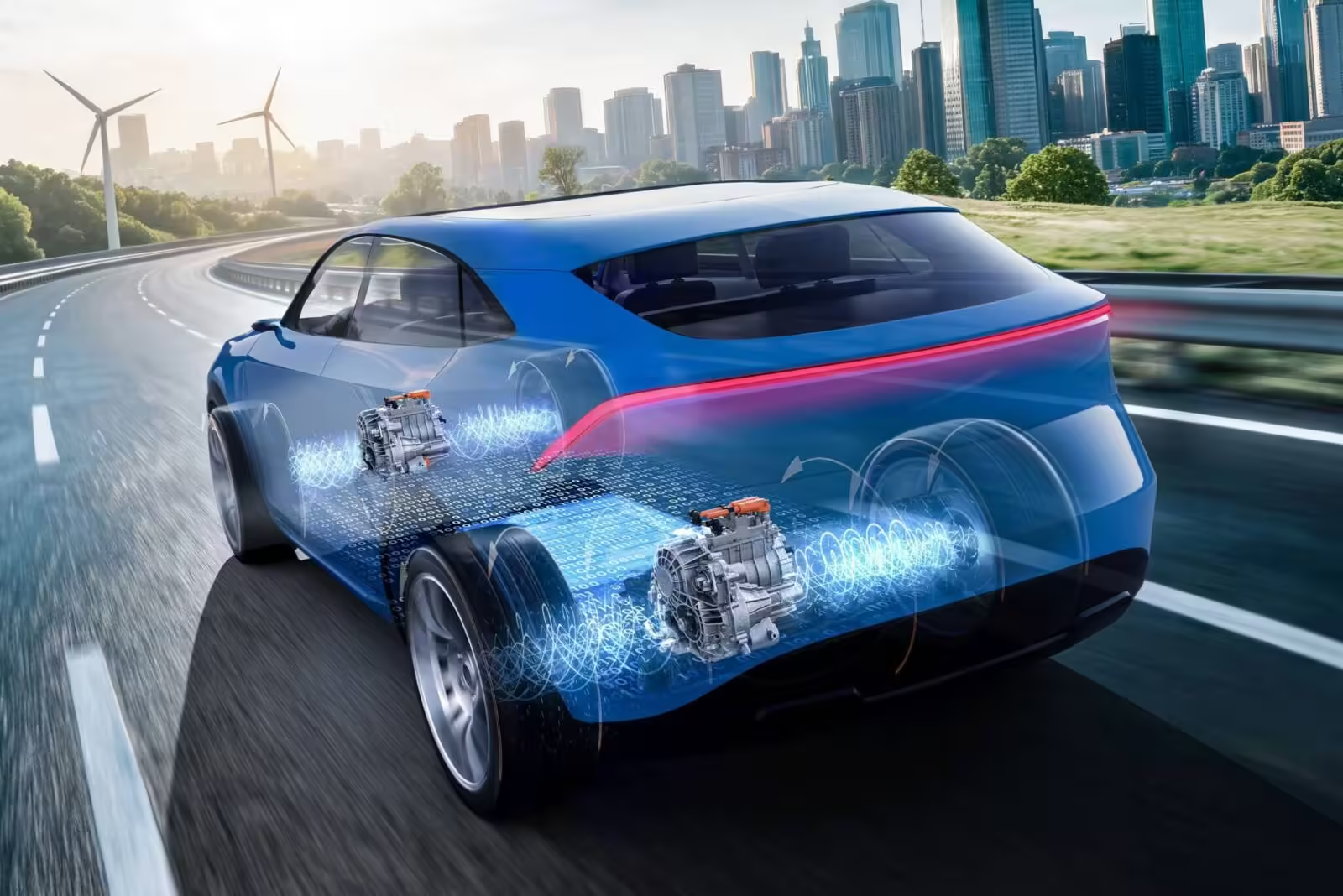

The ZF High Revolution Drive shows suppliers turning to motor speed as a route to lower cost and reduced reliance on scarce magnets
The ZF High Revolution Drive spins its electric motor at up to 30,000rpm, letting the supplier cut the 3-in-1 unit’s size and weight by almost 25% and halve its magnet mass against a comparable 18,000rpm drive. Built as a variant of the existing Select platform, the system targets high-volume passenger cars, with production planned by 2030.
Faster rotation lowers the torque a motor needs for a given output, and because torque tracks rotor volume, the motor can shrink. A two-stage spur gearbox with a roughly 18:1 ratio restores torque at the wheels; the version shown peaks at 200kW and 3,500Nm.
Halving magnet mass reduces cost and reliance on critical supply chains, a growing concern for drive suppliers. ZF says energy conversion holds at nearly 93% despite the speed and gearing, level with the Select equivalent, while the lighter unit should add range.
Noise and vibration become harder to control as speed rises. “Robustness and low noise and vibration levels were stringent development targets from the outset,” Thomas Meiser, Head of the E-Mobility Business Unit, said. “To achieve this, we considered the electric motor, gearing, bearings and tooth geometry as an integrated system. For the configuration presented, 30,000 rpm is the economic and technical sweet spot.”
The range covers roughly 150kW to 200kW and scales for 400V and 800V architectures. Reusing Select technology should shorten development for automakers, several of which are already in talks with ZF.
Source: ZF
Source: www.automotiveworld.com