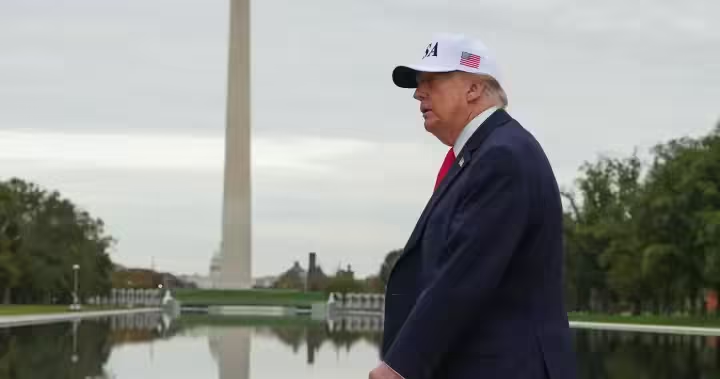

Call it a blue wave or call it a red rout, the U.S. midterm elections delivered a huge blow to U.S. President Donald Trump as voters handed control of both the Senate and the House of Representatives to the Democrats on Tuesday.
The first half of Trump’s fractious second term in office concluded with him set to become a lame duck president now that control of the legislative chambers will be in the hands of the Democrats as of January, leaving him vowing to make extensive use of his presidential power to execute his agenda.
Some experts say this signals a more combative Trump, willing to flex his executive muscle.
“Lame ducks can be aggressive,” said Daniel Beland, director of the McGill Institute for the Study of Canada and a political science professor.
Democrats flipped crucial Senate seats in Maine, Iowa, Kansas, North Carolina, South Carolina, Ohio and Texas. In a direct repudiation of Trump, several candidates in key races, including in South Carolina, Ohio and Texas, that Trump stumped for also lost to Democrats.
An embattled lame duck Trump might look a lot like an embattled Richard Nixon, who faced massive political headwinds over the Watergate scandal starting in 1972 until his resignation as president in 1974, said Drew Fagan, professor at the Munk School of Global Affairs and Public Policy.
The last days of the Nixon administration are documented in the book ‘Final Days,’ that paints the picture of a cornered president losing public support.
“There’ve always been suggestions that Nixon in his final months or weeks was unstable,” Fagan said.
“A lot of people would say Donald Trump’s been unstable for the last decade, and possibly longer.”

A more belligerent Trump?
Trump’s messaging has been mixed on how much he wants to cooperate with Democrats going forward.
In an interview with the New York Times, Trump said he was “absolutely willing to accept those results” and would “look forward to working with” Democrats.

Get breaking National news
Get breaking Canada news delivered to your inbox as it happens so you won’t miss a trending story.
However, he followed that up later in the evening by posting the picture of a red hat with the word “VETO” written on it.
In a rambling call-in to Fox News election special early Wednesday morning, Trump said he believes he “can work with (the Democrats) on many things.”
But the president almost immediately said the Democrats could bring him 50 bills “they’re excited about” and he could veto each one.

What happens to Trump’s trade policy?
The two areas where Trump can exercise the most amount of executive control are foreign policy and trade, Beland said.
“In terms of foreign policy and trade, especially foreign policy, the president has a lot of power,” he said.
Trump’s control over trade policy is evident in his trade war against Canada.
The two major sets of tariffs – the Section 232 sectoral tariffs on steel, aluminum and autos as well as the sweeping 50 per cent Section 338 tariffs – were imposed via executive order, not Congress.
Trump simply circumvented the U.S. Congress in imposing his tariffs on Canada.
“In terms of trade, Congress normally should have a major say, but it hasn’t been the case since Trump returned to the White House,” Beland said.
For the Section 232 tariffs, Trump used the Trade Expansion Act of 1962 to exercise power. When imposing the Section 338 tariffs, he used an even older statute called the Trade Act of 1930, which enacted the so-called Smoot-Hawley tariffs, named after the Republican lawmakers who introduced the legislation during Herbert Hoover’s presidency.
“He interpreted that as giving him effectively, the right to impose tariffs, even if tariffs are taxes and that’s the responsibility of Congress,” Fagan said.
Until now, the act was arguably most famous for its mention during an iconic scene from the classic 1986 film Ferris Bueller’s Day Off, in which a droning high school teacher played by Ben Stein tries to teach Bueller’s class about the tariffs’ impact on the American economy.
Section 338 of the act gives the president authority to determine “as a fact” whether a country’s trade policies discriminate against the U.S. and declare new or additional tariffs.

Observers of Trump’s foreign policy will be watching “the war in Iran and the disruption that he can still cause,” Fagan said.
On Tuesday, hours before voters were heading to the polls, Trump launched fresh strikes on Iranian targets in the Strait of Hormuz in a fresh sign of further escalation.
The Middle East and beyond have been on edge about the prospects of the U.S. resuming full-scale operations against Iran for the first time in almost two months.
Trump has alternated between threatening major strikes and pushing for a deal with Iran.
Speaking to reporters after the midterm drubbing on Wednesday, Trump admitted that the war drove up the price of gasoline but added that “if I had to do it again, I’d have to do it again.”
Declaring war is the prerogative of Congress, not the president — but military action can be taken without a formal declaration of war. Senate Minority Leader Chuck Schumer, who is poised to become the majority leader in January, said he will work with Republicans to end the war.
“We’re going to end the Iran war. We have some Republicans already who’ve joined us in ending the war,” Schumer said on Wednesday.

While Democratic control of Congress puts impeachment on the table, it will be a tall order.
Trump was impeached twice during his first time. First in 2019, for abuse of power and obstruction of Congress, and later in January 2021, a week before his term ended, for inciting an insurrection.
In both instances, he was not removed from office because of the impeachment. A simple majority in the House is enough to impeach a president, but only a two-thirds vote by the Senate can convict and remove a president from office.
Trump has signaled he will become more confrontational in executing his agenda in the event of a Democratic sweep in the midterms.
“I guess I’ll become Mr. Veto,” Trump told the New York Post in a podcast that released on Monday.
Source: globalnews.ca