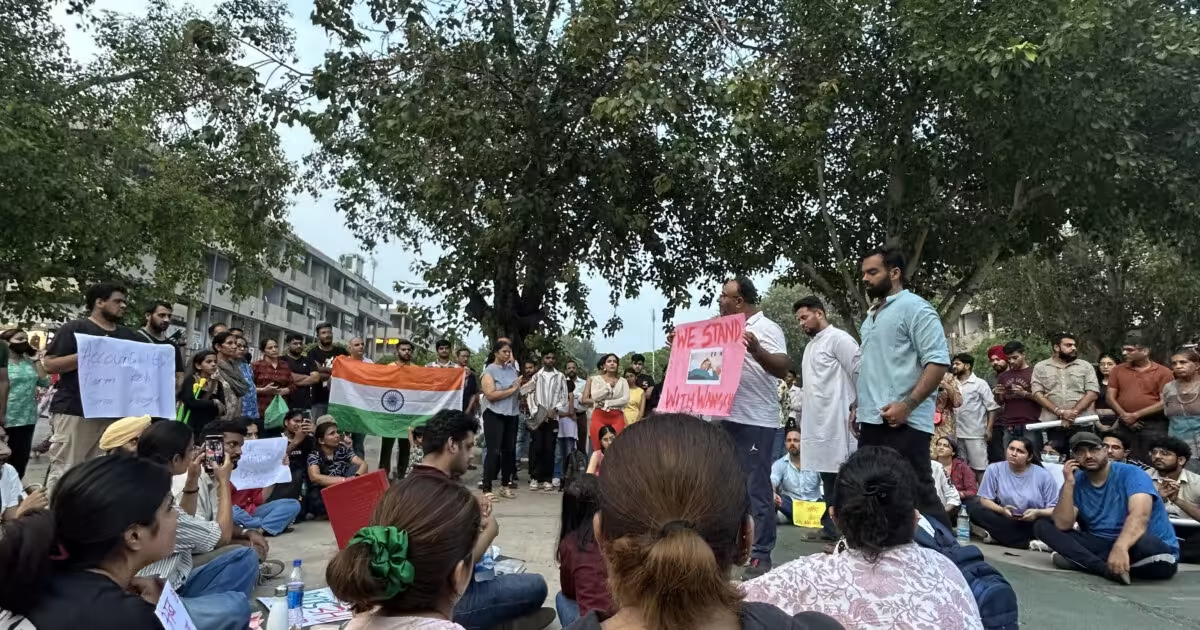

Following months of youth-led protests against exam paper leaks in India, women who took part were singled out for a distinct kind of retaliation – rape threats, doxxing and demands for public apologies – even when they used language no different from the men beside them. Journalists, activists and scholars told FairPlanet the abuse reveals less about protest conduct than about how uneasy Indian society remains with women speaking in public at all.
A viral apology
New Delhi’s Jantar Mantar had been a protest camp for weeks by the time the 15-year-old girl’s* face began circulating online. The teenager had gone to nearby Connaught Place with friends in July, run into a demonstration over the paper leak in India’s National Eligibility cum Entrance Test (NEET)and, by her own account, been swept up by the crowd around her. NEET, the national medical entrance exam sat by more than 2.2 million students, had been cancelled in May. A clip of her hurling abuse at Prime Minister Narendra Modi went viral. Within days, a police complaint had been filed against her, her personal details were circulating on WhatsApp groups, and she had recorded a tearful public apology. ‘I am only 15 years old,’ she said, hands folded. ‘This is my first and last mistake, and I will never repeat such an act again.’
Singh’s case became one of the most visible flashpoints in a pattern that ran through the youth-led Cockroach Janta Party (CJP) protestswhich forced the resignation of India’s then education minister, Dharmendra Pradhan, over the NEET paper leak. Women who joined the movement faced a scale and character of online retaliation that their male counterparts largely did not. Modi eventually addressed the abuse directed at him in a video posted to Instagram on 31 Julysaying he had been ‘personally abused’ and that even his late mother had been subjected to ‘filthy abuses’, but that the ‘mischievous children’ responsible deserved forgiveness rather than punishment. Many of his supporters did not extend the same grace to the women protesters who had insulted him, and continued to direct sexualised threats at them for weeks afterwards.
A coordinated campaign
Accounts with hundreds of thousands of followers posted AI-generated ‘target’ overlays over women’s faces, captioned with lines such as ‘Find her. She abused Prime Minister Narendra Modi.’ A separate investigation found that so-called ‘pro-Sanatan’ content creators – accounts organised around the defence of Sanatan Dharmaor Hindu religious and cultural orthodoxy, and often aligned with Hindu nationalist politics – tracked protest reels on a ‘minute-by-minute’ basis to identify young women. They then passed on the women’s phone numbers, college names and home addresses through WhatsApp networks; in some cases, vigilantes turned up at the women’s homes to ‘counsel’ their parents. Alt News co-founder Mohammed Zubair told ThePrint the pattern was not new; it had also followed the Shaheen Bagh sit-in and the farmers’ protests, and functioned to discredit protesters by attacking their character rather than contesting what they had actually said.
Sanatan Dharmaliterally ‘eternal religion’, is a traditional name for Hinduism. But among online supporters of Modi’s Bharatiya Janata Party (BJP), which grew out of the Hindu nationalist Rashtriya Swayamsevak Sangh (RSS), ‘defending Sanatan’ has become a banner under which critics of the government are recast as enemies of the faith itself. Outspoken women have repeatedly borne the brunt. In 2018, five UN experts, including the Special Rapporteur on violence against women, warned that journalist Rana Ayyub, a Muslim critic of the government, faced calls to be ‘gang-raped and murdered’ after a faked pornographic video of her circulated online. In 2021 and 2022, the apps Sulli Deals and Bulli Bai put photographs of around 100 Muslim women – journalists, lawyers and activists – up for mock ‘auction’; the first app was named after a derogatory slur for Muslim women used by Hindu nationalists.
Targeted at home
Soumyaan activist who took part in demonstrations in Chandigarh and at Jantar Mantar, described the same dynamic in a telephone interview with FairPlanet. The abuse, she said, escalated sharply once the protests grew larger and after activist Sonam Wangchuk was hospitalised against his will during his hunger strike: photographs of women protesters began circulating in ‘troll army’ groups alongside their names and home addresses. Her own family’s address in Korba, Chhattisgarh, was made public, she said, as was that of a fellow protester’s family in Gaya, Bihar. In one case, the parents of a student union office-bearer were visited at their home – ‘an intimidation tactic’, she said, meant to pressure the family into withdrawing their daughter from the protest. She also described receiving automated, pre-recorded phone calls from unfamiliar numbers, filled with graphic threats.
Soumya rejected the idea that women were targeted simply because they, too, used profane language. Both men and women swore at Modi during the protests, she said, but the two forms of speech were not equivalent. One popular protest placard mocking the prime minister was a jab meant to humiliate through satire, not to threaten. The abuse aimed back at women, by contrast, amounted to ‘descriptions of what kind of violence will happen to us,’ she said. ‘There is a clear distinction. Just because a word was used by both parties does not mean it was used in the same sense.’ Men who were trolled, she added, were typically called ‘anti-national’ or targeted with Islamophobic slurs; women were met immediately with rape threats and suggestions that they be ‘married off’ as punishment.
Why women are singled out
Joyojeet Pala professor at the University of Michigan’s School of Informationtold FairPlanet over WhatsApp that this shift – from political disagreement to character assassination – reflects how patriarchal norms treat female assertiveness, in the workplace or the public sphere, as inherently transgressive. ‘The way of bringing down the point they are
making is not by disputing the point itself but by delegitimising their right to speak up,’ he said. The extremity of rape threats and family-targeting, he added, is aimed less at winning an argument than at attrition: ‘If they are constantly afraid about how people will gang up on or abuse them, at some point you quite simply stop saying anything online.’
Writer Richa Kaul Padtewho has written widely on women and the internet in India, made the same point a decade ago: what provokes such abuse is ‘not so much what women say, but that they are speaking at all’, and its purpose is ‘to silence women’.
That silencing works because the threat is not abstract. India’s National Crime Records Bureau (NCRB) recorded 29,670 rape cases in 2023. The 2012 gang rape and murder of a student in Delhi and the 2024 rape and murder of a trainee doctor in Kolkata each set off nationwide protests. Against that backdrop, a rape threat aimed at a woman protester carries a weight that a profanity aimed at the prime minister does not.
A single comment, the same response
That attrition does not require direct participation in a protest. Nikita Charana psychologist, told FairPlanet by phone that she was targeted after posting a single supportive comment beneath a viral video of a woman who had stood in front of a police vehicle during a protest. A stranger responded by accusing her, apparently at random, of running an OnlyFans account, referencing her profession in a mocking tone. ‘If I am minding my own business and simply leaving a comment in good cheer … who is this man to come and say something so insulting to me?’ she said. Charan has not withdrawn from posting online, describing herself instead as more ‘vigilant’ about who engages with her content. But she noted that even sympathetic friends urged her to stop responding, framing continued engagement as a risk to her safety. When friends reported the harasser’s account, she said, ‘I’m not sure that did anything.’
A pattern beyond the protests
Both women pointed to a wider pattern. Amnesty International India has previously documented that women politicians received a disproportionate share of hateful and sexist mentions during election campaigns, while researchers describe technology-facilitated gender-based violence as compounding older restrictions on women’s presence in public life. India’s Information Technology (Intermediary Guidelines and Digital Media Ethics Code) Rules, 2021 require platforms to act against content that invades privacy or amounts to gender-based harassment within a set timeframe, and victims can file complaints through the National Cyber Crime Reporting Portal. In practice, both interviewees described those mechanisms as slow or ineffective.
Pal argued the effect of this backlash is cumulative and, in a sense, deliberate. The layering of abuse with likes, shares and reposts, he said, is designed to signal that women who do choose to participate online should stay ‘within contours of restraint and respectability that align with reactionary understandings of feminine behaviour’. Seen that way, Singh’s own apology video – recorded with folded hands, asking ‘the entire country’ for forgiveness – reads less like an isolated act of contrition than a demonstration of exactly the compliance the backlash was built to produce.
Accountability is possible when the state chooses to act: in the Bulli Bai case, police arrested the app’s alleged creator within days of the outcry. Enforcing the IT Rules’ takedown deadlines, prosecuting those who publish women’s home addresses and making the cybercrime portal answer complaints would show that women’s political speech is protected rather than punished. Until then, as Charan’s caution shows, the burden of staying safe falls on women themselves.
Source: www.fairplanet.org