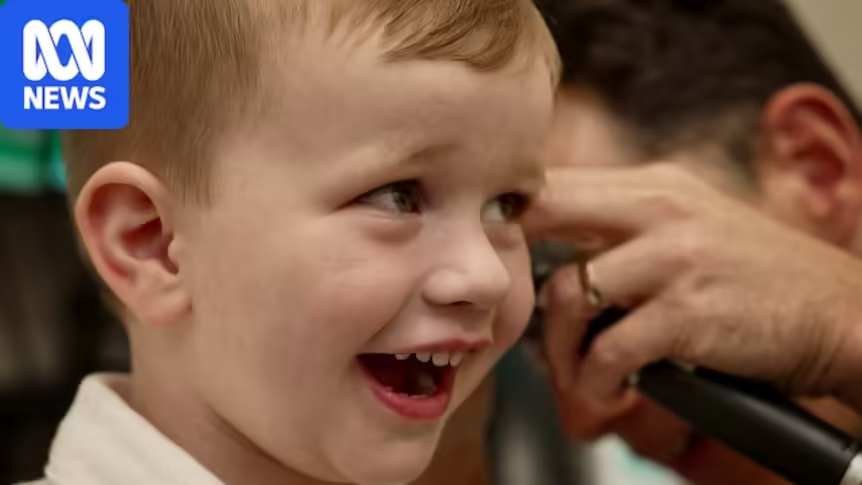

From today, hundreds of thousands of three-year-olds across the country will have access to a new Medicare-subsidised developmental screening program.
The initiative, part of the Thriving Kids program aimed at picking up some of the children to be diverted from the National Disability Insurance Scheme (NDIS), is intended to give families cheaper access to a doctor to help catch developmental concerns early.
Here’s what you need to know about the program.
How will it work?
Known as the Medicare Healthy Kids Check, the screening will involve GPs assessing a three-year-old child’s medical history, behaviours, relationships, toileting, lifestyle and sleep, while also comparing them against typical developmental milestones.
The Royal Australian College of General Practitioners (RACGP) said it was excited by the move, which arrives more than a decade after a Medicare check for four-year-olds was axed in 2015.
The checks look at a number of developments, including behaviours, relationships, toileting and lifestyle. (ABC News: Mark Leonardi)
The RACGP’s Tim Jones, who helped design the new check and was part of the Thriving Kids advisory panel, said the number of children who weren’t “ready to show their best selves at school” was growing.
“What this will hopefully enable is for us to pick up a lot of the kids who don’t have really obvious disability, but who do need a bit more out of the [health] system,” he said.
The check is available once per child per lifetime, though kids eligible for other assessments, including Aboriginal and Torres Strait Islander health checks, can continue to access those.
Tim Jones helped design the Medicare Healthy Kids Check. (ABC News: Mitchell Woolnough)
What happens after the check?
If a developmental concern is identified, the practitioner will decide whether to make any interventions or referrals for the child.
Referrals could be made to a wide range of places, from speech therapists to playgroups.
“We may discover a child is what we call ‘developmentally vulnerable’. There’s a couple of areas where if we don’t give them the right support, they’re going to start to struggle more and more and may potentially find the transition to school really difficult,” Dr Jones said.
Further support will be provided to children whose results show developmental vulnerability. (ABC News: Mark Leonardi)
“One of the things the check will enable us to do is then flow that conversation through into figuring out connections into support.”
Why three-year-olds?
Most key developmental milestones are expected to be met in the first three years of a child’s life.
But by age three, more than one in five children have at least one developmental vulnerability, according to the RACGP.
“Three is a particularly vulnerable time where there’s often big emotions, kids are going through big transitions, there might even be a younger sibling arriving [potentially distracting families],” Dr Jones said.
What else is the sector saying?
Doctors and specialists largely agree anything that supports early intervention is a positive move.
But paediatrician and independent MP Monique Ryan said she had questions about how the screening would be implemented and whether the health system would be set up to respond to any concerns that might be identified.
She said experts recommended nurses and allied health professionals also be able to deliver the check, but the government decided to restrict it to GPs.
The check will look at various aspects of a child’s life and health. (ABC News: Mitchell Woolnough)
“We know that in many parts of the country, people struggle to get into see a GP, there are shortages. We also know that some GPs don’t feel entirely comfortable with assessing child development,” Dr Ryan said.
The government will be supporting GPs and practices to bulk bill Medicare Healthy Kids Checks through existing incentives and programs but Dr Ryan said it was not guaranteed.
“It would be helpful for parents to have 100 per cent certainty that this assessment will be bulk billed when they walk through the door with their three-year old,” she said.
The initiative is aimed at picking up some of the children to be diverted from the National Disability Insurance Scheme (NDIS). (ABC News: Mark Leonardi)
What happens after the check will still depend on where a family lives, which services are available and how easily parents can navigate referrals.
Many of the state and territory-run targeted supports under the Thriving Kids banner are not expected to be up and running until January 2028.
Niroshini Kennedy, president of Royal Australasian College of Physicians (RACP) Paediatrics & Child Health Division, said identifying a developmental concern was only the first step and it needed to be coupled with assessment, specialist advice and wrap around services.
“There’s a risk that we’ll be identifying children but not matching them with timely intervention,” Dr Kennedy said.
“This process of screening is a gateway to support but it shouldn’t be the beginning of a lengthy wait.”
Dr Niroshini Kennedy worries children with a developmental concern might not necessarily be given timely intervention. (ABC News: Patrick Stone)
Dr Jones said the rollout of Thriving Kids over the next year or so represented a “critical time” for the country.
“In some communities close to two in five children are needing some form of extra support, but a lot of that support is simpler than what the NDIS was designed to provide,” he said.
“But if we don’t get that right, we know those problems only snowball and lead into increasing stress for families, but also … in our health and education sectors.”
Source: www.abc.net.au