
The revelations on Tuesday night were nothing short of extraordinary in Indonesia.
Police revealed allegations that the former chief of police, who was serving as the president’s chief of staff, had been tapping the calls of the most powerful man in the country.
By Wednesday, the president’s spokesperson was using the “T” word.
“These actions may fall into the category of acts tending towards treason,” presidential spokesperson Prasetyo Hadi told reporters.
As he was speaking, thousands of military personnel were being mobilised in Jakarta.
The wire-tapping allegations and military deployment escalated the political temperature in the capital, a city that was already on edge.
Calls had been intensifying for the vice-president, who has been under scrutiny over his educational qualifications, to resign or face possible impeachment.
As many in Indonesia wonder what could unfold next, some analysts see a connective tissue between these events: a widening rift between former president Joko Widodo and his successor, Prabowo Subianto.
The political drama comes at a time the president is already facing a dwindling approval rating, amid a near-record low currency, steep stock-market sell-offs and deep anger over forest and land fires.
The complex relationship between Prabowo and Jokowi
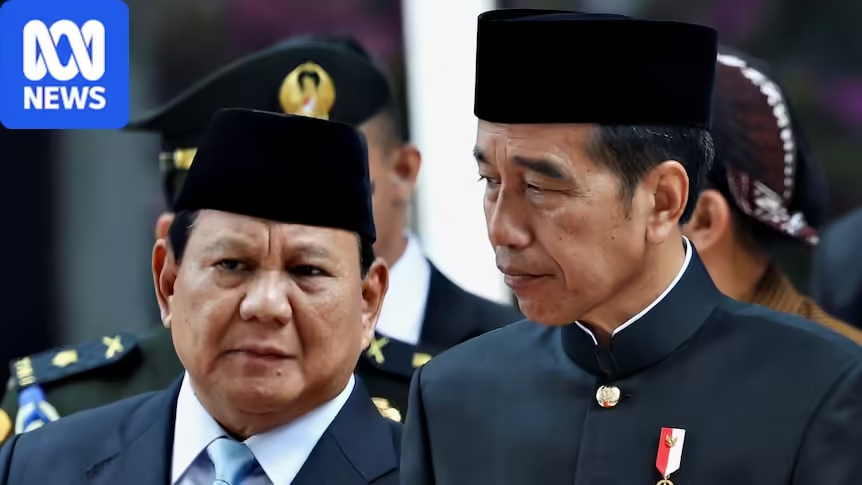
Indonesian politics has long been dominated by the political machinations of Prabowo Subianto and Joko Widodo, often known as Jokowi.
The pair were political rivals, going head-to-head in national elections in 2014 and again in 2019.
Following Jokowi’s win in 2019, Prabowo was brought in as defence minister.
Joko Widodo and Prabowo Subianto have a long history in Indonesian politics. (AP: Tatan Syuflana, file)
Jokowi, unable to run again because of Indonesia’s two-term presidential limit, supported his former rival in the 2024 elections, with his son Gibran Rakabuming Raka running for vice-president as Prabowo’s running mate.
The quid pro quo, for leveraging Jokowi’s political popularity, was that Prabowo would be a continuity president and carry on Jokowi’s legacy.
But some analysts say Prabowo’s decisions and leadership over the last two years in power have frustrated the former president.
Prabowo has cut annual funding for Nusantara, the new capital city that was championed by Jokowi.
There’s also a view that Gibran has been sidelined in Prabowo’s administration, given limited roles to do.
Meanwhile, in recent months, Jokowi has become more publicly active in politics. He embarked on a nationwide political tour in June, and in September he revealed he’d officially joined a political party led by his youngest son, Kaesang Pangarep.
Political analyst Djayadi Hanan said many in Indonesia viewed current politics through the lens of the relationship between the former and current president.
“Any political issues, particularly when there is conflict, in one way or another are usually viewed as related to the relationship between these two men,” Dr Djayadi Hanan said.
“There is demand from some groups that the president should isolate Jokowi as soon as possible, because they say he’s one of the sources of problems [in the country].
“On the other side, supporters of Jokowi say Jokowi should be given more room.”
In media and political circles, this is discussed as Hambalang v Solo, referring to Prabowo and Jokowi’s bases of operations.
This perceived rift has escalated in recent months, after Indonesia’s Constitutional Court in October found no compelling evidence that the vice-president held a high school diploma, which is required under Indonesian law to run for office.
The Supreme Court then ruled that a high school equivalency certificate he had obtained was invalid.
Gibran is now facing calls to resign and is also potentially facing impeachment.
Days before the Constitutional Court handed down its findings on Gibran’s qualifications, Prabowo reshuffled his cabinet, reassigning two Jokowi loyalists.
This included the chief of police Listyo Sigit Prabowo, who the president reassigned to presidential chief of staff, widely seen as a demotion.
A month later, after the wire-tapping allegations were revealed, Listyo was detained.
Indonesia’s ‘Watergate’ moment?
This week, some in Indonesia were describing what’s allegedly occurred in the halls of power as a “Watergate” moment.
Police allege Listyo and three other senior police generals wire-tapped Prabowo — as well as other politicians, media workers, civil society leaders and business owners — from 2025 to this year without authorisation.
It’s also alleged files gathered from the wire-tapping were deleted last month.
The police investigation is ongoing.
Listyo was appointed as police chief in 2021 by Jokowi, having previously served as police chief in the Indonesian city of Surakarta (Solo) when Jokowi was the city’s mayor between 2005 to 2012.
Political scientist Burhanuddin Muhtadi told Indonesian media outlet Kompas that Listyo is widely considered one of Jokowi’s “people”.
“It is very easy to conclude that what happened [the wiretapping scandal] involves the two big political factions of ours, Mr Jokowi and Mr Prabowo,” Dr Burhanuddin said in an interview.
“In my view, they are unavoidably drawn into this discussion because of Mr Listyo’s position.”
Listyo and the other two senior police generals have been named as suspects for offences including illegal wire-tapping and data tampering.
Police have not revealed a motive, or recipient, for the alleged wire-tapping.
Yusril Ihza Mahendra says the alleged wire-tapping is a serious concern for the country. (Reuters)
Inquiries by police and government officials continue, with Indonesia’s Coordinating Minister for Law Yusril Ihza Mahendra telling reporters on Wednesday that further legal provisions could be invoked.
“As the investigation unfolds, the motive and objective behind the wire-tapping will become clear,” he said.
“There are clear indications pointing towards treason, not suggesting an intent to assassinate, but pointing towards an attempt to incapacitate the president so that he cannot exercise executive authority.”
The developments sparked dismay from Jokowi’s predecessor Susilo Bambang Yudhoyono, known commonly as SBY, who was Indonesia’s president until 2014.
“How did our country end up like this? How did our politics become so unrestrained?” he wrote on his X account.
“It seems that any means of gaining power [political power] is considered justified.
“It does not matter whether they are good or bad. Moral or immoral.
“I worry that people will eventually feel afraid and unable to live in peace in their own country.”
This all comes at a politically fraught moment for Prabowo Subianto.
Demonstrations have been taking place over the government’s handling of forest and land fires that are burning in large swathes of the country.
Frustration continues to brew over economic issues, with Indonesia’s currency, the rupiah, sitting at near-record lows.
Investor confidence has also been rattled over the year, and the Jakarta Composite Index has slumped.
It’s in this context that a large-scale deployment of the military in the capital has raised eyebrows.
Scandals could be ‘just the beginning’
The Indonesian Armed Forces (TNI) has since Monday been readying and deploying more than 20,000 military personnel to Jakarta.
Some Indonesian analysts and local media reporting had speculated the deployment was linked to the wire-tapping scandal, but the military on Wednesday said the deployment should “not be linked to any other issues”.
But by Thursday, TNI chief General Agus Subiyanto said the “state of readiness” was intended to “defend the sovereignty” of Indonesia’s government against both “natural” and “man-made” threats.
“Man-made threats encompass social conflicts, terrorism, separatism, and acts of treason,” he said in a statement.
“Personnel and military assets have been placed on alert and are now at their designated posts.”
Dr Djayadi Hanan said the deployment could have been a way for the new police chief and the military to “show that they are unified”.
The sight of army personnel on the streets of Jakarta came as the scandal intensified.
(AP Photo: Tatan Syuflana)
Indonesia’s national parliament returns from a break on Monday, with discussion likely to begin over Gibran’s fate, which could lead to impeachment proceedings.
Jokowi, who attended an unrelated court hearing in East Jakarta on Thursday over his own educational qualifications, drew a large crowd of supporters and protesters.
When asked by reporters about the alleged wire-tapping, Jokowi said “we are respecting the process”.
“If this is not handled between these two figures, it is not impossible that what happened [this week] is just the beginning stage of a bigger political escalation between two leaders in the future,” Dr Burhanuddin said.
Source: www.abc.net.au