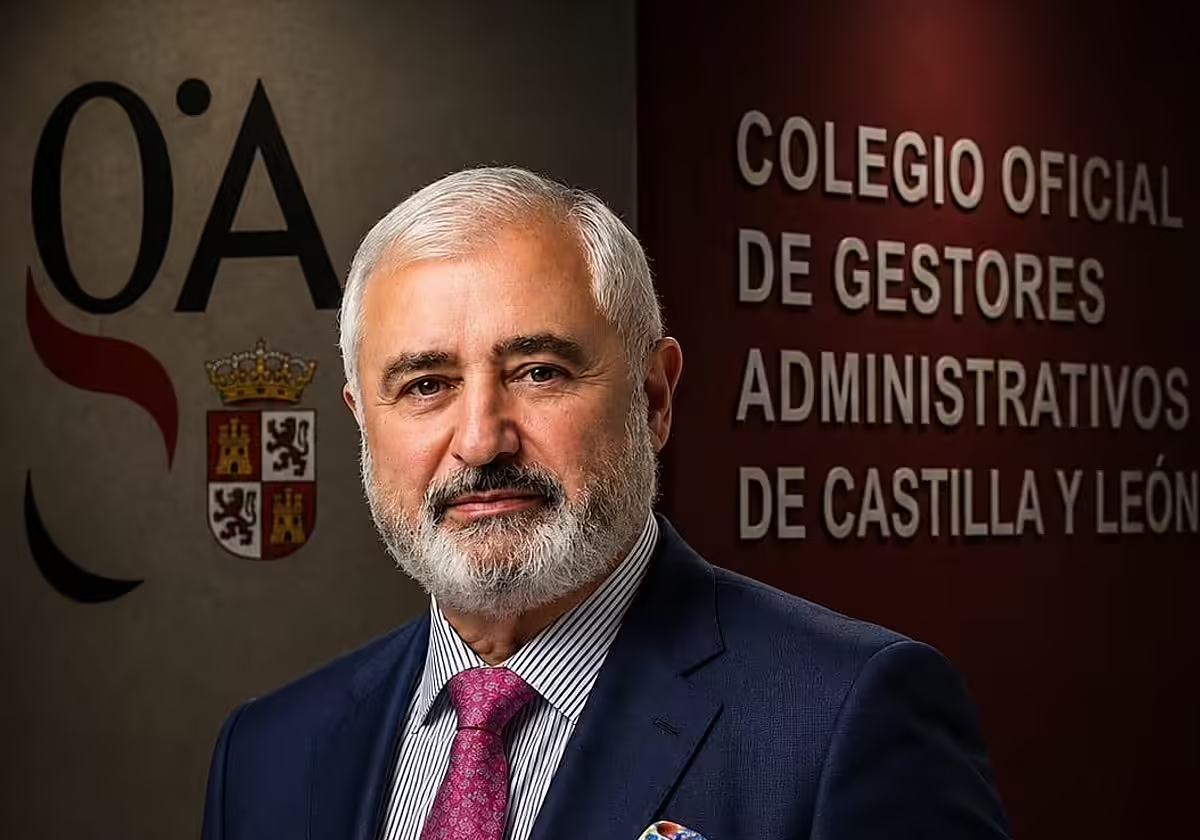

Its daily activity combines professional practice with the defense of the interests of members and attention to the problems of citizens and … companies. He is also a lawyer, administrative manager and social graduate. It has an office in León, and from there advises self-employed workers and small businesses on legal, labor, tax and accounting matters. Since 2018, Miguel Ángel Alonso de Paz has presided over the Official College of Administrative Managers of Castilla y León, where he promotes the training, modernization and institutional presence of a profession that ensures that the administrative machinery does not stop.
–What problems can an administrative manager solve?
–The administrative manager accompanies citizens and companies in their procedures before the administrations and in the fulfillment of their obligations. It can help a citizen, for example, with traffic, immigration, nationality, benefits or taxes procedures. To a company, with its tax, labor and administrative obligations, in addition to advising it so that it can make decisions with orderly and reliable information. The key is to offer technical knowledge, follow-up and personal treatment.
–From the perspective of those who work with companies and self-employed workers, what diagnosis do you make of the economic situation in Castilla y León?
–The business base of Castilla y León in 2025 is made up of 148,679 economically active companies as of January 1 of that year. From daily contact with self-employed workers and SMEs we see capacity for work and entrepreneurship, but also difficulties in assuming costs, obligations and regulatory changes. We must also take into account the territorial reality: dispersion and lack of relief or labor can complicate business continuity.
–How can the work of administrative managers contribute to maintaining economic activity in rural areas?
–Administrative management provides a close professional service where distance from administrations and the digital divide can become obstacles. We help process obligations, access services and keep your activity up to date. We also help businesses to spend more time on their work and less time interpreting procedures and deadlines.
–What difficulties do entrepreneurs encounter when starting a business in the community?
–In addition to obtaining financing and clients, they must face procedures, tax and labor obligations, licenses and decisions that depend on the activity and the municipality. The territorial dispersion and the difficulty in finding personnel or relief add complexity. Support from the beginning helps to organize the steps and prevent errors, although it does not eliminate the difficulties of each project.
–If you could ask the administrations for one measure to improve the situation of companies, what would it be?
–An effective and coordinated administrative simplification: less duplication, understandable procedures, predictable deadlines and digital systems that work in a connected way. The Administration must ask the company for the necessary information, but avoid having to provide it several times, the same documents, to different organizations.
–To what extent do constant changes in legal obligations make business planning difficult?
–The difficulty lies not only in the regulations changing, but in the frequency, scope and time. For a small business, each change may require reviewing processes, programs and costs. Greater regulatory stability and advance communication would facilitate planning and compliance.
–Has the Administration managed to make the procedures faster and simpler?
–Digitalization has made it possible to carry out many procedures without traveling and has streamlined some procedures. However, progress is not uniform: complex procedures, unintuitive platforms and access difficulties persist. Simplifying requires reviewing the entire procedure, not just transferring it to a screen. In this context, the role of the administrative manager is more relevant than ever. Its function is not to create bureaucracy, but to help people live with it, translating regulatory and technological language that is not understandable to everyone. The incorporation of new technologies has also transformed professional practice. But in the face of automation, the true added value remains human: professional judgment, personalized attention and the assumption of responsibilities. The digital divide is a reality that cannot be ignored. The administrative manager fulfills an essential social function here, preventing digitalization from becoming exclusion.
–What does an administrative manager contribute in an increasingly digital Administration?
–Provides knowledge of procedures, ability to anticipate problems and personal support. Digitization facilitates procedures, but it can also leave behind those who do not know how to access or resolve an incident. The manager helps technology translate into a useful and understandable service.
–What role is artificial intelligence going to play?
–It can help classify documentation, automate repetitive tasks and locate information more quickly. Its usefulness will depend on whether it is applied with guarantees of security, confidentiality and professional supervision. Technology can improve work, but case-by-case interpretation, accountability and care remain essential.
–How many professionals make up the group in the community and how has the profession evolved?
–In the College of Managers of Castilla y León, among the 7 provinces that make it up, with the exception of Segovia and Ávila that belong to the Madrid College, there are 290 registered members, between practicing and non-practicing. Every day more specialized, but preserving the essence of the profession.
–How many hours a year does a small business dedicate on average to complying with its tax, labor and administrative obligations?
–There is no single average that can be rigorously applied to all small businesses: it depends on the number of workers, activity, volume of operations and specific obligations. I prefer not to offer an estimate without a clear source and methodology. Yes, we can affirm that this time represents a management cost that subtracts resources from productive activity.
–Are there important differences between the time and cost of managing a business in Castilla y León and doing so in other communities?
–A good part of the tax, labor and commercial obligations are at the state level, but there are differences derived from regional and local regulations, the services available and the procedures of each administration. Obviously the costs are not the same.
–Finally, what future do you imagine for the administrative managers of Castilla y León?
–A more technological, more necessary profession with more social responsibility. For decades we have helped manage administrative complexity; Now we want to help reduce it.
Source: www.elnortedecastilla.es