
[Financial News] In line with reform of the criminal justice system, police plan to increase dedicated staff for protecting crime victims and secure the necessary budget. As the powers and roles of investigative agencies change, police intend to ensure victims’ rights in practice and expand cooperation with private organizations.
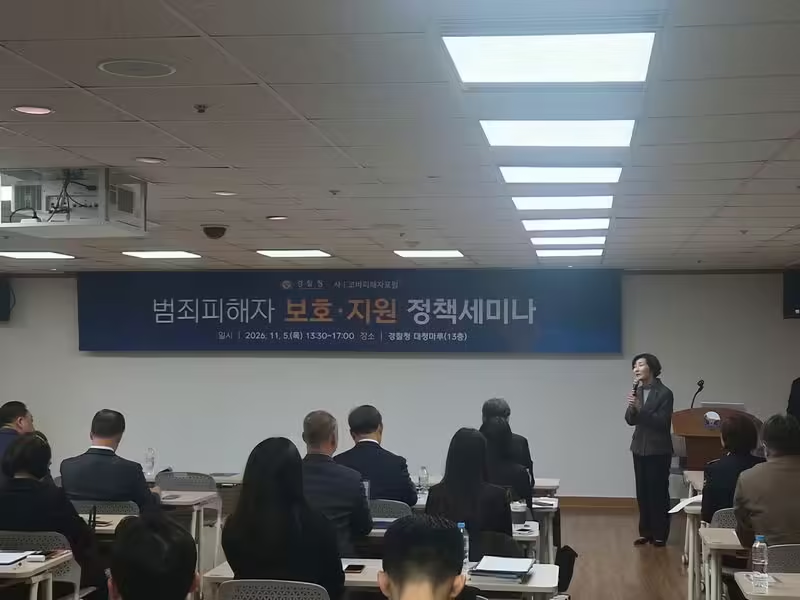
The Korean National Police Agency said it held an academic conference jointly with the Korea Victim Support Association (KOVA) on the afternoon of the 5th at Daecheongmaru in Seoul’s Seodaemun District to discuss ways to improve the system for protecting and supporting crime victims.
The conference was held under the theme “Challenges and Directions for Advancing the System for Protecting and Supporting Crime Victims amid Amendments to the Criminal Procedure Act and Changes to the Criminal Justice System.” It provided a forum to discuss guaranteeing victims’ procedural rights amid changes in the criminal justice environment, the police’s responsibility to protect victims, and ways to promote public-private cooperation.
The Victim Forum, established by the Korea Victim Support Association to research policies for protecting and supporting victims, is an academic research organization that brings together scholars, field experts and practitioners. It has held regular academic conferences every year, and this year organized the event jointly with the Korean National Police Agency.
The event opened with remarks by Lee Yun-ho, a Dongguk University professor and chair of the Victim Forum, followed by presentations and discussions on three topics.
The first topic was “Guaranteeing Crime Victims’ Procedural Rights and Tasks for Improvement amid Changes to the Criminal Justice System.” Participants examined how changes in the roles of investigative agencies affect victims’ exercise of their rights and discussed institutional measures to strengthen the protection of those rights throughout investigations and criminal proceedings.
Lee Sang-hun, a Daejeon University professor, moderated the session, and Lee Ha-na, a Cheongju University professor, gave the presentation. Jo Yun-o, a Dongguk University professor; Lee Yu-gyeong, a New York attorney; and Superintendent Bae Hyeon of the Korean National Police Agency’s Investigation Structure Reform Team took part in the discussion.
The conference then discussed the police’s role in protecting crime victims and ways to improve it. Key agenda items included staffing, funding and establishing a legal basis to ensure victims’ safety, prevent secondary victimization, and make economic and psychological support more effective.
With Un Dong-ho, a Kookmin University professor, moderating, Jeong Hye-sim, head of the Korean National Police Agency’s Crime Victim Protection Division, gave the presentation. Lee Jang-uk, a University of Ulsan professor; Kwon Gi-seon, a Griffith University professor in Australia; and Kim Ga-eun, a legislative researcher at the National Assembly Research Service, led the discussion.
Finally, participants examined the role of private victim-support organizations and ways to develop public-private cooperation. They discussed building a support system through cooperation between police and private organizations, extending from the protection of crime victims to their recovery of everyday life.
Yoo Young-jae, a Jungwon University professor, moderated the session, and Yun Sang-yeon, a Gyeongsang National University professor, gave the presentation. Kim Yeon-su, a Dongguk University professor; Jeong Yu-seon, head of the Daejeon branch of the Korea Victim Support Association; and Jeong Ui-mun, a victim-support officer at Seoul’s Yeongdeungpo Police Station, participated as discussants.
The Korean National Police Agency plans to review ways to improve its victim protection and support policies based on expert opinions and field recommendations presented at the conference, and to strengthen cooperation with relevant agencies and private organizations.
Acting Korean National Police Agency Commissioner Kim Jong-chul stressed, “Changes to the criminal justice system must not stop at simply adjusting the powers and roles of investigative agencies. We must build a new, victim-centered system for protecting and supporting victims so that their rights are fully guaranteed when needed.”
He added, “To that end, we will work to increase the number of police personnel dedicated to crime victims and secure funding. We will also expand cooperation with relevant agencies, including the Ministry of Justice, the Public Prosecution Office and the Ministry of Gender Equality and Family, as well as strengthen ties with private organizations responsible for protecting crime victims.”
[email protected] Kim Ye-ji Reporter
Source: en.fnnews.com