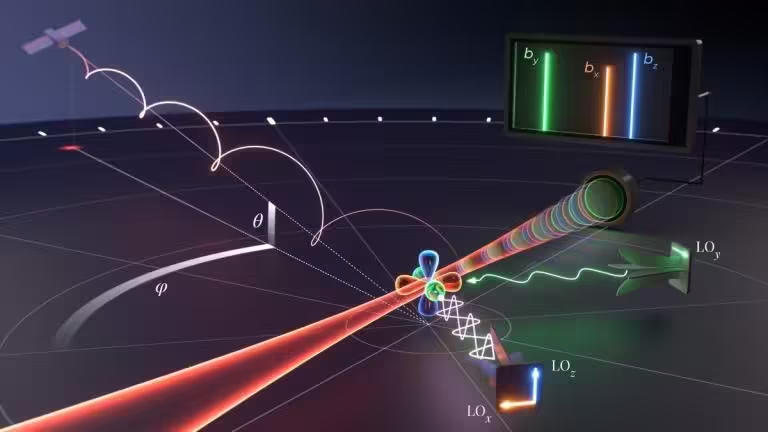

A groundbreaking lab-based quantum sensor can offer warfighters unprecedented insight into the electromagnetic spectrum (EMS) space on the battlefield; however, the tool has several limitations that researchers and engineers at the U.S. Army Combat Capabilities Development Command (DEVCOM) Army Research Laboratory (ARL) must address before soldiers can use the technology in real-life operations.
To make the Rydberg quantum sensor practical for the field, scientists must improve the fundamental performance and sensitivity of the framework systems and consistently achieve the standard quantum limit; create resilient and adaptable foundational lasers; and increase the sensor’s mobility, decrease the system’s power requirements and make the necessary advancements to unlock its ability to function outside of the lab without surrendering its potential and ability to give soldiers a warfighting advantage, per David Meyer, lead research scientist in the quantum sciences and technology branch at the ARL. The latter challenge is one the team at the ARL is actively confronting head-on and attempting to resolve.
ARL officials are collaborating with the private sector to explore new ways of developing the Rydberg quantum sensor, specifically by making it smaller and more agile, reducing its power requirements and making it self-sufficient and not reliant on the lab. Crews could then feasibly transport the Rydberg quantum sensor, which could then operate in the unpredictable and extreme conditions of the real world without the assistance of the lab. Right now, despite the potential the sensor possesses, warfighters in battle cannot take advantage of the sensor’s abilities because it is too large and impractical for soldiers to carry. The task of cutting down its size, which would also include limiting its power needs, is a large component toward opening the door for the capability to leave the lab—a development that needs to happen for personnel to thoroughly put the sensor to the test and show the tool’s abilities to commanders and investors, Meyer said.
“[Getting platforms that can leave the lab can] allow us to sort of do demonstrations that are more true to life, which there are a lot of lessons learned when you do those kinds of demonstrations, and it also makes it more tangible for stakeholders to really understand what it’s capable of,” Meyer explained during an interview with SIGNAL Media. “It’s one thing to write the paper; it’s another thing to actually go out in the field and do it, so that’s a big part of what we’re working on.”
He added that they are diving into the physics surrounding the Rydberg quantum sensor to gain a deeper understanding of the limitations of the platform and the improvements they can realistically achieve and apply.
The goal of making the Rydberg quantum sensor more mobile and compatible with the outside world goes hand in hand with another hurdle the ARL team has to clear: creating resilient and adaptable foundational lasers, or as Meyer called them, “robust lasers.” Researchers and developers must engineer a way to enhance these lasers so they can withstand heat, humidity, temperature changes, unstable environments, etc. Right now, scientific-grade lasers typically do not operate effectively in uncontrolled climates because they are designed to be in a lab. Meyer assured that crafting robust lasers is possible and has been done before; however, previously, crews have done it only for specific wavelengths, which are not applicable to the Rydberg quantum sensor. Additionally, building robust lasers requires a significant amount of power and precision, so only a few commercial manufacturers can produce them, which also means they are expensive. This detail leads to funding challenges in this space.
Meyer has noted that procuring and managing the funding for this project has been tricky. He said that if they receive enough funding, then performance will improve, but for that to happen, they need to conduct a fair amount of experimentation to get the exact laser they desire. Meyer said there are a plethora of options when it comes to lasers, so they have to endure a lot of trial and error before achieving their goal, a process that will take a substantial amount of money.
“You don’t necessarily want to overinvest in a particular wavelength too early, and realizing actually we invested all this money in this laser, this laser color, but actually we need it in this laser color for this particular application, and therefore, half of our investment is essentially null and void, and we have to start over,” Meyer said. “So that’s a big problem with Rydberg sensors is that our ability to develop performance and capabilities is still somewhat limited by the tools that we have, especially the laser systems.”
Source: www.afcea.org