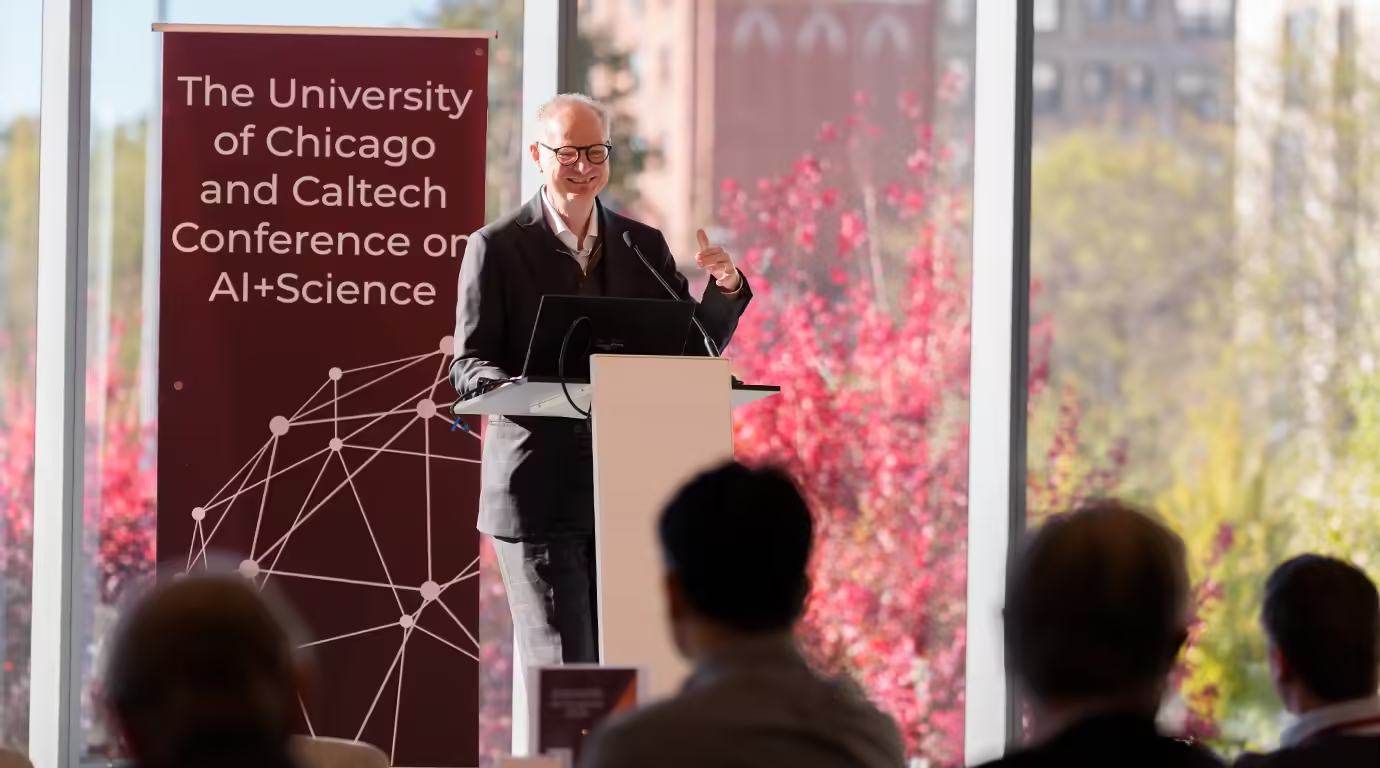

Academic research has driven scientific AI from the beginning, and it continues to shape the frontier of discovery today. That message ran through a recent gathering at the University of Chicago, which brought academic researchers together with leaders from industry, government and philanthropy.
The three-day University of Chicago–Caltech Conference on AI+Science included leading researchers from the host institutions as well as Harvard, MIT, Stanford and others.
“As AI’s capabilities grow, it is reshaping almost every field of science and engineering. Our challenge is to point these tools at the questions that define our fields, and to discover the questions we didn’t yet know to ask,” said Prof. Rebecca Willettthe Worah Family Professor of Statistics and Computer Science in the Wallman Society of Fellows and faculty director of AI at the Data Science Institute, in her opening remarks. “UChicago scientific AI scholarship is ethical, skeptical, and ambitious.”
During the conference, UChicago President Paul Alivisatos and Stuart Feldman, president of Schmidt Sciences, announced the Schmidt Science Computing Network, and a major grant from Schmidt Sciences to the University of Chicago establishing the AI for Science (AI4S) platform. This will significantly expand computing capacity for scientific AI research.
The AI for Science initiative, which includes participation in the new Schmidt Science Computing Network, will advance the University’s research and teaching goals in a range of scientific AI topics, including climate and weather forecasting, ecology and biological systems, astronomy, quantum, chemistry, AI-enabled instrumentation, and research at the intersection of AI, human reasoning, and creativity.
“Access to compute is a key to universities making breakthroughs in AI and science,” Alivisatos said. “We are deeply grateful for the support of Schmidt Sciences and proud to be taking this important step so our faculty can pursue their high ambitions for AI-enabled research.”
“Scientific ambition should not be limited by whether a research team can secure the computing power needed to pursue its most important questions,” Feldman said. “The Schmidt Science Computing Network is a bet on the ingenuity of scientists and the strength of research institutions. By pairing advanced computing with expert support and durable software, we can help researchers work at new scales advancing discoveries that benefit society.”
Intersection of AI and Science
During her remarks, Willett traced how breakthroughs like DeepMind’s AlphaFold method for protein structure estimation rested on decades of public data, academic ideas and people trained at universities. For example, on the UChicago campus, Prof. Jinbo Xu’s group at the Toyota Technological Institute at Chicago pioneered deep-learning methods for protein contact prediction that AlphaFold’s developers later cited, and Nobel laureate John Jumper earned his Ph.D. in theoretical chemistry at UChicago before joining DeepMind.
According to Willett, academia makes important contributions to AI-enabled science. UChicago researchers pose testable hypotheses that help us understand the natural world; pursue foundational research and new methods; launch startups that open new industry opportunities; build open datasets and benchmarks any lab can use; identify where AI tools can fail; and train the next generation of scientific AI researchers.
That emphasis on training is central to UChicago’s approach. In his opening remarks, Alivisatos said the University encourages students, trainees, and postdocs to learn to think “with AI, without AI, and about AI,” allowing them to pursue scientific AI research with rigorous inquiry while still centering its social, educational, and training impact.
A striking feature of the conference was how similar the hardest problems looked from one discipline to the next. Many talks centered on research where the hardest step is defining the question itself—from learning functional groups in complex microbiomes and modeling human vision to drawing mechanistic insight from data-driven weather models. Others treated measurement as a design problem in its own right, showing how AI and new instruments are changing what scientists can observe—from images of the hidden universe and large-scale cosmic surveys to digital twins of biological systems. Were data are scarce, several speakers argued, physical models must fill the gap.
A shared mission of AI-powered science
Conference speakers and attendees were interested in discussing and building partnerships across government, philanthropy, and industry, making AI research possible at scale. A keynote address by Darío Gil, the Department of Energy’s Under Secretary for Science, highlighted those partnerships.
Gil provided a striking example: AI-enabled research has taken the number of known protein structures from roughly 200,000 to 200,000,000 in the span of only a few years. “That is not an incremental improvement,” Gil said. “That is a change in what science can see.”
He used the quantifiable growth in the number of known protein structures to frame the DOE’s Genesis Missionwhich he described as organized around three pillars: assembling a portfolio of national science and technology challenges worth tackling at scale; building a platform (e.g., compute, data, instruments, and autonomous laboratories) to accelerate science and engineering; and investing in the next generation of scientists who will work across AI and the physical and life sciences.
Gil singled out significant federal investments in robotic and autonomous labs as central to the effort, and he noted that UChicago is a significant contributor to advancing the goals of the Genesis Mission.
Prizes for AI research excellence
During the conference the 2026 Pritzker Prizes for AI in Science Research Excellencewhich recognizes work that jointly advances AI and the natural sciences or engineering, were announced. This year’s winners included Kristin Persson of the University of California, Berkeley for her pioneering work in data-driven materials design, and a team prize recognizing Regina Barzilay and James J. Collins of MIT for their Antibiotics-AI Projectwhich applies deep learning to antibiotic discovery and drug design.
Conference co-organizer Anima Anandkumarthe Bren Professor of Computing and Mathematical Sciences at Caltech, concluded the event by looking forward to next year’s convening in Pasadena, which she called “a fitting next chapter for a partnership that has already helped define what AI+Science can be.”
—Article was first published on the Data Science Institute website.
Source: news.uchicago.edu