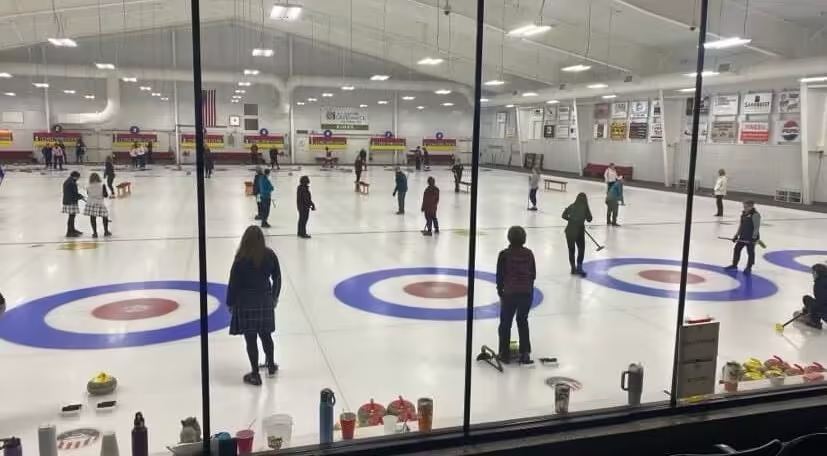

Canadians have been known to bury lucky coins beneath Olympic ice, hoping a little superstition might help their curlers bring home gold.
At the Wausau Curling ClubPete Susens relies on considerably less mysterious factors: water, cold and an almost obsessive attention to detail.
The retired teacher and hockey coach helps maintain eight sheets of curling ice, where a fraction of a degree can matter and the tiniest piece of debris can turn a perfectly delivered stone into a disappointing miss.
Understanding Wisconsin, Together.
WPR’s “Wisconsin Today” newsletter keeps you connected to the state you love without feeling overwhelmed. No paywall. No agenda. No corporate filter.
What’s the smallest thing that can wreck a shot?
“A human hair,” Susens said in an interview on WPR’s “Morning Edition.”
Susens and fellow ice maker Dale Gerlach begin their work by cleaning the ice, removing everything from dust to stray clothing fibers. Then comes shaving, followed by a fresh application of pebble, the tiny frozen droplets that allow curling stones to glide across the ice.
But perfecting that surface is far more complicated than freezing water.
Susens aims for ice temperatures between 23 and 24.5 degrees, air temperatures between 40 and 45 degrees and humidity between 30 percent and 40 percent. Even the water used to create the pebble must be carefully filtered and treated.
The science isn’t entirely settled, either.
Researchers have spent decades debating precisely why a rotating curling stone curves across the ice. Some theories focus on microscopic scratches left by the stone; others examine how friction changes as the granite travels over individual ice pebbles.
Susens, who spent 60 years playing and coaching hockey, compares maintaining curling ice to tending a golf green. Both demand patience, precision and a willingness to start over the next morning.
His approach was shaped by watching national ice technicians prepare Wausau’s facility for championship competition. Their lesson was simple: However good the ice becomes, it can always be better.
And while Canada’s tradition of hiding lucky coins beneath Olympic ice has become part of curling lore, Susens has a more practical measure of success.
“The best compliment is when there’s no complaints,” he said.
The following interview has been edited for brevity and clarity.
Shereen Siewert: When you walk into the curling center first thing in the morning, what’s the first thing you check?
Pete Susens: I’m always looking down at the ice, like every other member of the ice crew. We seem like we never look up because we’re always checking the ice, looking for damage from the night before or whatever.
SS: Most people picture curling ice as glassy smooth, but your sheets are covered in tiny frozen droplets. Why would anyone want bumpy ice?
PS: Well, to me it’s not bumpy. We want to make sure that the rock slides down the ice perfectly. And in order to do that, it has to ride on the little bumps, the pebbles that we make in the ice.
The first thing we do in the morning is shave everything off from the day before to get it flat. And then we start adding those pebbles to it.
SS: Every day you have to remake the ice in some way?
PS: Yes, we do.
SS: I’ve heard that curling is called the roaring game. Where does the roar come from?
PS: Originally, curling was done on a lake or a river that had frozen. And when the rock, which weighs over 40 pounds, goes across the ice, it made the sound of rumbling on the ice, a sound of roaring on the ice.
It doesn’t sound like that much anymore. Today’s ice rinks or curling clubs are a lot more sophisticated than the old lakes, let’s put it that way.
SS: Physicists have argued for decades about why exactly a curling stone curls. What’s your theory?
PS: Because the ice makers made the ice right, I guess. I mean, I’m not an expert. There are experts in the state, but the ice crew, Dale Gerlach and myself, we just try to make it the best that we can every day.
SS: So how did you end up becoming part of the ice crew at the club? Tell me about that.
PS: I have been on the ice all my life, but not in the curling club. I played and coached hockey for 60 years. And when I retired from teaching and coaching, my wife and I had started curling.
They said to me, “You’ve been on ice all your life. You might as well join the ice crew.”
And I won’t say I was an idiot, but I guess I jumped in. It was something to do.
When I was younger, I had worked at a golf course. I knew what it’s like to maintain a surface like a golf green, which curling has been compared to sometimes.
SS: Take me back to when USA Curling’s national ice master came to Wausau for club nationals. What did you learn from watching him work?
PS: Well, I think it was 2021 we hosted the nationals, men’s, women’s and mixed doubles. But here I’m this ice-making rookie, and I just watched the attention to detail.
Shawn Oleson and his crew, everything they did was with a purpose. And the ice the way it was wasn’t good enough. They always wanted it to be better.
I mean, the ice was really good, but they have a drive that they want the perfect ice. And I think I’ve heard Sean say you never get it, but if you can get close to it, that’s what you look for.
And our ice crew in Wausau looks to that as well. We want as close to perfect ice as we can get.
SS: What’s the recipe for making perfect curling ice?
PS: It’s easy. It’s water and cold.
It gets more complicated as to how cold and how clean the water is that we have nowadays compared to 10, 20, 30 years ago.
I mean, I was amazed at the stuff that they, like when the national ice crew came in, how particular they were that the water has to be deionized and then filtered and at the right temperature.
And they put room-temperature pebbling and hot pebbling on it. So I’d say really there’s a lot more to the recipe.
Transcript
Collapse
Transcript Terms of Use
Transcripts are provided for accessibility and convenience and may be created using a mix of automated tools and human review. While we strive for accuracy, transcripts may contain errors or omissions and are provided “as is” without warranties of any kind. The audio version is the official record of WPR programming. All transcripts are owned by WPR and protected by U.S. and international copyright law. They are provided for personal, non-commercial use only. You may not reproduce, modify, distribute, or use transcripts for public or commercial purposes without prior written permission from WPR. For permissions, contact [email protected].
From our bureau in Wausau, this is Morning Edition on WPR News. I’m Shireen Siewert. Curling has been part of Wausau’s winter tradition for more than a century, but behind every perfectly placed stone is something most spectators never think about. The ice itself. Creating the right surface takes precision, patience, and a surprising amount of science. Pete Susans of the Wausau Curling Club joins us to explain the little known art of making curling ice. Pete, thank you for joining us today.
Good morning.
When you walk into the curling center first thing in the morning, what’s the first thing you check?
I’m always looking down at the ice like every other member of the ice crew. We seem like we never look up because we’re always checking the ice, looking for damage from the night before or whatever.
Most people picture curling ice as glassy smooth, but your sheets are covered in tiny frozen droplets. Why would anyone want bumpy ice?
Well, to me it’s not bumpy. We want to make sure that the rock slides down the ice perfectly. And in order to do that, it has to ride on the little bumps, the pebbles that we make in the ice. First thing we do in the morning is shave everything off from the day before to get it flat. And then we start adding those pebbles to it.
Every day you have to remake the ice in some way.
Yes, we do.
I have heard that curling is called the roaring game.
Yes.
Where does the roar come from?
Originally, curling was done on a lake or a river that had frozen. And when the rock, which weighs over 40 pounds, goes across the ice, it made the sound of rumbling on the ice, a sound of roaring on the ice. It doesn’t sound like that much anymore. Today’s ice rinks or curling clubs are a lot more sophisticated than the old lakes, let’s put it that way.
Physicists have argued for decades about why exactly a curling stone curls. What is your
theory because the ice makers made the ice right I guess I mean I’m not an expert there’s experts in the area in the state um but I just try and the ice crew myself Dale Gerlach we just try to make it the best that we can every day
What is the smallest thing that can wreck a perfectly good shot?
A human hair.
A human hair.
The first thing we do every day is we dry mop the ice to get everything off from the night before. Before we even shave it or pebble it, we mop the ice to get all the dirt and hair, pieces of clothing, fuzz, whatever, off the ice. Because we wanna clean before we put any water on so the dirt doesn’t freeze in. And that’s just the way we start.
Which of your eight sheets has the most personality?
It depends on the season, last year was sheet four. the year before that, sheet 5, sheet 8 the year before that. Then we try to add some of our personality to it. We’ve, in the past two years, frozen in a spider that get people to not notice. It’s just a little individual touch, I guess.
So how did you end up becoming part of the ice crew at the club? Tell me about that.
I have been on the ice all my life, but not in the curling club. I played and coached hockey for 60 years. And when I retired from teaching and coaching, my wife and I had started curling. They said to me, You’ve been on ice all your life. You might as well join the ice crew. And I won’t say I was an idiot, but I guess I jumped in. It was something to do. And I’d had a background, and younger I had worked at a golf course. I knew what it’s like to maintain a surface like a golf green, which curling has been compared to sometimes.
Take me back to when USA Curling’s National Ice Master came to Wausau for club nationals. What did you learn from watching him work?
Well, I think it was 2021 we had hosted the nationals, men’s, women’s, and mixed doubles. But here I’m this ice-making rookie, and I just watched the attention to detail. Sean Olsen and his crew, everything they did was with a purpose. And it wasn’t the ice the way it was, wasn’t good enough. They always wanted it to be better. I mean, the ice was really good, but they have a drive that they want the perfect ice. And I think I’ve heard Sean say, you never get it, but if you can get close to it, That’s what you look for. And our ice crew in Wasa looks to that as well. We want as close to perfect ice as we can get. I mean, the temperature has got to be between 23 and 24 and a half. That’s the temperature of the ice. We want the air to be about 40 to 45, humidity between 30 and 40. Everything at that type of thing, we run the best ice.
What’s the recipe for making perfect curling ice?
It’s easy. It’s water and cold. It gets more complicated as to how cold and how clean the water is. that we have nowadays compared to 10, 20, 30 years ago. I mean, I was amazed at the stuff that they, like when the ice crew came in, the national ice crew came in, how much, how particular they were that the water has to be deionized and then filtered and at the right temperature and they put room temperature pebbling and hot pebbling on it. So there’s a lot more to the recipe than water and cold.
What do you think the best compliment is that a curler could give to an ice maker?
The best compliment is when there’s no complaints.
Pete Susans, thank you so much for giving us a look behind the scenes. It’s a side of curling most people never see. We really appreciate you being here today.
You’re welcome.
You can learn more about curling and opportunities to participate at WausauCurling.org. From Wausau, I’m Shireen Siewert. You’re listening to Wisconsin Public Radio.
Source: www.wpr.org