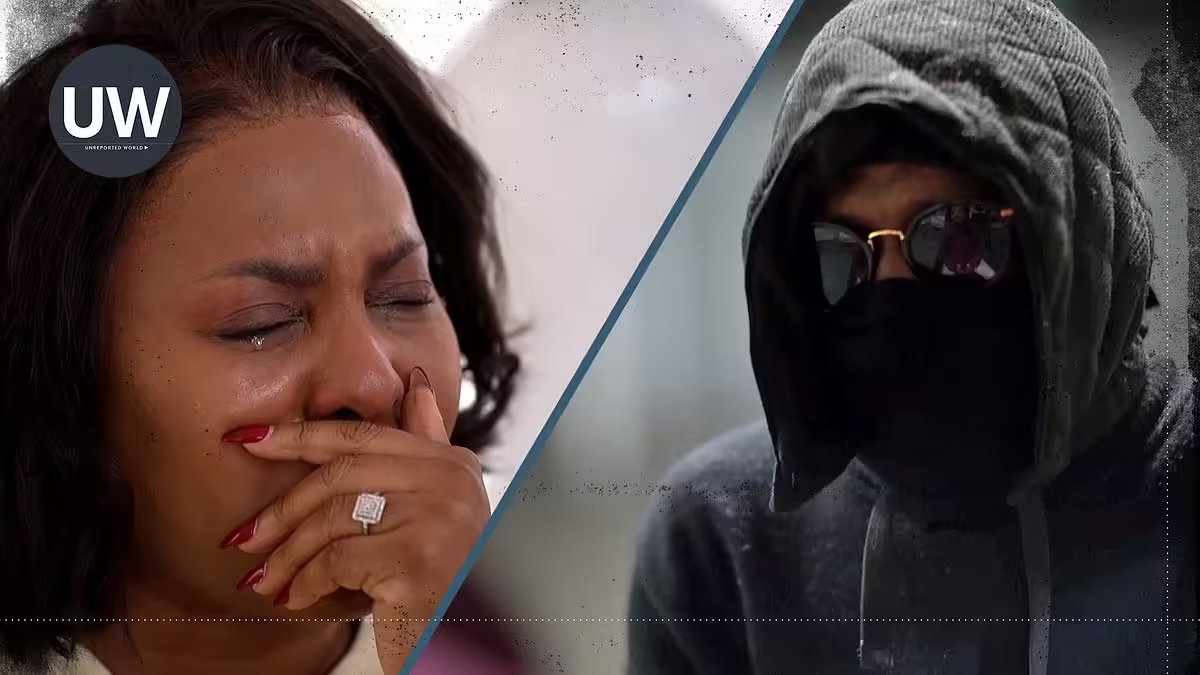

To coincide with the broadcast of the second Unreported World series of 2026, Darshna Soni writes about her experience filming in South Africa.
“How many people have you killed?”
The man sitting opposite me looked down and started to mumble. For a second, I thought I’d blown the interview by being so direct. But how else do you phrase such a question?
He’d already been nervous about being filmed. We’re in a huge, derelict warehouse on an industrial estate in Johannesburg.
Before we had started recording, before the man had even said hello, he had cautiously walked round the space, checking behind every dusty piece of furniture, peering out through every cracked window.

“I want to make sure nobody is watching, that nobody is tracking me,” he explained.
He worried that by speaking to us, he was putting his life in danger. Ironic, given his occupation. The small, thin man is a hired hitman, known as Izinkabi.
“We solve problems for rich people, that’s what we do. It’s all about money and power. In this line of work, I don’t consider you human, you are the problem and I have to solve that problem.”
I was chilled by his words. In South Africa, immense wealth exists alongside desperate poverty. It’s one of the most unequal societies in the world. It’s also been described as one of the most corrupt, and that has created a deadly marketplace, where money can buy murder.
In 2022, South Africa recorded 141 targeted killings, more than two a week. Many of the victims were murdered because they spoke out about alleged corruption.
Brave, fearless men and women who tried to do the right thing, like Eric and Johannah Phenya.
They’d worked hard to build a successful IT company and were proud of their success. In home videos, a smartly dressed Eric smiles at the camera and raises a glass of champagne.
But while delivering a contract for the Department of Home Affairs, they discovered evidence of an alleged multi-million rand fraud. The couple refused to look away and reported it to the police and the government department.

Over the next few weeks, Johannah said they noticed they were being followed. Then, on a holiday to Greece to celebrate their wedding anniversary, they received a threatening phone call. A hitman telling them to keep quiet, or pay the price.
A few weeks later, Eric had just dropped their children to school when he was gunned down in broad daylight.
It was heartbreaking to see the impact his death has had on his family.
Johannah has had to live in hiding ever since. Her children can no longer go to school. Every time they go out, even to the shops, they need an armed guard.
Nobody has been brought to justice for the killing. One man has been charged over the killing, but the justice system is struggling with a massive backlog of cases.
Johannah has faced delay after delay.
But even when the trial starts, it’s unlikely to bring answers. Because although the men who pull the triggers are sometimes caught, those who order the killings rarely are.
Back in the warehouse, the hitman told me he never knew who ordered the killings he carried out.
He told me he had grown up wanting to be an accountant.
“I had a family. Five siblings. Things were good until my dad passed on. Things were very tough.”
He said they fell into poverty and he moved out, to try to find work elsewhere.
There are few opportunities in Johannesburg to escape the grinding poverty, and so when people turn up offering cash for killing, there’s no shortage of desperate recruits. The hitmen themselves are often exploited and expendable, killed themselves when they are no longer useful.
So far as we talked, he’d been opening up about his background, the struggles he faced. He said he was just 23 when he took on his first hit.
But he tensed up when I started to ask about his victims.
I couldn’t help thinking about families like Johannah’s, and others we’d met.
“No matter how desperate you were,” I asked him, “what about your victims and their families? You didn’t see them as human?”
“No, you don’t humanise them because when you humanise them you are getting attached. There are no feelings needed,” he said.

“But you had a choice, didn’t you? And the people you were targeting, they had families, some of them had children. You didn’t have to do it.”
“I needed the money,” he told me simply.
And that’s the bitter truth. He was paid as little as £125 to end a life.
He told me he now has regrets, he has flashbacks when he thinks about what he did. But I still wanted to push him.
That’s when I asked him how many people he’d killed. I thought he was going to end the interview.
Then I realised – he was counting to himself.
“Eight,” he told me, matter of factly. Eight people. Fathers, sons, brothers. I asked him again about their lives and the impact on their families.
“But if you really want to help those families, surely if you went to the police and told them who had ordered it, what you know, that would help them?”
He seemed to get annoyed at this.
“What about me? What about my family? I made a vow that I won’t say anything.”
“And that vow is more important to you than helping the families, the loved ones of the people you killed?” I asked.
“I don’t know them,” he told me. “It was just my line of work.”
As Unreported World returns to screens, Channel 4 News is publishing an exclusive series of newsletters on Substack; each one dedicated to a single episode of the renowned foreign affairs programme.
Written by the award-winning journalists who were there, these individual newsletters go beyond the broadcast, offering readers a rare, personal look back at what it really felt like to report from some of the world’s most extraordinary places, on the most extraordinary stories.
Source: channel4news.substack.com