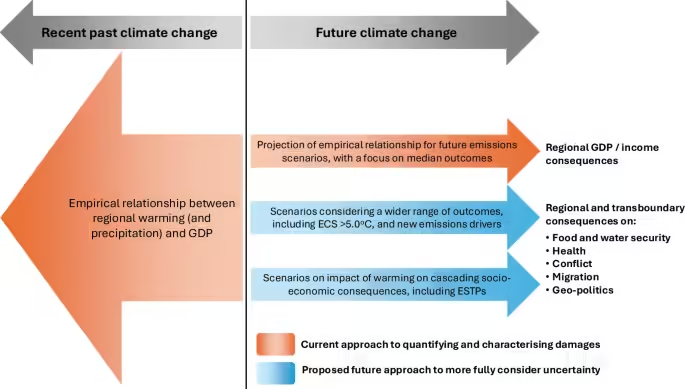

Addressing the inclusion of omitted factors in current damage estimates is of paramount importance. It requires a consideration of future climate impacts that goes beyond both the methods and metrics derived from empirical analysis (Fig. 1).
The orange arrows denote current practice in producing estimates of future climate-related economic damages based on past estimates of regional climate-economy relationships. The blue arrows propose a broader, scenario-based consideration of higher warming scenarios (top blue arrows) and discontinuities, including cascading socio-economic impacts and Earth System Tipping Points (ESTPs). Source: authors.
On methods, this means scenario analysis rather than historical trend extrapolations to accommodate uncertainties around future warming, the ways in which climate impacts could translate into social, economic and ecosystem consequences, and the possibility of transgressing Earth System Tipping Points.
On metrics, inclusion of omitted factors requires a consideration well beyond Gross Domestic Product (GDP), towards a characterisation, and ideally quantification, of aspects that actually matter to societal and ecosystem health moving forward, such as mortality and morbidity. For example, agriculture accounts for a small share of measured global GDP of ~4%13—but it underpins food security, health, livelihoods, labour productivity, political stability and trade. This central role in society makes its potential collapse economically systemic rather than marginal.
Underlying many damage estimates is a critical feature that warrants explicit scrutiny: economic growth continues throughout the century, albeit at a slower rate than it would be without climate change. Yet it seems plausible that climate damages, whether through cascading socio-economic effects or tipping-point transgressions, could overwhelm economies’ capacity to grow. A collapse of agriculture illustrates the point well: cascading consequences for food security, health, labour productivity and political stability could not be adequately represented by a GDP-based damage function, given its small contribution to that particular metric. Damage functions are calibrated to historical relationships in which macroeconomic growth persisted despite various shocks. This means they cannot capture genuinely transformative disruptions, nor the nuances of distributional and equity considerations, for example, around who bears the damages.
There is a dearth of evidence as to the credibility and likelihood of such scenarios materialising. To address that, we propose exploring their dynamics, credibility and likelihoods rather than consigning them to caveats.
The Network for Greening the Financial System’s more recent short-term scenarios14 do not rely on empirically derived damage functions and use a more exploratory scenario approach to disruptions. They point towards how a broader palette of possibilities could be constructed. Scenarios could be expanded to include shocks and disruptions beyond climate policy15, including those stemming from an exceedance of 1.5 °C and other plausible factors, such as AI acceleration, geo-engineering action, a biodiversity collapse event or the possibility that increasing climate impacts start to impede or derail16 efforts to mitigate climate change. Each of these dynamics requires consideration within a more comprehensive suite of scenarios, including exploration of the compounding and cascading consequences of multiple plausible shocks (Fig. 2).

The Network for Greening the Financial System short-term scenarios (top of figure) cover two scenarios focused on transition risks: “Highway to Paris” (timely carbon tax, with revenues recycled to low-carbon technology investment) and “Sudden wake-up call” (delayed carbon tax and partial revenue recycling, with higher transition risks). In addition, a high physical risk scenario (“Disasters and policy stagnation”) includes higher emissions, greater climate impacts and reduced investment (though investment is not endogenously linked to these climate impacts). Finally, a scenario with both transition and physical risk (“Diverging realities”) details Paris-aligned pathways in some regions, resulting in still-high climate impacts. This is a broad set of scenarios, yet it should be supplemented by a greater exploration of highly relevant factors. When considering transition risks, this could include scenarios that overshoot the 1.5 °C Paris target, exploring the implications of AI on energy demand, as well as the implications of biodiversity losses and their feed-through to the agriculture and energy sectors. Transition and physical risk scenarios could more fully explore how physical climate impacts could compromise, or even “derail” efforts to achieve low-carbon transitionss, whilst physical risk scenarios should engage more directly with the growing likelihood of geo-engineering actions such as Stratospheric Aerosol Injection, aimed at rapidly cooling temperatures. Source: authors, adapted from Network for Greening the Financial System scenario descriptions14.
Developing decision-useful and real-world-relevant climate damage estimates
Financial sector climate stress test exercises, and the analyses feeding into them, should explicitly recognise that omissions of sectors, variables and dynamics are more than just caveats: they are structural inadequacies of the modelling and analytical approaches taken, which need to be addressed as soon as possible. Otherwise, there remains a risk of epistemic overconfidence, in which the numerical precision of calculated damage values, with caveats as addenda, creates a (misleading) illusion of certainty. Action is required across different time horizons.
In the near term, we need to change how existing damage function outputs are understood. Supervisory bodies should formally designate empirical damage function estimates as lower bounds in their stress-testing frameworks, rather than as central projections. Explicitly embedding this in regulatory guidance would shift incentives in climate risk disclosure and is achievable within existing supervisory powers.
Next, a medium-term step is to apply reverse stress testing to climate tail risks. Already an established regulatory tool in UK banking and insurance supervision, reverse stress testing, in which one works backward from severe systemic loss to identify what combinations of factors would produce it, does not require models to assign probabilities to discontinuous outcomes, but instead, only to assess their plausibility.
In the longer term, regulators should require that damage function-based estimates be accompanied by parallel estimates from alternative methodologies that can represent non-linear outcomes. Such methodologies can include` expert elicitation, other mental-model approaches such as superforecasts, as well as systems mapping and storylining approaches to systemic risk assessment17. The Bank of England’s latest Supervisory Statement18 makes explicit that non-modelled analytical approaches like expert elicitations can and should be used to supplement modelled analysis in light of its limitations. Such guidance should be replicated throughout countries and regions as a standard requirement of future climate stress tests.
The reinsurance sector offers some lessons here. Having long confronted low-probability, high-consequence events for which historical calibration is structurally inadequate, it employs exceedance probability curves and probable maximum loss estimates that attempt to characterise the full loss distribution rather than a central estimate. Critically, future climate risk probability estimates that feed into such curves should be co-developed by climate risk researchers, financial regulators and financial institutions. This could lead to greater transparency and accountability for the assumptions that financial institutions are internalising, and surface where these align with or diverge from the emerging evidence on catastrophic climate risks.
Finally, there is a strong case for risk metrics that go beyond GDP to capture what empirically-based damage functions most egregiously miss. Standardised climate systemic risk metrics, analogous to those used in financial stability monitoring, would give regulators and institutions a more appropriate basis for assessing exposure to the full range of plausible futures.
Source: www.nature.com