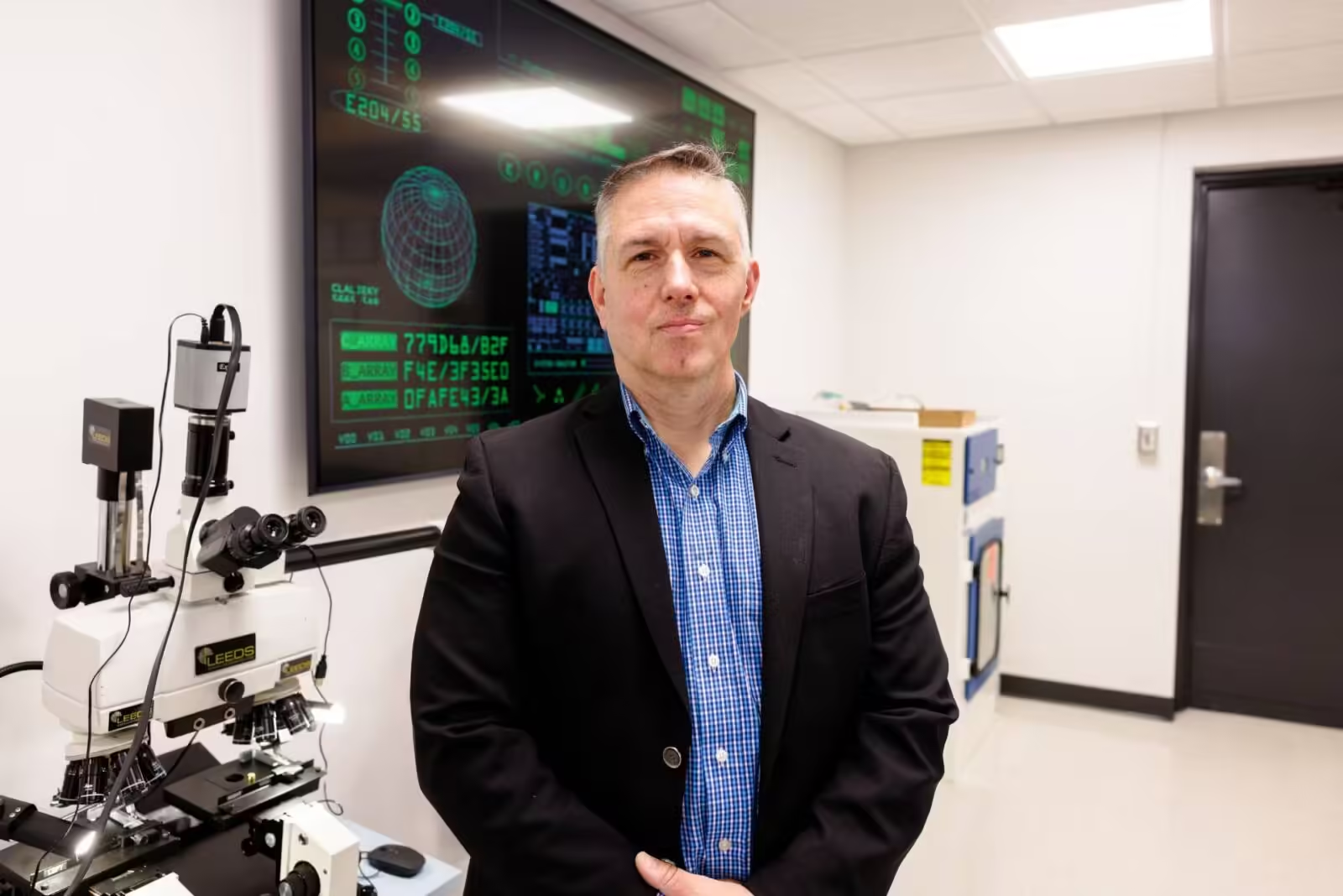

Criminal justice majors at Illinois State University have the chance to study forensic investigations with one of Central Illinois’ most experienced investigators.
Dr. William Lally ’98, M.S. ’02, has spent more than 20 years in law enforcement, mostly as a detective and chief of police. Currently the chief of the Goodfield Police Department, Lally joined Illinois State to teach Fundamentals of Criminal Investigation and Crime Scene and Evidence Documentation—or, as true crime fans would call it, forensic investigationsthe new course sequence within the criminal justice sciences major.
“The program is one-of-a-kind,” said Dr. Donna Selman, department chair of Criminal Justice Sciences. “Students can flow from classroom to crime scenes and then to the lab in one location. Our lab has more advanced equipment than many police departments across the state.”
Inviting experienced law enforcement officers to serve as lecturers and instructors is a key component of criminal justice at Illinois State and the new forensic investigations sequence, according to Selman.
The program supports the demand for forensic science technicians, expected to grow by 15% between 2024 and 2034.
To give some perspective on the rewards and challenges of a career in investigative criminal justice, Lally sat down to answer questions about his career and what students can expect in his classroom.
What drove you to pursue a career in law enforcement?
Oh, it was the stories. Always the stories. Both my grandfather and great-grandfather were Chicago cops.
For example, there’s the story about grandfather getting into a foot pursuit with a guy who ran into an abandoned factory, and this is back in the ’40s when you didn’t have radios. So, the notion that he was on his own—that’s the type of bravery that I think is extraordinary, but it was also his self-control.
“Develop attention to detail. Investigators have to remind themselves of that every day.”
—Dr. William Lally ’98, M.S. ’02
You see, grandpa had his gun drawn when the guy eventually jumped out in front of him with his hands up, and he says, “Don’t shoot!” Grandpa had already pulled the trigger, but because they had revolvers back then, he was able to slip his hand between the pistol and the hammer as it came down, so it didn’t fire. Now it hurt like hell, but he saved the man’s life.
Those kinds of stories I find incredible, and it shows how individuals rise to the occasion and become self-sufficient protectors.
As a public servant and academic, what questions do you want to consider about criminal justice?
I’m constantly asking students when we’re doing labs and using different techniques, “Is this a science, or is this an observation? Is this empirical, or is this subjective?”
For instance, we can calculate trajectories for blood stain patterns using a computer program. You can do calculations with the size of the blood stain and you can objectively calculate the angle of trajectory for that particular blood stain.
This is opposed to fingerprint analysis, which is based largely on observation. First of all, there is no definitive proof that no two fingerprints are alike. But also, there is no official standard for comparing the fingerprints of a suspect and those found at a crime scene. It’s entirely up to a jury whether or not they believe the fingerprints match or the prosecution can prove anything with them.
The court system does a pretty good job at telling the difference between what is science and what is observation, but the average citizen doesn’t understand that, and they are the people you need to learn to convince as to the validity of the evidence.
Why do you think there’s so much rising interest in forensic investigation?
My wife loves to go to sleep listening to true crime podcasts. They make my anxiety go through the roof.
But I think that it’s like any other puzzle—anything that requires you to use your brain to reach a moment of discovery. So, true crime invites you to be involved by listening and thinking, “What about this evidence? What about this suspect?”
I try to play off of that through the criminal investigations course I teach. I create a simulated crime that the class has all semester to try to solve.
It starts with a crime scene. They document it as well as they can, and then, for the rest of the semester, they are developing information. They submit search warrants for cell phone records, bank records, even Venmo accounts. They’re sending things to the lab. They’re filling out lab paperwork and getting things back—autopsy reports, search warrants for houses, and you name it. They even do interviews on the phone with people of interest. It’s through this process that they start to put together timelines and find inconsistencies or coincidences, or apparent coincidences.
What they learn is that the majority of investigations are solved just through good old-fashioned investigative work. Forensics can support or refute theories, but the idea of who did it, when it happened, why it happened, and where it happened—all of that is developed through detective work.
What can students in the forensic investigations sequence expect to get their hands on?
The things we work on and with are exactly what you will be required to do if you want to be a detective. Even if you don’t become one, we know that 90% of our students go into the field of criminal justice, whether it’s corrections, parole, or prosecution—this experience will help anyone in those roles.

They learn what a forensics lab can and cannot do. Even if they don’t work in forensics, they’ll know that you can still take fingerprints after it has rained. They’ll know you need to make sure that any biological materials are packaged in paper, or they risk molding and destroying your DNA evidence. They’ll know that gunpowder residue on a suspect’s hand is very fragile, and there are steps that need to be taken immediately to swab them.
Our students work in and out of the lab so that they know how the entire forensic investigation process works between the crime scene and the lab.
What advice do you give to students who are interested in studying criminal justice?
Develop attention to detail. Investigators have to remind themselves of that every day.
The slightest details at a crime scene might make or break a case, and, when writing a report, if there are mistakes or even typos, a defense lawyer will use those to tear a case to shreds. Doing something as simple as getting in the habit of proofreading emails for 10 seconds before you send them is good.
There can tend to be a type among investigators. We tend to be anxiety-driven, we tend to be night owls, we tend to seek stimulus. But there isn’t really a type among students entering the field who will definitely succeed.
The way I see it, all students who enter this field come in average. Everyone is average. The rigor and demand of the field is what conditions people to become greater than average in carrying out this work.
Source: news.illinoisstate.edu