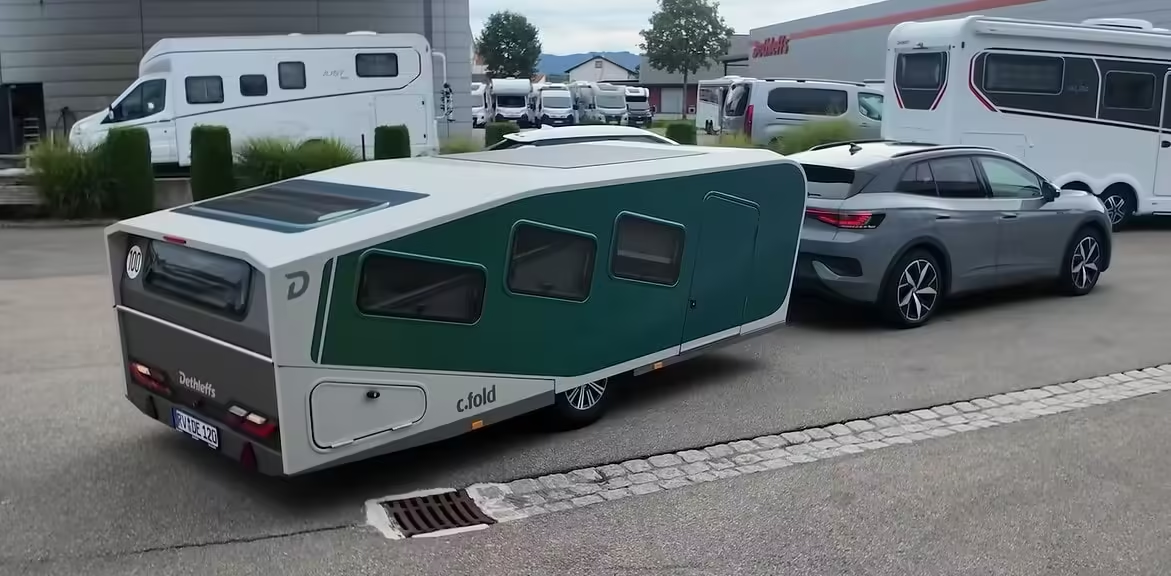

It’s always a shame to see a nice concept not get the chance to get off the ground and move into production as a “real” product, for whatever reason. That feeling of regret also comes with the new c.fold travel trailer, despite the fact that it was never meant to go into production in the first place.
The c.fold travel trailer is a transformable trailer from German specialist Dethleffs, one that was ironically never meant to move past the concept stage. It’s a real product, though, and it’s getting real miles in the real world, pushing the envelope on travel trailer design and introducing innovative features to EV towing.
The c.fold was introduced earlier this year at the 2026 edition of the CMT trade show in Stuttgart, as the latest iteration in a series of concepts that Dethleffs is doing on the future of RV-ing. These are basically RVs, both towables and motorhomes, that the company designs and builds for an imagined future, with features that may or may not trickle down into actual production series models.
It’s a fully functional prototype, designed for real-time use by a pair of experienced RV-ers who want to use it with their new electric vehicle (EV). Perhaps a more accurate description would be that it’s a one-off conceptual vehicle meant as a testbed for innovative features and design.
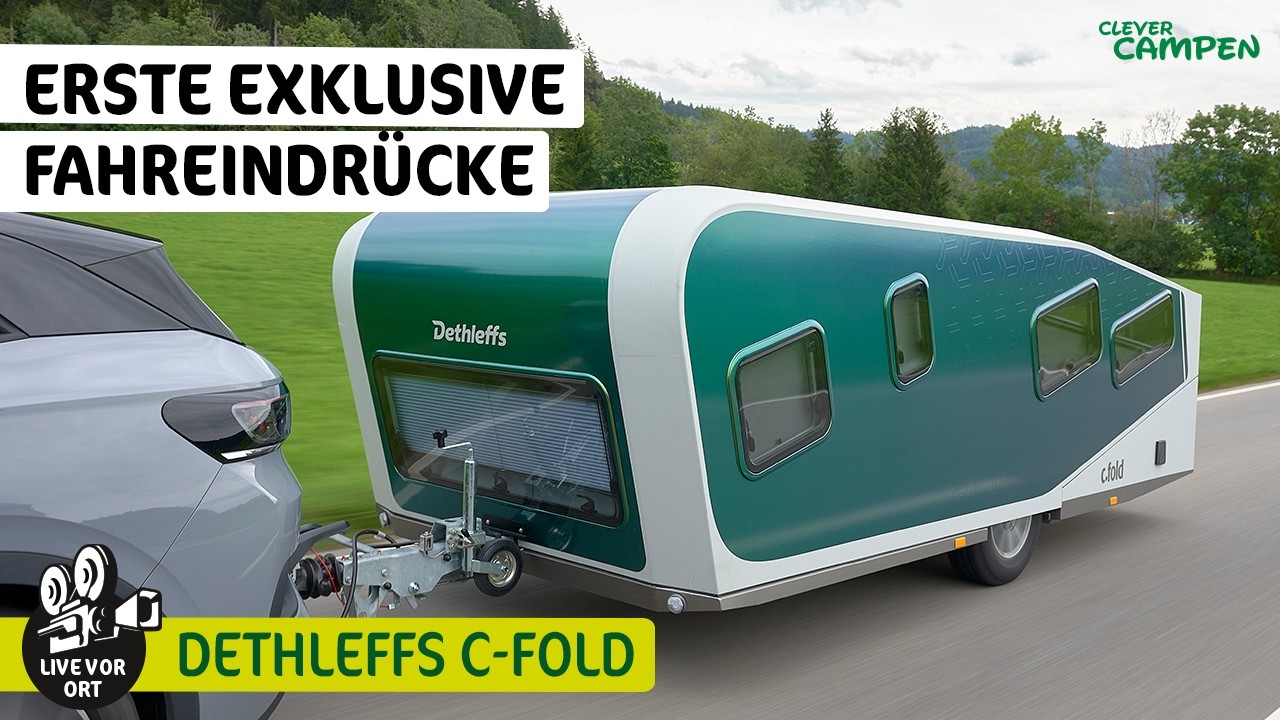
Semantics aside, the c.fold is a neat piece of engineering and RV design – and more details about it have just come to light. That’s because the owners and Dethleffs have agreed to let an established RV publication to take it out for a test drive to confirm its reduced impact on range and enhanced drivability. You can see that test drive in the video tour at the bottom of the page.
First things first, though.
The c.fold was created by Dethleffs for Monika and Peter Marchart, a pair of longtime Dethleffs customers who wanted something built specifically for their new EV.

Photo: Dethleffs
The solution proposed was a transformable caravan, one that would travel compact in road mode but would expand at camp to offer all the basic creatures for the travelers, including light cargo hauling capabilities, some autonomy, and the basic features like a bathroom, a galley kitchen, and a nice bed.
In the process, though, Dethleffs pretty much rewrote every rule in book. They started with construction with honeycomb aluminum panels (Alucore) in two layers, placing between them an insulating layer of recycled PET plastic. On the inside, they added a layer of felt, which also helps with creating a cozier vibe.
Arguably the biggest innovation was the decision to use independent wheel suspension and air suspension, designed specifically for the project by partner Goldschmitt. The c.fold is the only caravan in Europe to feature this kind of suspension, and the recent test drive shows that the difference it makes on the road is incredible.

Photo: Dethleffs
Then, Dethleffs opted against using a trailer chassis on which to mount this structure. Instead, the base is overlapping Alucore panels, which means that the axle is bolted directly onto the floor – onto the almost fully enclosed underbelly, to be more precise.
This, the very low-profile design in road mode, of just 1.65 meters (5.4 feet), and an dry weight of under 1,000 kg (2,204 lbs), ensures an easy towing experience. The exterior design obviously also plays an important part in that: the c.fold has rounded corners and a tapered rear end, which means reduced drag.
Dimensions include a width of 1.9 meters (6.2 feet) and a length of 5.49 meters (18 feet), with a height at camp of 2.18 meters (7.15 feet). That means that, inside a caravan that’s exceptionally lightweight, surprisingly light profile, and so easy to tow, you get full standing height. You also get almost 400 kg(882 lbs) of payload capacitywhich is way more than you get with most European caravans.

Photo: Dethleffs
That said, Dethleffs promised with the c.fold a travel trailer that would not severely impact the range of the electric towing vehicle, and they delivered. Clever Campen, who conducted the test drive on a VW ID.4 GTX test car with a 77kWh battery, reported an impact on range of 22.4 kWh per 100 km/62 miles, as compared to 36 kWh per 100 km with a traditional caravan.
The test drive video doesn’t show the inside, but the second one included below, of the display unit in Stuttgart, will have you covered for that.
The interior of the c.fold is as interesting as the exterior designwith modular furniture of real wood, hinged so that you can even have overhead cabinets that you don’t have to remove when you go back on the road, plenty of space to move around, lots of natural light, and an overall very cozy vibe.

Photo: Dethleffs
One of the many downsides of this type of transformable trailers is that they almost always have an improvised or half-baked quality about them, but the c.fold is able to avoid that.
It also comes with features like 300W of solar on the roof, mounted perfectly flush in the name of the same principles of aerodynamics, a 300Ah lithium battery pack, a 2000W inverter, and a scale feature integrated into the air suspension, so you can always see on the app just how much payload you still have to work with. The folding out mechanism is fully automated, taking under 1 minute to fully set up.

Photo: Dethleffs
The Dethleffs c.fold isn’t meant for mass production, but based on the positive reception of the conceptit’s probably safe to assume at least some of the great things about it will make it into other series production models – in one form or another.

Source: www.autoevolution.com