
Young people today, with their outlandish attitudes, their loud music, their wild dress sense – and their Rover Metro 1.1Ls. Earlier this year, Ben Woodbridge, the 17-year-old son of a friend of mine, decided to take a walk on the mild side, ignore the rants of Alan Partridge and buy a 1992 Metro.
He is not alone. While classic car ownership is mostly the preserve of older men, more and more younger drivers are choosing older models. Some enjoy their mechanical simplicity, while others are fascinated by engineering from a previous era. There is also the pride in maintaining, preserving and enjoying automotive heritage – plus the entertaining reactions of the public on seeing a car a generation (or several) older than its driver.
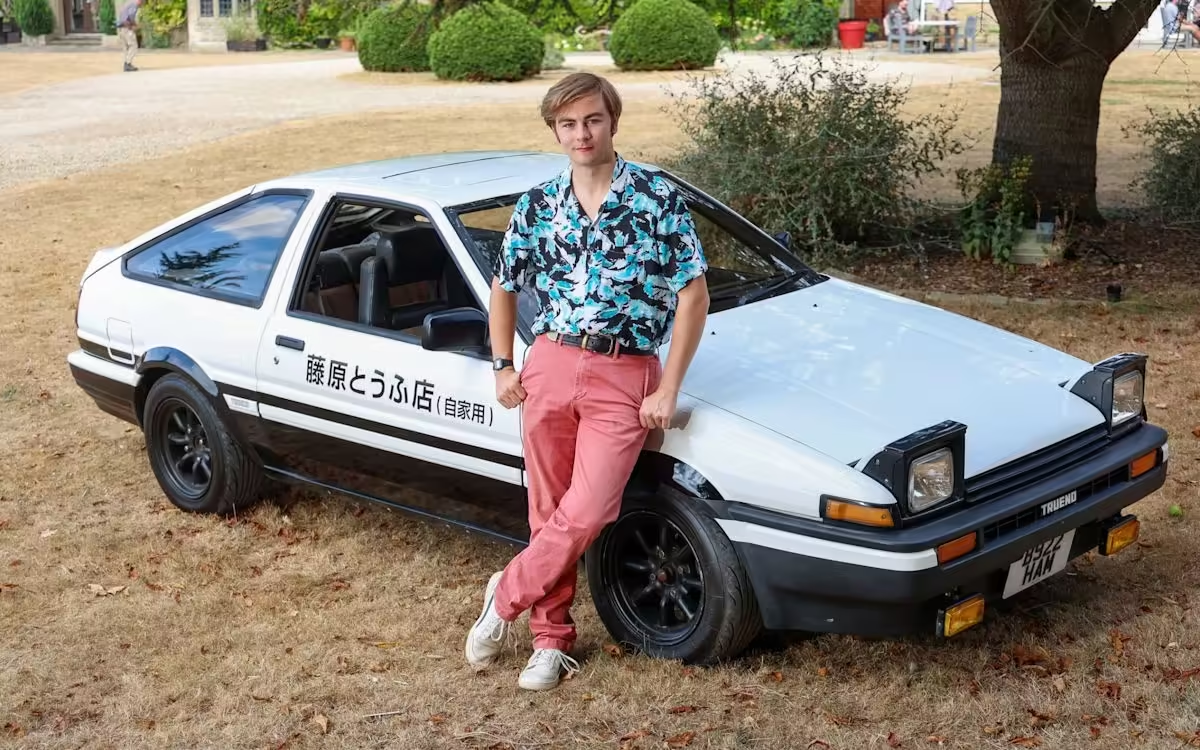
To celebrate this new wave of classic owners, we encountered Woodbridge along with two youthful fellow enthusiasts. Engineering student Andie Holker owns a 1956 Morris Minor Series 2, while 22-year-old Sam Simmons is the custodian of a 1986 Toyota Corolla AE86 Sprinter that he privately imported from Japan in 2023 and returned to the road in 2024.
Ben Woodbridge with his Rover Metro 1.1L – John Lawrence
Woodbridge regards his Metro as a major incentive for passing his driving test recently. “I was initially considering a Mini, but they are ridiculously expensive. The Metro is so enjoyable to drive, with that wonderful engine note.” As he was born in 2008, his Rover dates from a time that is as remote to him as a 1953 Austin A30 would have been to a 17-year-old in 1986. Almost every detail of the Metro fascinates him, from the four-speed gearbox to the choke lever.
Advertisement
Advertisement
However, the Rover Metro looks positively modern compared with the Morris Minor, which is half a century older than its owner and hails from when The Telegraph was complaining about Teddy boys.
Their reasons for buying an old car are as diverse as its owners. Woodbridge was guided by his aunt, Tanya Field, who collects Austin/Rover Maestros and Montegos. Holker’s father and great-grandfather owned Morris Minors – “Mossie” joined the Holker fleet in response to an email from the Morris Minor Owners’ Club’s Manchester branch. Simmons finds his AE86, a cult vehicle in its homeland, most exciting to drive: “It has a front engine, rear-wheel drive, is lightweight and revs up to nearly 8,000rpm. The perfect recipe for a fun car.”

Andie Holker with their Morris Minor Series 2 – John Lawrence
All three believe in frequently using their classic cars. Woodbridge regularly commutes to college by Metro and Simmons drives the AE86 around Swindon, to the amazement of its residents. Holker has taken Mossie on an Morris Minor Owners’ Club Young Members Road Trip around the Giant’s Causeway of Northern Ireland.
The decision on whether to modify a classic car is inevitably subjective, but while most classic car enthusiasts prize originality, these young drivers appear not to have qualms about modifications. Woodbridge has upgraded his Metro with larger aftermarket wheels. Holker has fitted Mossie with Jaguar XJS seats, a custom-built sound system and new wiring as well as a replacement engine and gearbox, along with flashing indicators.
Advertisement
Advertisement
However, the Minor retains the original semaphore trafficators, which pop out from the central pillar between the doors; they were finally replaced by conventional flashing indicators at front and rear in 1961, remaining for the final decade of Minor production.

Semaphore trafficators were fitted from the start of Morris Minor production in 1948 until 1961 – John Lawrence
Not surprisingly, members of the public are often amazed at seeing an older car with a young owner. Holker says: “No one at university believes me when I say that I drive a 1950s car, until they see it.” Woodbridge’s Metro often prompts double-takes (only partly due to its rarity), while Simmons sorts reactions to the AE86 into three categories. Some are confused by the Japanese script on the doors – “you do get some weird looks” – and others “know about its heritage and freak out on seeing an AE86”. A third group thinks it might be a DeLorean.
The trio are merely three of a growing number of young classic owners. Lydia Highfield, 25, has owned her 1984 Porsche for nine years and says the reaction is usually one of “amazement at seeing a 924 in the wild”. Lou Brisdon and Harry Tansley are two enthusiasts who revel in the 1970s/Eighties style of their classic Fords. Brisdon is 23 and owns a Granada Mk2 2.8 Ghia that looks ideal for a trip to the Berni Inn. Tansley bought his 1982 Escort Mk3 1.6 Ghia in 2024, when he was 16. It was a car from a long-lost world of Sinclair ZX Spectrum home computers.

(L-R) Holker, Simmons and Woodbridge with their classic cars – John Lawrence

(L-R) Morris Minor Series 2 (1956), Toyota Corolla AE86 Sprinter (1986) and Rover Metro 1.1L (1992) – John Lawrence
The Rustival event, which celebrates older, everyday cars, and the Classic Motor Show at the NEC in mid-November regularly attract large numbers of younger enthusiasts who marvel at vehicles of previous generations. The classic car insurance specialist Lancaster runs the Bright Young Sparks competition for younger fans of historic vehicles. Yvonne Gosney of Lancaster says: “Many of the car clubs we speak to are keen to extend their membership to younger members.”
Advertisement
Advertisement
As Holker puts it: “Classic cars can bring generations together, as well as teach you skills. My Morris Minor is so simple to maintain, you can learn far more from working on your car than from opening a book. A good few of my friends have actually asked to get involved with working on classic cars.”
Source: autos.yahoo.com