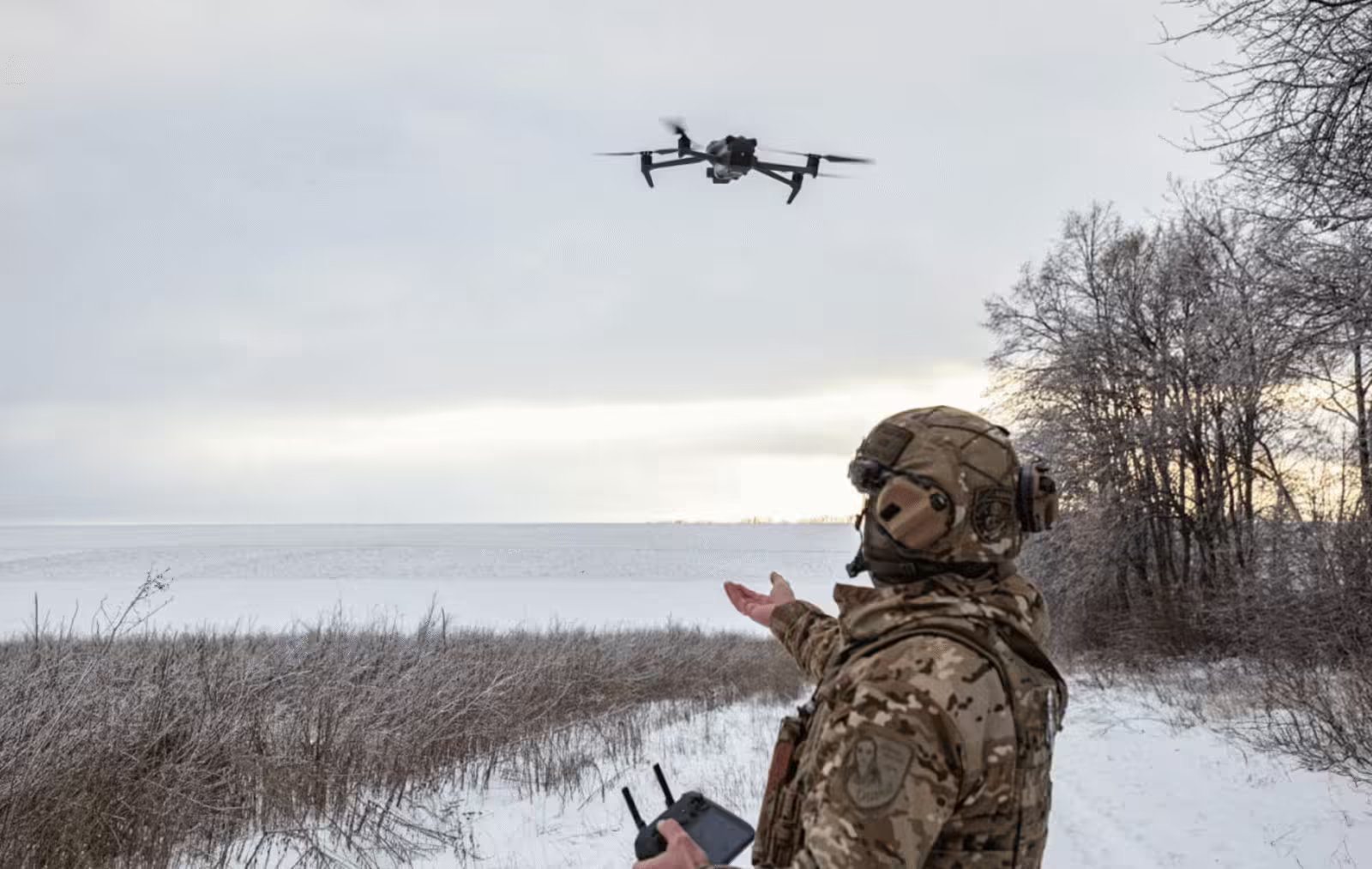

In early August, an explosive-laden drone targeted the Leipzig Hall Airport in Germany. While authorities successfully defused the drone, investigators discovered debris from other drones near the airport. In the following days and weeks, German security officials speculated that Russia’s military intelligence service may have been involved with the planning and logistics of the attempted drone attack.
German authorities had good reason to suspect Russia: The Leipzig airport serves as a significant cargo hub for transporting U.S. and NATO armaments to Ukraine, and the drone had been discovered near Ukrainian cargo planes. The incident highlighted the increasing role of drones in geopolitical conflicts as nations unleash offensive drones against militaries, critical infrastructure, and civilians alike in nations both directly and indirectly involved in a conflict.
This drone attack attempt is not an isolated incident. In May, Iran launched a drone attack against Amazon Web Services’s data centers in the United Arab Emirates, and in August, Russian drones killed at least 37 people during an attack on a warehouse in a residential area near Kyiv. Meanwhile, nations continue to prioritize developing offensive drones: China tested its GJ-21 stealth attack drone and its Type 076 amphibious assault ship, which will serve as the drone’s launch platform.
Security and warfare experts agree that drones are shifting the dynamics and calculus of warfare as they become more cost-effective and multiuse: While one Shahed drone costs between $30,000 and $50,000 to produce, an air defense system’s interceptor can cost 10 times that price. The evolving use of drones in conflict will require interoperability with allied nations and for them to share lessons learned.
Advancements in Drone Technology
Drone technology’s pace of evolution has been blistering. Drone technology currently advances every three to six months. Military technology—including drone and anti-drone capabilities—has a six–week learning cycle on the battlefield. Companies update drone software weekly and its physical hardware every few weeks. This pace is challenging for traditional military equipment procurement processes: Bulk purchases of millions of drones become ineffective when drones purchased today become outdated within a year.
The United States purchased 4,000 small drones in 2024 and 40,000 in 2025but those drones may not have been adapted to recent lessons, such as the ability to avoid GPS jamming, learned from the conflicts in Ukraine and the Middle East. In contrast, Russia launched 57,000 drones against Ukraine through March 2026.
Artificial intelligence (AI)-powered drones and drone systems have also already made an impact. Operation Epic Fury—the February U.S.-Israel joint military action against Iran—leveraged an AI platform, Maven Smart System, that integrates nine major sensory systems, databases, and real-time intelligence from drones, satellites, and other technologies. The military also deployed AI-enabled identifying and targeting in drones, speeding up the military operating tempo or kill chain: an AI bot can collect, synthesize, and assess data flows at machine speed and trigger a weapons release much faster.
Russia’s “swarm” tactic is another form of AI-enabled drone usage. At the beginning of the war in Ukrainesmall-unit drone teams had a commander who approved swarms of drones to engage. Compared to drone attacks with one or two units, drone swarms make a cumulative impact by degrading readiness. Today, software can also coordinate swarming attacks on targets. Defense systems that target each incoming drone will likely run out of interceptors or fail to re-aim quickly between each drone.
Application of AI technology in drones continues to expand. Korean Air is developing drones that leverage “physical AI,” which uses sensors and mechanical devices to perceive and assess its surrounding physical environment to determine flight routes and mission execution methods. China is working on an algorithm that would enable drones to decide on an attack based on incomplete information while maintaining swarm coordination. Japan and India are also collaborating on drones that use a single-silicon system with an AI processor to process up to four cameras at once, enabling 360-degree situational awareness. A clear advantage of such AI-powered military drones is that drones could operate in environments without a connective network.
Required Interoperability
The increasing sophistication, use, and impact of military drones create an imperative for allied nations to collaborate not only to ensure that AI-enabled drone attacks, kill chains, and swarming are executed accurately but also to ensure that allied nations’ drone technology is interoperable and that the intelligence embedded in drones is protected from adversaries.
There are largely three components that require interoperability: drone hardware, drone software, and other military equipment.
First, drone hardware needs to be interoperable. Currently, the U.S. Navy lacks a framework for repairing unmanned surface vehicles and launch platforms, which risks stranding systems logistically. When conflicts are fought abroad and equipment is deployed to neighboring nations, having drone hardware that can be repaired with or by allied nations’ machinery will be critical to sustaining drone systems overseas.
Adhering to common standards can help ensure interconnectivity among allied nations’ drones. One such standard is the Standard Interfaces of the Unmanned Aircraft (UA) Control System for NATO UA Interoperabilitywhich NATO formally ratified in 2002 to outline standards for functional architectural components of drone systems and five levels of interoperability. Nations have also begun pursuing drone interoperability through joint investments, partnerships, and alliances such as the U.S.-South Korea drone alliancewhich agreed to develop a joint supply chain and establish common standards to improve interoperability and lower logistics costs.
Second, as AI-powered platforms coordinate, analyze, and synthesize information from drones, the software needs to be compatible. For example, the Dutch Ministry of Defense is investing in command-and-control software that will connect drone fleets and ground systems from different manufacturers.
Lastly, drones must be compatible with existing military equipment such as vessels, aircraft, and launch platforms. The defense industrial base is developing such compatibility, as in the interoperability demonstration between Boeing’s P-8 Poseidon maritime patrol and reconnaissance aircraft and Northrop Grumman’s MQ-4C Triton naval drone: The P-8A Poseidon was able to send mission instructions to the Triton, which then autonomously planned and executed the mission route.
Opportunities for Improvement
Beyond technical interoperability, allied nations should share lessons learned, just as U.S. adversaries do. North Korea is upgrading its drone capabilities based on experience in the Russia-Ukraine war. And in July, North Korea expanded production of both Shahed drones and similar smaller ones with Russian support. China is also reportedly helping Russia enhance its Shahed-type attack drones by supplying key components, such as turbojet engines, servomotors, and gyroscopes. The United States and others can draw on the recent experiences of Ukraine. They can also share lessons with South Korea, which has already expanded its drone acquisition, invested in its domestic drone industryand trained drone operators in response to North Korea’s threats.
While military drone technology’s evolving sophistication, role, and impact create new challenges for warfare, military procurement processes, and interoperability, the rise in investment to the U.S. drone industry—from less than $10 billion in U.S. venture firm investment in 2020 to between $30 and 50 billion in 2025—creates opportunities to overcome the challenges.
Source: www.lawfaremedia.org