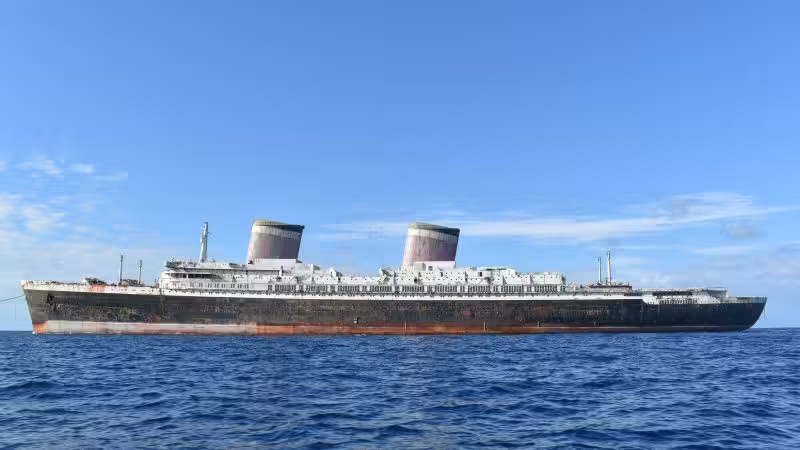

A storied American ocean liner that once set a world record crossing the sea is about to set one beneath it.
This month, a series of explosions will blow holes in the former SS United Statessinking it some 25 miles off the Florida panhandle to become the world’s largest artificial reef.
When it hits the sand some 180 feet below the surface, the massive ocean liner will become the 21st and largest vessel on the Florida Panhandle Shipwreck Trail, spanning the roughly 150-mile coastline from Pensacola to Port St. Joe.
The trail, with shipwrecks dating back to 1942, has become a haven for both marine life and recreational scuba divers since its official establishment in 2012 — an effort to boost tourism after the devastating 2010 Deepwater Horizon oil spill.
The sinking will give new life to a vessel whose once-striking black-and-red exterior paint has been faded by the sun as rust spots pockmark a hull that ferried American luminaries and European royals across the Atlantic Ocean.
Besides plans to use the ship as a dive site, the SS United States Conservancy, a nonprofit that has been taking care of the ship and preserving its history, plans to eventually build a museum in Florida near dive embarkation sites where visitors can see artifacts from the vessel and explore its history. The ship’s two large funnels have been removed and are expected to be part of the museum.
The SS United States was more than a luxury passenger ship. At 990-feet – larger than the Titanic — and with a top speed of 44 mph set during sea trials, it was also considered a military asset, so much so that when construction began in 1950, its more than $70 million cost was divided among the Transportation Department’s Maritime Administration, the US Navy and the commercial United States Lines, according to the Naval Historical Foundation.
The ship was designed so that it could quickly be converted for troop transport, with its normal complement of 1,900 to 2,000 passengers replaced by up to 14,000 troops.
And its maiden voyage in 1952 saw it cross the Atlantic from New York to Europe in just under three days and 11 hours at about 42 mph — a record that stands to this day.

Largely made of aluminum to conserve weight, SS United States was about 10 mph faster than today’s cruise ships, which have more steel construction.
During its heyday in the 1950s and 1960s, it was the most prestigious way to cross the Atlantic. Four sitting, retired or future US presidents sailed on it: Harry Truman, Dwight Eisenhower, John F. Kennedy and Bill Clinton. International and Hollywood royalty — including Marlon Brando, Sean Connery, Marilyn Monroe, Judy Garland, Prince Rainer of Monaco and the Duke and Duchess of Windsor, among others — used its staterooms.
Maritime historian Sal Mercogliano called the ship “the culmination of a centuries-long race to conquer the North Atlantic and bridge Europe and North America.”
But its reign as king of the Atlantic would not last long.
“Its fate was sealed in 1958 with the introduction of the commercial jet liner which replaced the ocean liner as the primary means to cross the Atlantic,” said Mercogliano, a professor at Campbell University in North Carolina.
It was retired in 1969.
“Her sinking will mark the end of the great ocean liners,” Mercogliano said.

In the years after its retirement, the SS United States sat at a few Atlantic ports as a succession of owners decided what to do with it. In 2024, with it facing eviction from the Philadelphia shipyard where it had been tied up for 30 years, owners faced a choice: sell it for scrap or sell it to become an artificial reef.
It was then that Okaloosa County, Florida, stepped in with a $1 million bid to buy it, according to the county’s website.
Last year, after several delaysthe ship was towed the 1,800 miles from Philadelphia to Mobile, Alabama, where it was stripped of any hazardous materials that could harm the marine environment. Most of the ship’s interior was gutted before that trip, according to the conservancy.
Remarkably, the ship’s hull retains 90% of its original integrity, the conservancy’s website said.
“The ship’s hull was designed similar to battleship specifications and was built to stand the test of time, surpassing today’s cruise ships,” it said.
That should serve it well at the bottom of the Gulf, where it is expected to quickly become the center of a thriving ecosystem, marine scientists said.
“Fishes will start congregating around a new artificial reef within hours or days,” said Michael Parsons, professor of marine science at Florida Gulf Coast University in Fort Myers, adding that bacteria and algae will make the SS United States their home almost immediately.
According to the diving trail’s website, previous wrecks have attracted large numbers of fish like snapper, grouper, amberjack, angelfish and barracuda as well as sea urchin and corals.
Artificial reefs offer marine life protection, scientists said.
“In the open ocean, having hiding spots or things to grow on can increase survival, so they can serve as nurseries or population refuges for some species, particularly fish,” said Melissa May, associate professor of marine biology at FGCU.
While the ship is expected to quickly attract marine life, measuring its effectiveness depends on the reason it was deployed, said Chris Stallings, a professor of biological oceanography at the University of South Florida in Tampa.
“Artificial reefs are tools, not inherently good or bad solutions. The question is, what ‘problem’ are we trying to solve with them?” he asked.
Some may be designed to make fishing easier, others to make the overall ecosystem more abundant, he said.
Okaloosa County is touting the SS United States as an environmental and economic boost. If it can bring divers to the region and drive tourism, it will have a benefit outside the ocean, Stallings said.
“Artificial reefs can support recreational fishing, charter fishing businesses, dive charter operations, boat and fuel sales, as well as hotels, lodging, and restaurants for tourists visiting the area to enjoy activities associated with the reefs,” he said.
If it lands on the Gulf floor upright, the keel of the SS United States will sit at a depth of 180 feet, but the ship’s large size means it’s upper deck could be just 55 to 60 feet below the surface, making it accessible to recreational divers with open-water certification, according to the Okaloosa County Tourism Department website.
Once sunk, the SS United States will surpass its predecessors on the trail, including a sunken aircraft carrier, the former USS Oriskany, by nearly 80 feet.
“Get ready to explore a record-breaking ship, now repurposed, reborn and soon to be breaking records in the underwater world,” it says.
Source: www.cnn.com