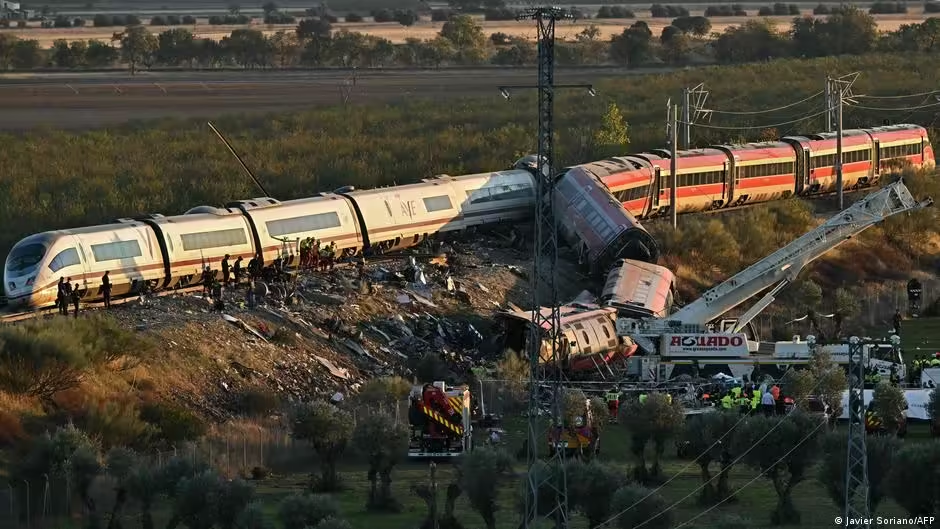

Spain began three days of national mourning on Thursday in remembrance of the 69 people killed in one of Europe’s deadliest train disasters in recent memory.
On Wednesday morning, a high-speed train run by state operator RENFE slammed into the back of a stationary train operated by private Italian-Spanish company Iryo in the central region of Castilla-La Mancha, south of Madrid.
A British tourist who was rescued from the RENFE train told the Associated Press that “suddenly, everything started falling apart.”
“We realized carriage two, carriage one, all gone, all smashed. There was blood all over,” the man said.
Josimar Medina, a 31-year-old Peruvian who was on holiday in Spain with his girlfriend, said he was sleeping on the RENFE train when “I woke up and I was in the air.”
Pablo Mejia, 42, escaped with injuries to his head, telling the AFP news agency that a last-minute change of seat saved his life.
He recounted “a very strong hit … a lot of people on the floor, on top of each other, seats ripped out, suitcases, a lot of chaos,” while wearing a bloodstained jumper and holding a tattered suitcase. “I think I’ve been born again,” he said.
Emergency crews work through the night
Emergency crews continued searching through the wreckage overnight for survivors and bodies, using cranes to move mangled metal.
Relatives of passengers gathered at nearby facilities seeking information about missing loved ones.
Residents of the nearby town of Urda joined emergency workers in helping survivors, providing first aid supplies, water and blankets.
Teams of Red Cross workers offered support.
Red Cross psychologist Carmen Garcia told AFP news agency that many people are in shock and “haven’t taken on board what has happened.”
“The grieving will be complicated,” Garcia said.
Authorities are collecting DNA samples from relatives in MadridToledo, Cordoba and Seville to help identify the missing.
Spain’s rail network safety in question
Wednesday’s crash was Spain’s second high-speed rail disaster this year and has raised fresh questions about rail safety.
Transport Minister Oscar Puente blamed the crash on an “inexplicable” decision to allow one train to continue after an automatic control system failed along a stretch of track.
He said the RENFE high-speed train had travelled about 25 kilometers before hitting the stationary Iryo train.
Audio recordings reveal pre-crash exchanges
On Wednesday evening, Spanish media published audio recordings revealing confused conversations between the train drivers and the railways control center in the 30 minutes before the crash.
In one recording published by the The Country newspaper, among others, a control center operator appears to instruct the driver of the RENFE train to resume his journey at normal speed after some technical issues.
“Continue your journey and then proceed … at normal speed [and] with normal operation,” the operator tells the driver.
“At normal speed?” queries the driver, to which the controller confirms: “Yes.”
A few minutes later, in another recording, the driver of the Iryo train then informs the control center that she is “stationary in front of the entry signal at [the town of] Urda” — about 25 kilometers (15.5 miles) ahead of the RENFE train.
When she is still told to “resume the journey” normally, she says she cannot because of the security system error, reiterating that this is why she is stationary.
The second recording suggests therefore that the control center was aware of the stationary Iryo train having already instructed the RENFE train to travel towards it — but no further action appears to have been taken.
Spanish PM pledges full investigation
Prime Minister Pedro Sanchezwho visited the crash site, pledged a full investigation and measures to strengthen rail safety.
“It is clear that we need to reinforce the safety of our train service to rebuild the trust in our high-speed rail,” Sanchez said. “It is not acceptable for a country like Spain to endure two high-speed train accidents in the same year.”
In January, 46 people died when a high-speed train derailed and collided with another in the southern Andalusia region.
The latest disaster comes just weeks before Spain’s November 29 general election which Prime Minister Sanchez had called hoping to leverage a wave of discontent over housing costs and high rents — and distract from right-wing attacks on his liberal migration policies and accusations of corruption against his party and his wife, which they both deny.
About an hour before Wednesday’s crash spread, Sanchez had posted a campaign message on social media reading: “There are lots of reasons to be optimistic about this country.”
Within 24 hours, Transport Minister Puente was facing calls to resign while Sanchez’s main rival, conservative Popular Party leader Alberto Nunez Feijoo, demanded a full investigation of the crash and canceled campaign events for the day.
“This is the moment to respect the dead, the injured and their families,” Nunez Feijoo said. “But that does not mean we will ignore the fact that Spaniards are asking tough questions that demand answers.”
There was noticeably less restraint on show from Santiago Abascal, the leader of the far-right Vox party, who will be hoping to enter a coalition government with the conservatives.
“More dead. Another tragedy. More rage over being left to fend for ourselves, the despair and the betrayal that Spaniards are enduring,” he said, refusing to join Nunez Feijoo’s campaign pause.
“I promise to work tirelessly until this government, which is a criminal organization, is sitting in a courtroom to answer for its crimes,” he said.
Edited by: Wesley Rahn
Don’t let the algorithm hide the news. If you rely on our team for trusted reporting, please take a moment to select us as your Preferred Source on Google by clicking here and hitting the “star” or “preferred” button, so you’ll always see our verified news first.
Source: www.dw.com