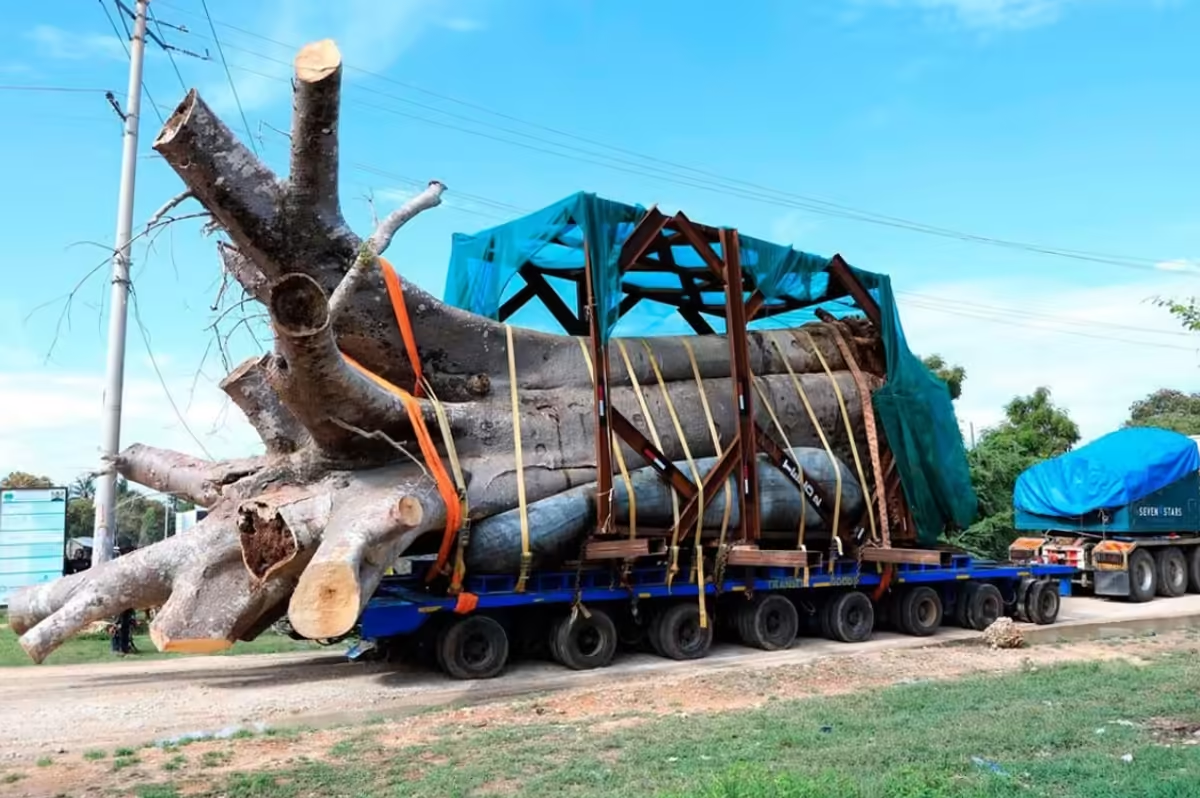

South African authorities have told OC Media that they have refused an appeal to send five Baobab trees to Georgia, submitted after the Department for Forestry, Fisheries and the Environment (DFFE) halted the planned export in July on the grounds that the exporter may have felled and transported the trees illegally.
The uprooted plants, which can live for 2,000 years and are indigenous to Africa, lie on hot tarmac outside a warehouse in Durban, South Africa, while authorities investigate possible wrongdoing in connection with their planned export to Georgia. The unidentified exporter submitted the appeal on 8 August.
The department previously told OC Media that the exporter, if found guilty, will have committed ‘a first category offence and may upon conviction be sentenced to a fine or imprisonment for a period of up to three years, or to both a fine and such imprisonment’.
The harvesting of the trees, which are indigenous to Africa and whose fruit is integral to the economy of many rural areas, has caused local outrage.
In October, local outlet Daily Maverick photographed the five trees, which have spent almost three months, according to their reporting, outside a warehouse in the port city of Durban.
Christopher Dalzell, a former botanical garden curator and expert in tree transport, has offered authorities pro bono help in replanting, claiming to the Daily Maverick that they need to be moved from the warehouse asphalt soon in order to guarantee survival.
‘They have to go somewhere else very quickly. They will die unless they get to a botanical garden or specialist nursery’.
However, Dr Sarah Venter from the Baobab Foundation told OC Media that as succulents the trees were technically ‘really easy to uproot and replant somewhere else’, estimating that the trees were between 200-300 years old from photos. Yet, she also highlighted that Georgia ‘has not had a good track record keeping these trees alive,’ adding that ‘the best solution for these trees is to be replanted in South Africa, rather than being exported to Georgia’.
In one high profile case, all eight baobab trees imported in 2023 from Kenya to the Shekvetili Dendrological Park — founded by billionaire, ruling Georgian Dream party founder, former Prime Minister, and tree enthusiast Bidzina Ivanishvili — died the following year. After the plants perished, the park blamed the opposition political party United National Movement (UNM).
Other baobabs have survived in Georgia and there is still interest from some landscapers in exporting more, despite some of the trees’ native countries — such as Kenya — tightening restrictions. Formula TV reported in September that a private residence linked to Ivanishvili had a ‘special landscaping project,’ which planned to include a baobab tree. OC Media has attempted to contact several representatives for Ivanishvili. The DFFE has not named the exporter or suggested that the trees are linked to this project.
The trees in Durban ‘were harvested in the Lephalale Local Municipality, Waterberg District, Limpopo province, and were scheduled for export to Georgia, Europe,’ according to the DFFE.
Kenya blocks export of baobab trees to Georgia citing ‘irregularities’
Kenyan authorities have moved to block the ‘uprooting and transportation’ of eight baobab trees to Georgia, after the government said that a license to uproot them was issued ‘irregularly’. In a statement on Monday, Kenya’s Minister of Environment and Forestry, Roselinda Soipan Tuya, said she had revoked a license to transport the trees that had already been uprooted, while a license to uproot the trees had also been revoked. Documents from the Kenyan Forestry Service seen by OC Media sugges
Authorities told OC Media that the exporter applied for a license to remove and export the trees, but the application was declined as at that point the case was already ‘under criminal investigation and the Department will not issue a licence retrospectively to regularise allegedly illegal criminal activities’.
The warehouse’s owner Africa Global Logistics (AGL) previously told OC Media that ‘when concerns about the regulatory documentation’ came to their attention, they ‘stopped the proposed shipment’.
AGL said that they were ‘not the owner, exporter, or permit holder for the trees, and was not involved in uplifting them or moving them from Limpopo. Responsibility for obtaining and maintaining the required licences, permits, and regulatory approvals rested with the owner’.
The warehouse owner told OC Media that ‘AGL has cooperated with the relevant authorities and will continue to do so. No criminal charges have been brought against AGL in connection with this matter. As the matter remains subject to ongoing processes, AGL will not comment on the conduct or legal position of any other party’.
Additional reporting by Nino Shurghaia.
Source: oc-media.org