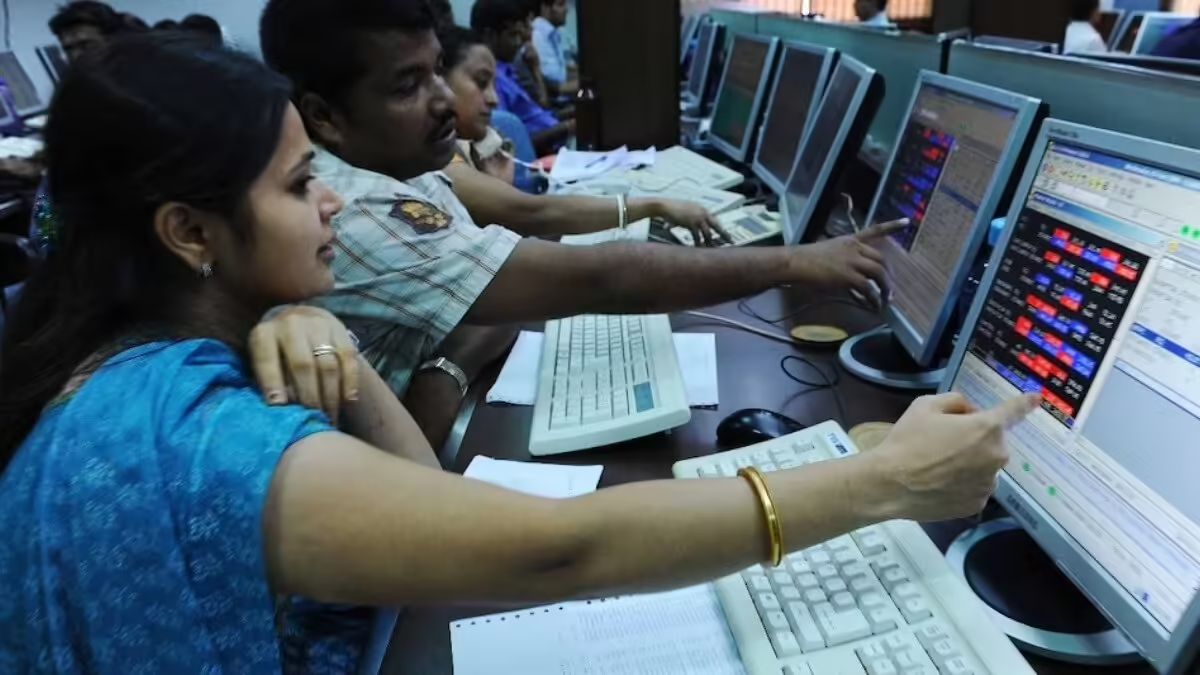

On Friday, there was a break in the decline that had been going on for three trading sessions in the Indian stock market, but in no time it came to a halt. The market started trading with gains on the basis of buying in IT shares. BSE’s Sensex opened 416.25 points higher at 73,665.64 in early trade, while NSE’s Nifty 50 rose 54.55 points to 22,742.20. Bank Nifty also opened with a rise of 40.05 points at 54,965.75. There was a jump of more than 300 points in Nifty IT stocks. TCS shares rose by 2.63%, Infosys stocks rose by 1.53%, Wipro stocks rose by 0.85%, HCL Tech shares rose by 1.22%.
However, as the hours of the trading session increased, the market movement appeared to be slowing down. The impact of weakness in international stock markets and high prices of crude oil was seen on the market. Sensex and nifty The lead gradually weakened. Nifty reached the red zone shortly after opening in green. There was a decline of more than 100 points. Sensex also fell by more than 150 points and reached the red zone. Bank Nifty remained in the red zone throughout the session. There was a decline of more than 500 points.
Brent crude near $114 per barrel
Brent crude is trading around $114 per barrel. India imports a large part of its needs, so oil becoming expensive can increase pressure on inflation, companies’ costs and the country’s trade deficit. The Indian rupee also started with slight strength in the currency market. The rupee opened 3 paise stronger at 94.79 per dollar on Friday compared to Thursday’s closing level of 94.82 per dollar. On the other hand, a decline was seen in Asian markets. American stock markets also closed mostly with losses on Thursday.
Investors’ concerns over companies’ increasing spending on Artificial Intelligence (AI) and high crude oil prices put pressure on market sentiment. Now investors in the domestic market will also keep an eye on the results of companies for the September quarter. These results will indicate how companies’ earnings have been amid expensive energy, weak global environment and economic uncertainty.
The market will get support next week
There are also some positive signs for the stock market. The sharp fall in the yield of 10-year American bonds and the strengthening of the rupee will contribute significantly to this. These factors may help reduce selling by foreign institutional investors (FIIs), which is expected to support the stock market.
Bids worth about ₹ 3.73 lakh crore have been received in the IPO of Jio Platforms in the last two days. After the completion of the process of allotment of shares, there is a possibility of more than ₹ 3 lakh crore of this amount coming back into the market. This may increase the availability of cash in the market next week and may provide support to the shares.
There will be strength in the shares of big companies
If there is a rise in the stock market on Monday, then it can be led by the shares of big companies. Large-cap stocks are showing relative strength and there can be investment opportunities in shares of good growth companies at reasonable prices.
On the contrary, pressure may continue in mid-cap and especially small-cap stocks. The earlier rise in valuations of these stocks was, in many cases, driven by additional cash inflows available in the market rather than by the strong business performance of the companies. In such a situation, it may be difficult to justify the current prices of some shares on the basis of their business performance.
What is the signal for investors?
At present there are two types of signals in front of the market. On one hand, the market may get support from buying in IT shares, slight strengthening of rupee and possible cash flow next week. On the other hand, crude oil price of around $114 per barrel, weakness in global markets and uncertainty regarding the quarterly results of companies are increasing the risks. In such an environment, it would not be right for investors to take decisions only after seeing the initial rise in the market. Along with finding investment opportunities in big and strong companies, it is important to also pay attention to the company’s earnings, valuation and risks. There is a need to be careful especially while investing in small-cap shares.
—- End —-
Source: www.aajtak.in