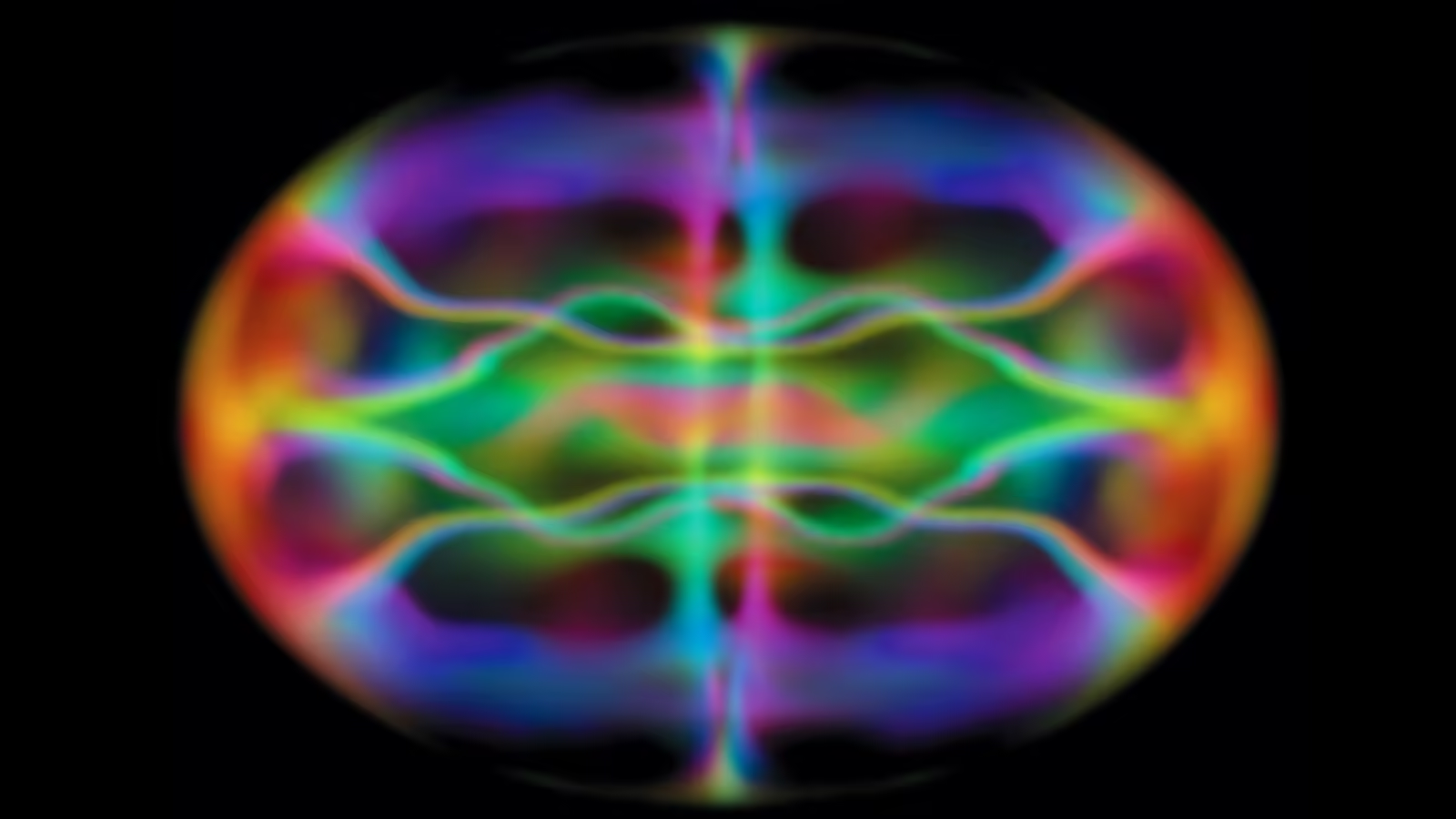

Even the seemingly empty vacuum of space isn’t completely cold.
The Universe was born some 13.8 billion years ago in a state so hot and dense that the leftover radiation still permeates every one of its nooks and crannies.
The average background temperature of space hovers around 2.7 kelvins – that’s -270.45 degrees Celsius, or -454.81 Fahrenheit.
Now, scientists have made something with an equivalent temperature 280 billion times lower – shattering the previous record in humanity’s quest to get as close as possible to absolute zero.
Aboard China’s Tiangong space station in Earth orbit, physicists have achieved a record equivalent temperature of just 9.7 picokelvins – or 0.0000000000097 kelvins – “which is, to our knowledge, the lowest equivalent temperature ever measured,” the researchers write in a paper published in Science.
Absolute zero – or zero kelvins – is the theoretical lower limit temperature can reach in the Universe. At that point, thermal energy physically cannot plunge any lower. It’s like the speed of light – a fundamental limit that the laws of physics simply cannot cross.
Unlike the speed of light, however, absolute zero is impossible to reach. The closer scientists get, the harder it becomes to remove the remaining thermal energy, until reaching the limit would require a cooling process that could never be completed.
But that hasn’t stopped physicists from trying – and the closer they get, the weirder matter begins to behave.
One of the best examples is the Bose-Einstein condensate, an exotic state of matter that forms when certain atoms are cooled to temperatures just fractions of a degree above absolute zero.
At these extremes, the atoms begin to behave collectively, their individual quantum states merging into a single, coherent whole. They stop acting as a collection of separate particles and instead function almost like one enormous quantum object.
Because quantum effects are usually most apparent on the atomic scale, Bose-Einstein condensates allow scientists to study quantum behavior on a much larger scale, rather than trying to observe it in individual atoms.
They can also be used to make extraordinarily sensitive measurements of the physical world, potentially helping scientists probe some of the fundamental laws governing the Universe.
But making Bose-Einstein condensates isn’t easy, and here on Earth, the process comes up against an inescapable limit – gravity, which makes it increasingly difficult to cool atoms to such extremes.
So the researchers took their experiment somewhere gravity would pose much less of a problem: space.
They are not the first. NASA created the first Bose-Einstein condensate in orbit aboard the International Space Station in 2018, cooling a cloud of rubidium atoms to 100 nanokelvins.
Since then, others have pushed that envelope even further, with the previous record of 38 picokelvins achieved during a free-fall experiment in Germany’s Bremen Drop Tower, described in a 2021 paper.
The new experiment, led by physicists Xiaoji Zhou and Xuzong Chen of Peking University, and Weibiao Chen of the Chinese Academy of Sciences, took advantage of the prolonged microgravity environment to push the limits of cooling even further.
As many others have before them, the researchers began with a cloud of rubidium-87 atoms – an isotope of the element particularly well suited to laser cooling and the creation of Bose-Einstein condensates.
They used lasers to cool the atoms, confined in an optical trap in an apparatus called the Cold Atom Physics Rack.
Then, they applied a technique called evaporative cooling, in which the most energetic atoms are allowed to escape, leaving the remaining atoms with less energy. It’s like your coffee growing cold as its most energetic molecules escape as vapor.
Here, though, gravity once again decided to be a problem. On Earth, gravity can help this process by pulling the escaping atoms away from the trap. In orbit, where everything is in continuous free fall, that assistance is missing.
So, having gone to space to rid themselves of gravity, the researchers had to find a way to recreate gravity.
They did this by applying a magnetic field gradient that mimicked gravity’s effect on the atoms, allowing the most energetic ones to escape more efficiently.
At this point, the experiment contained a Bose-Einstein condensate of around 20,000 rubidium atoms, cooled to a temperature of just 3.1 nanokelvins.
But the researchers weren’t done.
They transferred the condensate into a second, wider trap made of laser light, then gradually weakened the trap, allowing the cloud of atoms to spread out and reducing the energy it would release as it expanded.
Finally, they switched off the trap altogether and watched the cloud disperse.
It expanded so slowly that the researchers could still detect the atoms seven seconds after their release.
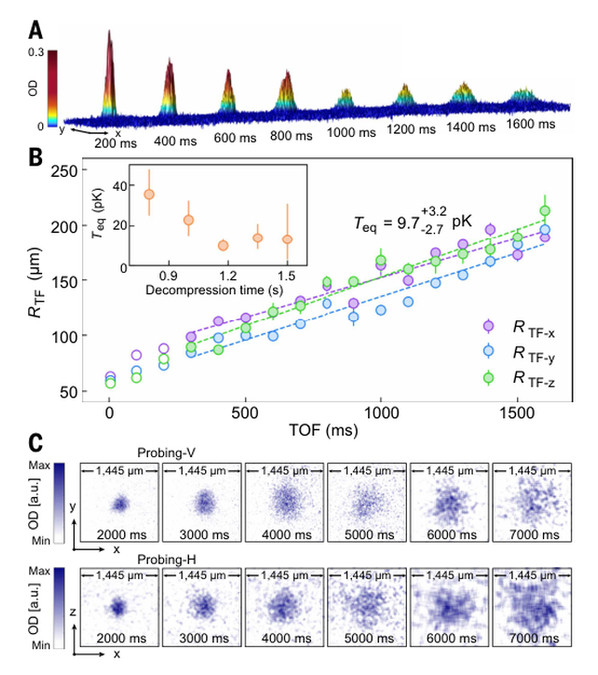
By measuring how quickly the cloud spread, the team calculated its equivalent temperature: a record-breaking 9.7 picokelvins.
This isn’t quite the same as the conventional temperature. Equivalent temperature instead describes the energy associated with the cloud’s expansion. It’s seeing how slowly the atoms are moving, using that motion to determine how much energy they have, and expressing that energy in kelvins.
And for scientists hoping to use these clouds of atoms to make extraordinarily precise measurements, that distinction is important. The more slowly the atoms disperse, the longer they can be observed and manipulated – and the more sensitive those measurements can become.
The point isn’t just about setting temperature records. The result has some really cool implications for future research, too.
One particularly promising application is atom interferometry, which exploits the wave-like properties of atoms to measure extraordinarily small changes in their environment.
With more time to observe the atoms, scientists could build more sensitive instruments for testing fundamental physics, including the equivalence principle – the idea that gravity affects all objects equally, regardless of their mass or composition.
The ability to produce such ultracold quantum gases in space could also allow researchers to explore exotic states of matter that are difficult to study in laboratories on Earth.
“This all-optical ultracold platform … meets the exacting requirements for quantum simulation and precision metrology in future space missions, thus positioning it to advance two primary scientific frontiers,” the researchers write.
The research has been published in Science.
This article was fact-checked by Fiona MacDonald and edited by Fiona MacDonald. While we pride ourselves on our process, we are only human. If you spot a mistake, please let us know.
Source: www.sciencealert.com