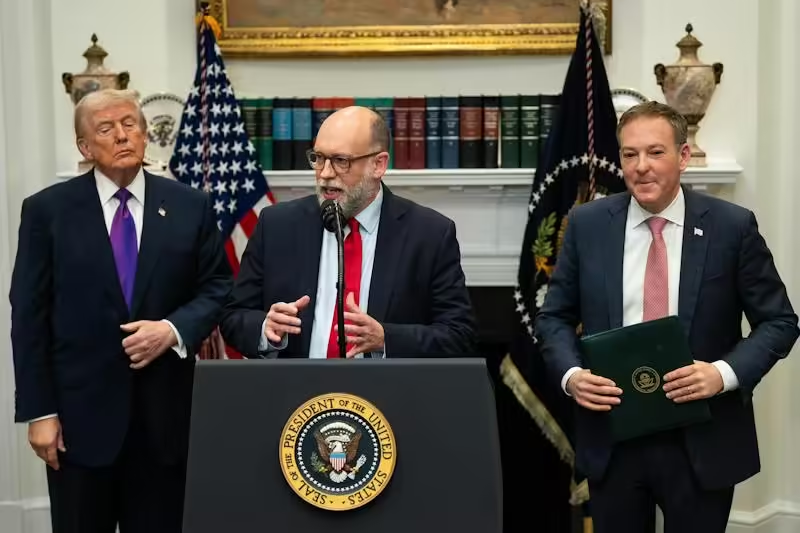

The White House’s Office of Management and Budget has proposed sweeping changes to guidance for federal research funding, eliminating what the rule describes as “woke” and “anti-American” research. The changes are set to go into effect on Dec. 11.
The proposed rule comes as part of an effort to align with directives from President Donald Trump which outline a “commitment to transparency, accountability, and proper oversight for the Federal grantmaking process.”
The rule mandates that studies aim to fulfill a “gold standard for science,” a term the White House introduced in an Executive Order permitting increased government supervision over research processes. The rule will limit grant money from supporting awards that sponsor conference attendance or studies relating to “unlawful” diversity, equity and inclusion.
However, these rule changes may put United States’ research “at a global competitive disadvantage,” according to Cornell University’s official response to the revisions. Instead, Cornell President Michael Kotlikoff wrote, the rules will lower “the return on federal research investments.”
While the changes were initially set to go into effect on Oct. 1, Congress overwhelmingly voted to extend all financial appropriations through Dec. 11 — postponing the application of the new rule.
The action follows moves by the Trump administration to regulate grant funding through executive orders, lawsuits and an attempt to establish a board of political appointees to review all grant applications.
Last year, the federal government froze over $1 billion in funding for Cornell and issued 120 stop-work orders to the University. The University did not respond to whether they knew that rule changes would follow the settlement struck with the Trump administration to end the freeze.
As a private research universityCornell relies heavily on federal and state grants to fund research efforts. Cornell received a combined $450 million in research grants from the National Institutes of Health in 2026, with over $350 million delegated to Weill Cornell Medicine. Weill is the 26th largest receiver of NIH funds in the nation.
The rule changes “could have a chilling effect on investments in institutions,” Prof. Dan Lamb, public policy, told The Sun. He added that if states “feel like the federal money is not there,” state governments will invest less in university infrastructure.
It is likely that the rule, if put into effect, “would immediately be challenged by attorney generals from New York, California, Colorado,” Lamb said, who believes that such a challenge would likely end in an injunction on the basis that the changes are unconstitutional.
An injunction would require the Office of Management and Budget to stop implementing the new provisions, but “that doesn’t stop this administration from trying things,” Lamb said.
The Supreme Court ruled in August 2025 that the “NIH [may] filter their grant making process through” the lens of OMB rules, referring to the decision that Trump’s Executive Order may block almost $800 million in NIH grants for DEI and health equity initiatives.
Trump’s fiscal priorities can be seen in his proposed 2027 budgetwhich outlines “cuts to woke programs,” “ending the green new scam” and “stopping the invasion of violent crime.” It also touts a $73 billion, or 10%, decrease to all non-defense spending.
One source of this decrease is a $5 billion cut to the NIH, the largest public funder of biomedical research in the world — down from a proposed $20 billion cut last year. After a record-breaking 76 day partial government shutdown, Congress passed a budget similar to prior years for 2026, despite the President’s proposal.
Some labs are already changing their behavior to maintain access to federal funding.
Samie Jaffery, leader of the Center for Excellence in Genomic Studies at Weill Cornell, said that this year he was advised by the NIH to “remove any statements that referred to individuals who had been underrepresented” from his mission statement and grant proposals.
The center was awarded a 5-year $12.2 million grant by the NIH in 2021 for its research in mRNA manipulation, the largest grant given to Weill Medical School in 2026, according to the NIH’s database. Jaffery said the rule changes will limit who he can recruit and that admission is now based on grade point average and an essay.
In prior years, he has prioritized recruiting undergraduates from underrepresented backgrounds, finding that expanding access to working in labs can have a “pretty big impact on the type of people who are involved in science.”
But in response to NIH recommendations, Jaffrey led the center to “just follow the guidelines,” he told The Sun.
Almost 500,000 public comments were submitted to the Office of Management and Budget’s proposed rule changes in May, most of which are in opposition. These were to be considered as part of the agency’s process in enacting the new rule, according to the official process.
However, there is no mechanism to ensure this happens, Lamb said, stating that “it’s kind of a trust thing.” Lamb added that “if you know that there’s 95% opposition to a rule,” and the government is still moving forward with it, “there’s something wrong with the process.”
Among public comments, Cornell faculty raised concerns about the proposed regulations, citing tighter restrictions on research funding and increased government oversight in the distribution of money.
Cornell is “concerned” that the office’s proposed changes will have the “opposite of their intended effects,” Kotlikoff wrote. He cited worries about increased administrative complexity, research instability and a decreased value of American research.
Kotlikoff proposed nine “principle recommendations” to the rule changes. One recommendation called for scientific experts to have peer-review power over political appointees. Another recommendation necessitated clearer national policy requirements, noting that terms such as “Gold Standard Science,” cannot be applied uniformly.
“Cornell [has] been able to make so many discoveries that have advanced the health and well-being of Americans,” Gary Koretzky, vice provost for research wrote to The Sun, adding that he felt “gratified” by the outpouring of support for “preserving the integrity of the grant-making process” communicated through public comments.
The National Education Associationthe largest labor union in the country, has also come out against the changes, stating that the broad and undefined regulations “conflict with congressional directives, constitutional protections, and judicial interpretations of federal law,” adding that the changes “would grant the Executive Branch unprecedented discretion to advance changing partisan policy objectives through the federal grants system.”
They write that the “broad prohibitions” on topics the Trump administration disagrees with such as diversity, immigration and gender identity “create a chilling effect and improperly intrude on academic speech and content.”
The Association of American Universitiesa network of 71 research universities, of which Cornell is a founding memberchose to comment due to the proposal’s potential to “reshape” the distribution of federal funds, they wrote in their public comment. They reiterated concerns that the rule conflicts with federal and congressional regulation, adding that the decision to implement these rules on such a short timeline “threaten the nation’s capacity for discovery, economic competitiveness, and national security.”
“To rebuild our research infrastructure could take years, if not decades,” Lamb said. “[If] you drain our research ecosystem, it’ll take years to come back, and I think there is a bipartisan understanding of that.”
Dalton Mullins is a member of the Class of 2027 in the College of Agriculture and Life Sciences. He is a senior writer for the news department and can be reached at [email protected].

Lila Davis is a member of the Class of 2029 in the College of Agriculture and Life Sciences. She is a staff writer for the news department and can be reached at [email protected].
Read More
Source: www.cornellsun.com