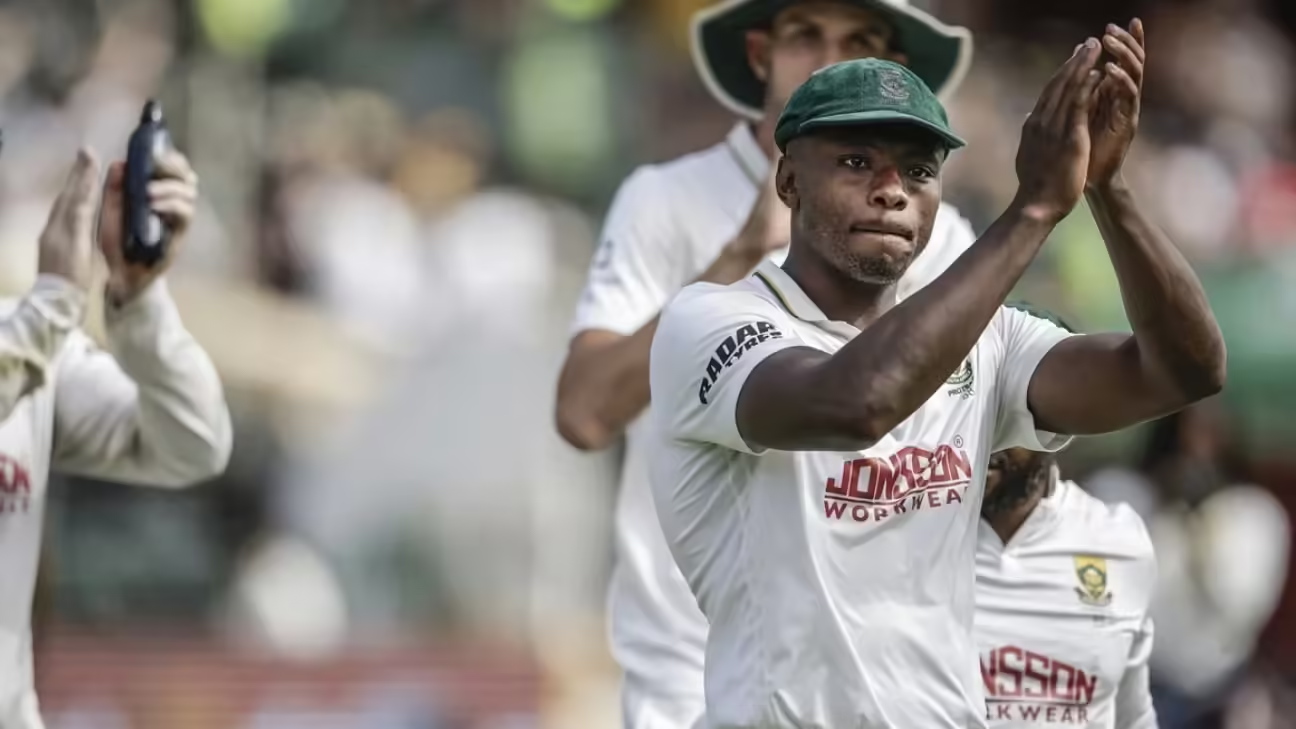

He’s fierce. He’s fast. He’s built a legacy to last.
To be sung in the tune of the Cockney pub song “Knees Up Mother Brown”
Faced with the difficult but doable task of chasing 288, Australia were dumped in the cauldron straightaway, when Matt Renshaw followed Rabada down leg and tickled an edge to Ryan Rickleton’s right. He reacted quickly and took a good diving catch to get the ball rolling for South Africa.
Rabada was pumped and immediately started going fuller and searching for late nip. His first attempt turned into a full toss, and Marnus Labuschagne got a leading edge that went past gully for four to give him his first runs of the Test. That was all he got. Rabada ended a searing opening over with a delivery that jagged back from a full length as Labuschagne left and was struck on the back pad. As South Africa’s cordon appealed and Richard Kettleborough thought about it, Rabada was already asking for a review. By the time Kettleborough’s finger went up, Labuschagne had made the T sign too, but it seemed optimistic. In the end, replays showed the ball was just clipping the top of offstump but it was enough, and it also underlined how exceptional Rabada’s skill set is.
In one over, he got more movement off the seam than Australia’s big three did for most of yesterday but perhaps it wasn’t all his own doing. Pre-play, Vernon Philander, who was instrumental in bowling Australia out for 47 on this ground at a similar time of year 15 years ago, assisted in picking the match ball. He told Cricinfo that he looked for a ball with a “prominent seam,” and that it was always “easy” for him to choose on that basis. Whether Australia apply the same meticulous methods to their choices is not known but what was obvious is that none of their bowlers was able to get as much out of the ball as Rabada did.
And his best was still to come. Teams often speak of cutting off the head of the snake when asked how they hope to get on top of an opposition. Against Australia, it applies more literally. To clench their fists around this series, South Africa needed to remove Travis Head and they did in statement style when Rabada pitched it full on fifth stump and found late movement away. Head had a nibble, got a thick edge and Marco Jansen mopped it up at gully. That Jansen semi-taunted Head by pulling out the same celebration Head performed when Australia dismissed Temba Bavuma late on the third day – let’s call it the puppet-on-a-string imitation – tells you how important that wicket was for South Africa.
But someone still had to bowl South Africa to the win.
He’s wily. He’s smart. He’s made spin bowling an art.
He’s Simon Harmer. Simon Harmer.
Same tune
It was the perfect double act. On a pitch that did eventually deteriorate enough to assist spin, Harmer was right at home. He bowled into the rough from the Wynberg End and found substantial turn and South Africa had the luxury of plenty of runs for him to play with. Harmer created a chance with his seventh ball. Cameron Green charged him to hit the ball on the full and sent it straight back to him, Harmer went for the catch one-handed, but it didn’t stick.
He got another in the same over, when Cooper Connolly could not resist a drive but then Australia settled into a rhythm. They turned down runs as Cameron Green faced the quicks to “protect” Pat Cummins, as the Australian captain said. In turn, Cummins fronted up against Harmer, who Green had had problems against. After 10 overs, South Africa had enough. Temba Bavuma used Gerald Coetzee to turn Harmer around and it worked immediately. Green jumped out to his first ball from the Kelvin Grove End, which spun through the gate and bowled him. Harmer bowled another over and was switched around again, to finish off.
Then, he had almost free rein. He beat the bat over and over again, and when Cummins played for turn that wasn’t there he had him out lbw to get five before ending the match with a ball that dipped, drew Josh Hazlewood forward and spun away to hit the top of offstump. “In true champion spirit, the opportunity was there and he made the play for the team,” Bavuma said.
It also made the point that one of the hardest selection calls South Africa have had to make paid off. After South Africa misread conditions in Durban and played two spinners, they’ve preferred Harmer over their premier spinner since readmission, Keshav Maharaj. Pre-match Bavuma called it one of the toughest things he had to do, especially as Harmer was himself “disappointed” with the way he went about things at St George’s Park. Though he scored crucial runs, and took good catches, he was wicketless in the first innings and took two in the second. To return with to take ten, made a statement about his ability and more importantly, his character, which plays a huge role in who South Africa include in their space.
Their pace spearhead and spin sensation won the game but South Africa are far more than the sum of their parts. Their horses-for-courses approach could be what Bavuma referred to as the “crazy formula” Shukri Conrad uses when he makes big calls. “Whatever decision we make, we back it with 100% conviction.”
That showed in the way Rabada and Harmer bowled but it showed even more in the way South Africa celebrated each of their wickets, and the one they didn’t take. Marques Ackerman’s run-out of Josh Inglis was greeted with most gusto, proving that the South African way remains a collective way. In these parts, the philosophy that I am because we are, known as Ubuntu, defines who people are. This South African team, in this series, are winners because Rabada and Harmer were heroes on day five, and all the rest wore the same capes in the days before.
Firdose Moonda is Cricinfo’s senior correspondent for Africa and women’s cricket
Source: www.cricinfo.com