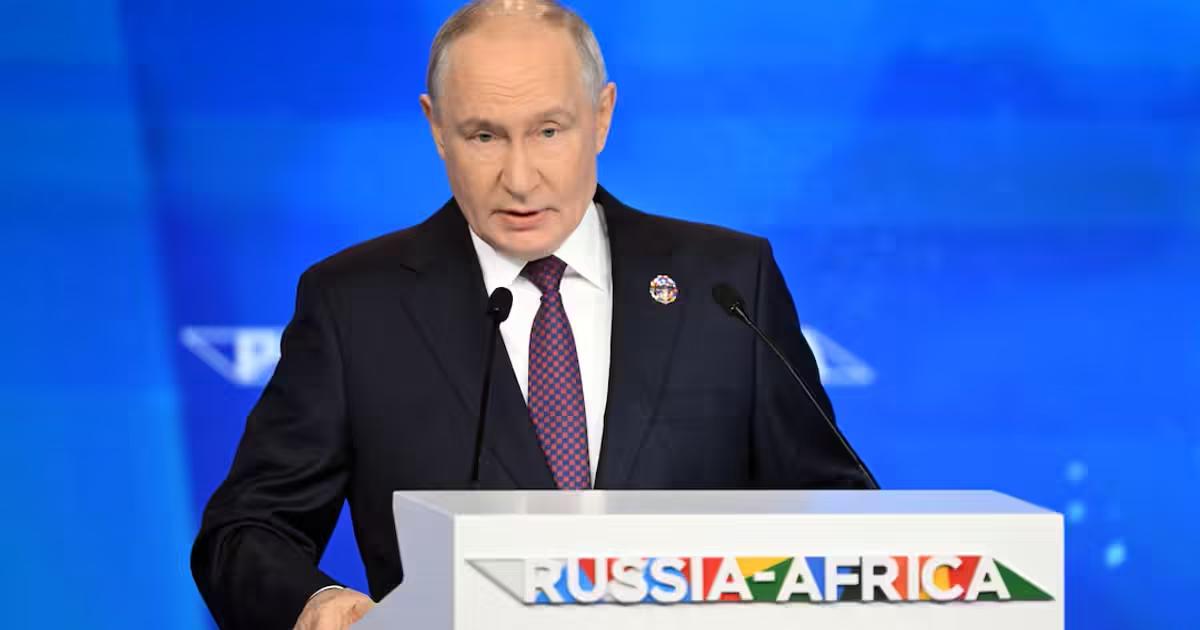

Putin made the pitch on Wednesday at the third Russia-Africa Summit in Moscow. The two-day gathering attracted government delegations from 48 African countries, including 22 heads of state.
The Russian leader presented Moscow as a more equitable alternative to the United States and European powers competing for access to Africa’s markets, political support and natural resources.
He accused Western countries of pushing African nations into debt and offering financing on terms that restricted their long-term development.
Putin did not identify the countries or financing arrangements to which he was referring.
“Our business does not engage in the predatory, neo-colonial exploitation of natural and human resources,” Putin said, according to Reuters.
He said Russian companies would instead support the processing of African raw materials within the continent, creating employment and generating tax revenue for host governments.
Putin also promised to share Russian expertise, including digital technology, and support joint transport and agricultural infrastructure projects.
Russia expands its grain and investment pitch to Africa
Agriculture is one of the strongest parts of Russia’s commercial relationship with Africa.
Putin said Russia supplied 13 million tonnes of agricultural products to the continent during the first nine months of 2026. More than 40 African countries currently receive Russian grain and fertiliser, according to the Russian president. Moscow is prepared to increase those supplies, he said.
Russia exported more than 18 million tonnes of grain to African countries in 2025, according to figures released by the Kremlin before the summit. Its fertiliser shipments to the continent reportedly increased from 1.5 million tonnes in 2025 to more than 2.2 million tonnes in 2026.
The importance of those supplies gives Moscow commercial and diplomatic leverage in countries that depend heavily on imported wheat and fertiliser.
Putin also said approximately 40,000 African students were studying at Russian universities, describing it as a record number.
Beyond trade and education, Russia is pursuing opportunities in African mining, energy, nuclear power, manufacturing and transport infrastructure.
The Russian president said Moscow would support stronger African representation at the International Monetary Fund and the World Bank. Reforming the two institutions has become an important demand among African governments seeking greater influence over global financial decisions.
Russia’s pitch comes as the United States, United Kingdom, European Union and China are also trying to secure strategic minerals, energy projects and political partnerships across Africa.
However, Russia’s economic relationship with the continent remains considerably smaller than those of its largest competitors.
Russia-Africa trade exceeded $27 billion in 2025, according to the Kremlin. That was still $13 billion below the $40 billion target Putin announced at the inaugural Russia-Africa Summit in 2019.
By comparison, trade between Africa and the European Union reached approximately $395 billion in 2025, while China-Africa trade stood at about $348 billion, according to figures cited by Chatham House.
Russian agricultural exports to Africa nevertheless increased by 35% in value during the first half of 2026, reaching $2.9 billion.
The number of African heads of state attending the Moscow summit also increased from 17 in 2023 to 22 in 2026. It remains below the 43 leaders who attended the inaugural gathering in Sochi in 2019.
The summit gives Putin an opportunity to demonstrate that Russia is not internationally isolated and continues to command support among African governments despite Western sanctions over the war in Ukraine.
African countries could gain another source of grain, investment and diplomatic support. The impact will depend on whether Moscow turns its latest pledges into funded projects and signed agreements.
Source: africa.businessinsider.com