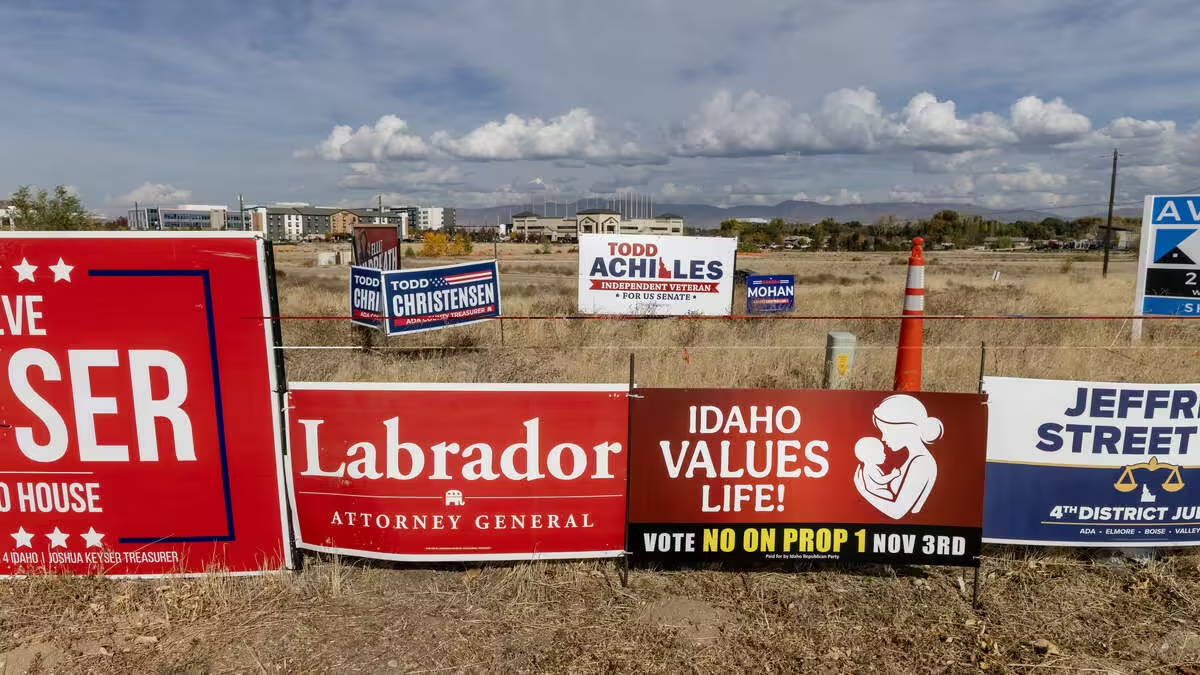

The battle over whether Idaho will vote to rewrite its abortion laws has attracted enormous amounts of money from supporters and opponents.
The fight over Proposition 1, a ballot initiative that would expand abortion access in the state, has engaged new activists — especially those opposed to the changes — who are unfamiliar with the state’s campaign finance laws, Idaho Secretary of State Phil McGrane said. And the amount of money flowing in on both sides of the fight has created something of an “arms race,” he said.
All of this has added up to “the most challenging year” McGrane has experienced for campaign finance enforcement, he told the Idaho Statesman.
“Prop 1 may break our campaign finance laws,” he said.
A ‘Wild West’ for campaign finance violations
These days, it seems like every street corner is covered in campaign signs. Mailboxes are stuffed with flyers, and multiple text messages each day vie for voters’ attention.
Under Idaho law, all of these signs and messages must include information about who paid for them. Those who disseminated the materials must disclose their spending to the Secretary of State’s Office.
Frequently this year, that’s simply not happening — and McGrane’s office, which oversees elections and campaign finance enforcement, is having trouble keeping up.
Melanie Folwell, the executive director of Idahoans United for Women and Families, the organization that got Prop 1 on the ballot, shared with the Statesman examples of signs and leaflets opposing Prop 1 that did not disclose who paid for them. She said her team reported those violations to McGrane’s office — but received no reply.
“The environment is completely out of compliance,” she said. “It’s kind of a Wild West environment right now.”
Most of the violations McGrane has seen this cycle have been from those opposed to Prop 1, he said. Prop 1’s opponents tend to be less organized than its supporters — and as churches have joined the fight against Prop 1, they’ve activated many “mom and pop” advocates who don’t know the rules, he said.
McGrane has reached out to those leading the charge against Prop 1, including Idaho Republican Party Chairwoman Dorothy Moon and Blaine Conzatti, the head of the Idaho Family Policy Center, to ask, “Hey, can you help spread the word and encourage people to comply?” he said.
Outdated laws, few resources
McGrane noted that his office does not usually respond right away to those who report violations, because it needs to investigate the claim and reach out to those committing the violation.
But on the whole, he said, Folwell’s concerns were fair.
Part of the problem is that Idaho’s campaign finance laws are vague and outdated, McGrane said.
“Our campaign finance laws were a citizens’ initiative from the 1970s. They read like one,” he said. There are even times when he struggles to explain or defend a certain campaign finance law — “because even I know it’s probably not constitutionally defensible,” he said.
Resources present another issue: McGrane’s office has only two people who oversee all campaign finance and enforcement issues.
“We don’t have a big army or apparatus for the enforcement side of this,” he said.
The office’s software, too, is ill-equipped to track independent expenditures for initiatives or constitutional amendments. It’s something his team aims to fix, but “we can’t do that in the thick of the campaign,” McGrane said.
Technology has also posed a challenge. In recent days, some voters received text messages from a group claiming to be the Democratic Socialists of America satirically supporting Republican U.S. Sen. Jim Risch in his race against independent Todd Achilles.
The messages didn’t say who paid for them — and the Democratic Socialists of America publicly denied sending them. Achilles, too, said his campaign was uninvolved. It can be extra hard to pin down who disseminated these kinds of messages, McGrane said.
One of the biggest fixes McGrane wants to see to campaign finance laws is how fines are meted out. He wants Idaho to adopt an approach more like the federal government’s, in which fines are proportional to the offense — whether a candidate spent $100 on text messages or $100,000 on TV ads, he said.
Right now, a candidate who violates campaign finance law is fined $250, while a political action committee is fined $2,500. Those are set figures, no matter how big the violation was.
Those numbers are just too small to matter to some campaigns. One group, which McGrane declined to name, has been fined regularly over the years — and made a joke with McGrane’s team about a “punch card system,” he recalled.
“That doesn’t really give you reassurance,” he said.

Idaho Statesman
Source: www.idahostatesman.com