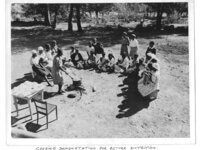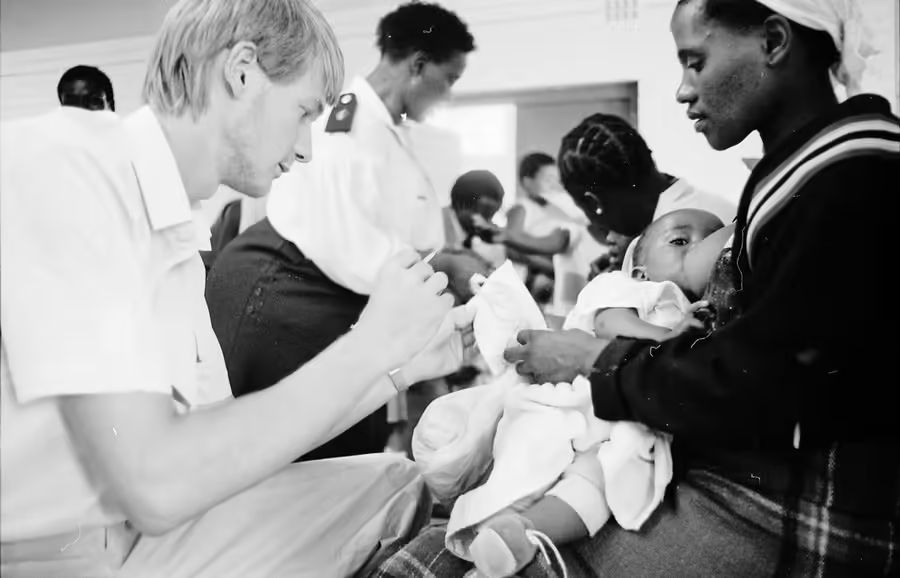

These are all snapshots of life in and around the Alex Health Clinic, a pioneering public health service that operated in the South African township of Alexandra, just north of Johannesburg, during the country’s years of white minority rule, known as Apartheid.
The photographs were taken between the mid-1980s and the mid-’90s and are currently on display in the Bowdoin College Museum of Art. It’s an exhibition with especially close ties to the College through Bowdoin’s Roger Howell Jr. Professor of History David Gordon, whose scholarship covers central and southern Africa.
The show—Healing in Apartheid South Africa: Michael Goldblatt’s Photographs of the Alex Clinic—was curated by students in Gordon’s Spring 2026 course After Apartheid: History and Identity in Contemporary South Africa. Furthermore, the collection of black and white photographs on display are all part of Gordon’s personal collection, passed on to him by the photographer Michael Goldblatt, who is also Gordon’s stepfather.
“The photographs of the Alex clinic were taken over a decade,” explained Gordon. “The intention was to catch the workings of the clinic and the patients it served, but also the broader social and economic condition of the people who lived in Alexandra Township.” One image, for example, shows sanitation workers hauling away buckets of raw sewage—In the absence of a sewage system, many townships collected human waste in buckets and disposed of it manually, a practice that contributed to the spread of disease.
Navigating Apartheid
“When Mike started taking photographs of the clinic and its surroundings in the mid-1980s, Alex was a desperate place to live,” remarked Gordon. The township had become overcrowded as new migrants flooded in, living largely in hostels or renting a patch of land on which to build a shack to live in. “It was also a violent and fraught place, as tensions simmered between different groups of residents.” This tension was exacerbated by the political situation, added Gordon.
The township, which was established in the early twentieth century, became a flashpoint for violence and resistance to South Africa’s apartheid system of government, which ended in 1994. One of Goldblatt’s photographs shows workers rebuilding the nurses’ quarters at the clinic after they were firebombed by South African security forces, who believed the nurses were supporters of anti-apartheid groups such as the African National Congress (ANC).
Amid these challenges, the clinic served as a radical blueprint for community health care. Local residents played a major role in managing the facility, which promoted the idea of social medicine with an emphasis on nutrition, sanitation, and disease prevention. Goldlbatt was asked by the clinic to document as much of these activities as he could, said Gordon, who can recall accompanying his stepfather to Alex on occasional photo shoots as a teenager. “He wouldn’t go into people’s homes by himself but would sometimes follow health workers into residences or places of employment like factories, as they administered vaccines or communicated information about diseases like HIV.”
One of the key challenges facing the clinic during these years, said Gordon, was how to fulfill its role as a health care provider while at the same time being a hub of community activism. As the attack on the nurses’ quarters showed, the clinic often found itself on the front lines of the anti-apartheid struggle.
Handling the Archive
Gordon came into possession of the photographs about nine years ago, he said, when Goldblatt handed over his collection. “Okay, ‘This is yours now,’ said Mike,” recalled Gordon. “‘You’re the historian in the family,’ he told me.”
For a few years, Gordon wasn’t sure what to do with the collection, which comprises thousands of images, including negatives, contact sheets, and prints. An encounter in the fall of 2025 with Anne Cross, the Bowdoin College Museum of Art’s newly arrived Andrew W. Mellon Postdoctoral Curatorial Fellow, spurred Gordon into action. “I mentioned I was from South Africa, and she told me she’d done fieldwork in South African photojournalism. That conversation changed everything.” Gordon was already planning to teach a class on apartheid the following semester, he said, and so decided to center the course around Mike’s photographs, with the students taking on the curatorial work. The results, he said, were “genuinely rewarding.”
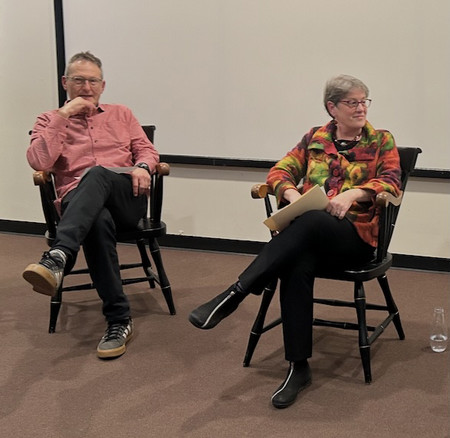
The main pedagogical aim, said Gordon, was that the students learn to work collaboratively to tell a story. “I wanted them to learn what a photograph tells and what it doesn’t. And by using images as sources, try to understand the world of the artist or photographer.” As for the aim of the exhibition more widely, Gordon said it tells a remarkable story. “It’s about collaboration between doctors, nurses, patients, and the people of Alex, working across divides the apartheid state had created in an attempt to heal—to heal people and to heal elements of the community.”
Healing in Apartheid South Africa: Michael Goldblatt’s Photographs of the Alex Clinic is on display in the Bowdoin College Museum of Art’s Markell Gallery until February 7, 2027. After that, Gordon wants to find a permanent home for the collection. One possible candidate, he added, might be Wits University in Johannesburg, home to the medical school that provided many doctors and other staff for the clinic. “There are between 8,000 and 10,000 images in all, and my intention is to place them in an archive that historians can access.”
Source: www.bowdoin.edu