
He Australian chef Josh Niland He has been defending a different way of understanding seafood products for years: use the fish practically in its entiretyapply ripening and conservation techniques and transform parts usually discarded into products of gastronomic value.
His approach also serves to look differently to one of our traditional stores: the fishmonger.
Local food trade It plays an important role in the life of neighborhoods, towns and squares. In the case of fishmongers, to this social function is added a trade based on knowledge of the species, the season, the freshness, the cuts and the different culinary possibilities of each fish.
The fishmonger is not limited to selling. Get up early, buy, move the merchandise, clean, fillet, debone, portion and advise. He knows which fish is in the best moment, which can replace another, how much a family needs or how to cook a certain piece. That knowledge continues to be one of the sector’s greatest strengths.
But the consumer has changed. Less cooking is done in homes, the purchase of fresh fish has decreased and the general increase in prices also conditions purchasing decisions. Every time more convenient solutions are sought, products ready to cook or directly prepared.
There appears one of the great opportunities for these essential businesses of our food culture: evolve towards a model in which the traditional counter coexists with new ways of working with the product.
An important part of the clientele continues looking for fresh fishwhile Demand grows for clean, rationed, packaged and easy-to-prepare pieces. There is a lack of time and, in many cases, also knowledge to confront certain entire species. Convenience has become part of the purchasing decision.
However, this evolution finds a important obstacle. The health requirements and the conditions necessary to produce products make it difficult for many fishmongers to transform their businesses and incorporate a small workshop..
Beyond fresh fish
Marinated, salted, smoked, pickled, breaded, stews, fumets, stock or vacuum-cooked fish can considerably expand the offer of an establishment.
A piece that has little sale on the counter can find another life through elaboration. Thorns and heads can become fumets and funds; cuts and less demanded parts can be integrated into croquettes, fillings, cakes or stews. Traditional techniques such as pickling, salting or smoking can coexist with other more contemporary ones such as low temperature cooking or under a vacuum.
He exploitation thus acquires a double dimension: economic and environmental. Reducing waste means make raw materials more profitablebut also use in a more responsible way a food whose capture and production has an obvious cost.
In this sense, Niland’s philosophy is especially suggestive. His proposal consists of stop observing the fish exclusively through the fillet and understand it as a complete piece susceptible to different cuts, treatments and applications. For fishmongers, this perspective opens an important field of work.
The fishmonger as a small workshop
Taking that step is not easy. Incorporating own elaborations is obligatoryin many cases, to invest in machinery, space and facilities before even knowing how the new business model will respond.
The food safety It must, of course, be a priority. But there should also be a balance that allows the small business evolve without turning each change into a barrier that is difficult to assume.
Because behind every fishmonger that tries to transform itself there is an entrepreneur who risks capital, adapts his premises and bets on keep a job alive which is part of our markets, squares and neighborhoods.
If we want this type of commerce to continue to have a future, we also needs support, help and greater sensitivity on the part of administrations to facilitate this transition.
Otherwise, we run the risk of asking for innovation from those who have the least margin to assume it, while each closure leaves a space that is unlikely to be occupied by another small business.
Innovating does not mean losing your job
Hay examples that show that another fish shop is possible.
Ernesto Prieto from Madrid has been exploring new ways to market fish for decades. Born as a neighborhood business and later installed in the Chamartín Marketwas progressively incorporating frozen products, live seafood and, later, a kitchen workshop.
Carabinero, squid or hake croquettes, scorpionfish pie, fumets and different stews are part of a proposal where the fresh product coexists with the preparation. To this was later added the digital sales and communicationshowing that tradition and modernization do not have to be opposing concepts.
These types of experiences show that the fishmonger can become more than just a counter. It can also be a gastronomic space where knowledge of the product is expanded through transformation, conservation and cooking techniques.
This allows us to sell less in-demand species, reduce waste and offer consumers new ways to approach fish.
Room to evolve
The fishmonger of the future does not have to stop looking like one. You can continue to display the fresh fish on the ice, maintaining the direct contact with the client and that daily dialogue between those who know the product and those who arrive asking what to put in their basket.
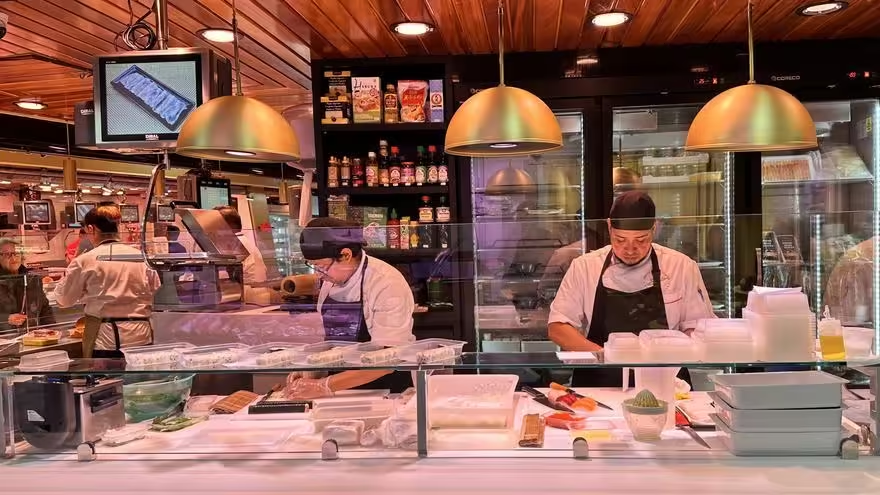
But behind the counter There may also be a small workshop: a space to take advantage of, transform and cook part of that product, adapting it to new forms of consumption and giving value to what could previously have been difficult to find.
For this evolution to be possible, training, investment and adequate facilities are needed. But also a regulatory framework capable of accompanying small businesses without giving up food security. Maybe The challenge is not only to sell more fish, but to make better use of all the fish we already have.. And to achieve this, the craft needs to evolve. But he also needs to be allowed to do it.
Source: www.noticiasdegipuzkoa.eus