
“Passing Strange” will seem just a little less strange to theatergoers now than it might have when it opened on Broadway in 2007 and scored big wins at the Tonys, the Drama Desk Awards and the New York Drama Critics’ Circle Awards. Without naming any names, there are plenty of successful shows since then that have taken cues from the rock musical, from how it put social and racial issues up front for its fouth-wall-breaking protagonist to having a live band on stage.
The only truly strange thing, maybe, at this late date? Why it took so long for the show to get an L.A. production. After all, Stew and his creative partner Heidi Rodewald used to be prominent figures on the Los Angeles music scene, as members of the critically hailed band the Negro Problem, before the development of this show took them to New York in the early 2000s. So they’ve always a loyal audience of rock fans in SoCal eagerly waiting for the show to take root here, too, on top of Angeleno theater buffs who never got to see the show back east. Now it’s finally happening, thanks to director Zhailon Levingston, who won the Tony this year for best direction of a musical for “Cats: The Jellicle Ball.” When he sat down with the top folks at Pasadena Playhouse to discuss what he might like to do here, giving “Passing Strange” its proper SoCal premiere was at the top of his list.
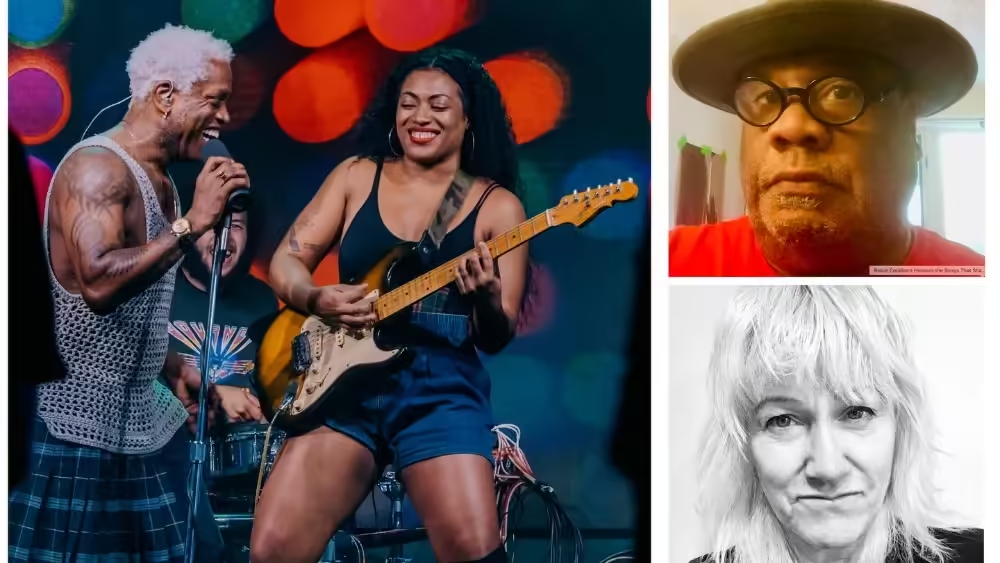
Stew and Rodewald will not be performing in the show in Pasadena, as they did throughout its entire Broadway and pre-Broadway runs. (Neither will Colman Domingo, who had a supporting role, pre-fame, on Broadway. You can see all of those performances in the film version Spike Lee directed.) Vintage Trouble singer Ty Taylor stars in this production as the Stew stand-in known only as Narrator, along with Brittany Campbell (pictured above), Britton Smith and Saycon Sengbloh. Stew and Rodewald are as eager as anyone to see what Levingston has done with a project that takes elements of Stew’s real coming-of-age and sets them to rock ‘n’ roll. The pair Zoomed in with Variety to discuss the history and impact of the show, as well as reveal some projects now in the works.
The two of you aren’t directly working on this Pasadena Playhouse direction, but more like watching appreciatively from afar how it’s going, right?
Stew: Oh, yeah. No, we wouldn’t dare. Zhailon Levingston was sweet enough at one point to invite us to peek in, but he’s a total visionary, so all we could do at this point would be drag it down. First he knows the play better than we do. Secondly, if you’ve ever seen his work, like the work he did in “Cats: The Jellicle Ball,” he’s honestly the last person I would give any advice to.
Rodewald: The way he talks about “Passing Strange” just makes us think: Whatever you’re going to do, you get it.
Stew: As I was just telling him just a few minutes ago, it was made for him. We don’t make art for the contemporary world. The stuff that’s moved me and Heidi for the most part has always been those early morning moments when you go home with somebody and they wanna show you that they’re cool, so they put on a record that you’ve never heard before. I call that 3 a.m. music, and I think that’s what we make. I think the Negro Problem are a 3 a.m. band. “Passing Strange” is a 3 a.m. musical. It’s not something you’re gonna get fed by the mainstream, but somebody very cool is gonna turn you onto it. You don’t necessarily make a lot of money that way, but that’s not why we’re in this, obviously.
Here in L.A., remembering your band as an L.A. band originally, I remember hearing of the show when it was first playing at the Public and then coming to Broadway, thinking that it’d be great to see when you brought it to L.A. I couldn’t have realized that would be a 22-year journey.
Stew: I know. We didn’t either. “Passing Strange” has been done in almost every major city except L.A. It’s been done in South America; it’s been done in Europe — so, yeah, it was starting to stick out in a kind of a weird way. But, see, we’ve always had a adversarial relationship with both Los Angeles and to the L.A. press, particularly the L.A. Times. So we were sort of not surprised at all, but other people would always come to us and go, “What’s up? The play won a Tony! Why aren’t you guys in your hometown?” And we’re like, “Uh, I don’t know.” … It’s certainly nothing we’ve lost sleep over. Having a London production to me was a dream come true, so it’s all good. But the good news is that this amazing director is doing it in L.A., so who cares about time? It’s gonna be worth the wait.
Going back to the very beginnings of the show, weren’t you kind of developing some kind of preliminary version of it in clubs?
Stew: Yeah, we had this thing called “Travelogue” that we did at some places in New York, which was sort of a cabaret version of us talking about different places that we had lived and different experiences — a very primitive version in Joe’s Pub and a couple of other clubs where we did stuff in New York, and that’s when the word started to get around. We were approached by the Public Theater. We weren’t petitioning to make a play. They approached us and said, “Would you like to make it a theater (piece)?” We said no three times, and then finally said yes.
You’ve said that Broadway was not an aspiration of yours, ever. It was not your dream come true.
Stew: Not at all.
Rodewald: No, and that’s why it ended up being what it is, because we weren’t thinking that way at all. We weren’t trying to please people. We were just pleasing ourselves. I think we really held onto that. … It was this crazy surreal thing. And then we did have choices of doing it a different way or being on Broadway, and we went with that. We didn’t have to go to Broadway; we could have been one of those cool shows that goes on and on forever, off-Broadway. But it wasn’t like “Oh my God, this is all we’ve ever wanted.”
Stew: It really helped being a rock band, because I guess there must be some rock bands that get really overly excited about things, but I think a lot of rock bands are like us: we’re very jaded. Don’t forget, we’re old enough to have experienced the implosion of the music business itself. So we remember the point where people were trying to get record deals, and then we also were there when people are like, “Fuck a record deal. Let’s make the record ourselves.” Which is what we did.
We were in the office with Lenny Waronker, talking about a record deal, and they did give us $10,000. Woo, right? And we took that $10,000 and instead of making their demos, we took that $10,000 and made our record with it. So technically our second record is a DreamWorks project, but they don’t know it. Their accountant probably knows it, but they don’t.
At what point did you go east from L.A. to New York?
Stew: Yeah, we were playing in New York a lot when we were touring a lot, but I guess 2000 was probably where we really started spending more time. The best thing you can do in New York is not tell people you moved there. When you’ve moved there, you tell people you’re just visiting so they treat you better.
Rodewald: We haven’t talked about this in a long time. With “Passing Strange,” we get this commission, and then we’re working at the Public Theater, and they’re sending us away to do workshops and it’s like, “Wow, they’re giving us money, so we can just keep going.” In the middle of this, Stew and I are still making albums and touring, so we’re not banking everything on it; we’re just doing this other thing. And one of the great things that happened was, by the time Broadway happened, we still didn’t officially live in New York, so they had to put us up. Otherwise, how would we have done that?
Stew: Sort of like all the luxuries we never got with a big record deal, suddenly theater people were giving it to us, and they were much nicer.
Rodewald: At one point, we were at Sundance, and I remember looking at you and going, “They actually care! Like, no, they actually do.”
And that was not your experience with the record business.
Stew: I feel like record business was just a lot of suits pretending that they get you, but not really. Theater people are really into lyrics, for instance. So that for us was something very astonishing. People liked our stage show and our outlandish name and our ambitious music or whatever, but people in L.A. didn’t really say much about lyrics. Some people did, but not like press and stuff. Then suddenly we go to New York, and the theater people are like, “Whoa, we love these lyrics.”
Also, it’s a touchy subject because I know a lot of our L.A. people feel funny about the fact that we really did have to go to New York in order to make a living from this. Because we were selling out Spaceland on Saturday night, but there was a glass ceiling, and we couldn’t get that big record deal that was no longer around, or no longer around for a band like us. That wasn’t a possibility anymore. Suddenly in New York we had a career and could make a living. It’s always weird when hometown people leave and go elsewhere, and things happen.
I have a lot of friends, and Heidi has a lot of friends, who, back in the day, would get a big advance from a record company, and they’d be crawling the carpets with all the cocaine and Gil Turner (high-end liquor) deliveries. And the thing is, theater doesn’t give you Gil Turner money. It doesn’t give you cocaine money up front. But it does provide you with everything else you need to create. “We’re gonna send you away on a nice retreat in the cool countryside or the hills or Berlin.” They give you everything you need in assistance, but you’re not gonna become a coke addict on a theater budget. And that’s good!
Rodewald: It was amazing, but kind of embarrassing, to tell peole, “Well, we have a week, and we’re working on this, and we’re getting paid fairly.”
Stew: I wasn’t embarrassed!
Let’s talk about the impact “Passing Strange” had on Broadway. Did you arrive at a point where you were able to recognize the influence it had?
Stew: For sure. After us, there were two things that were very clear. One is that every show wanted to have a band on stage. That was almost immediate. And the micro thing that only theater people would know is our lighting design, which was considered so weird at the time. Our lighting designer was like, “I want to use these lights that’ve been rejected from, like, seven shows.” And we saw it, and it looked like “Liza With a Z,” and we were like, “Hell yeah, we want this.” And then suddenly everybody started copying that look once they saw it. But that stuff isn’t really that big a deal. When I say “of course we would be influential,” I don’t mean that as from an egotistical point. Obviously, when you introduce something new, artists wanna check it out and play with it.
But I don’t think our influence was deep enough, if anything, to be honest. I still think musicals are pretty un-rocking and kind of shallow. And when they say “rock musical,” that just means there’s gonna be a scene where you hear a fuzzy guitar turned up.
Do you know the Iggy Pop thing where he’s [at a show in Cincinnati], he’s covering the peanut butter [all over his body] and stage diving into the audience? I show that to all my theater students, and I say, “For me, this is the epitome of rock ‘n’ roll. Why? Because we don’t know what’s going to happen next, and he is in completely in that moment. He’s high as a motherfucker, but he is completely in that moment.” And that’s what we want to achieve in rock ‘n’ roll. We want to be so present and so there that you want to come there with us. And then I ask them, “Can you show me moments in musical theater that are like this?” And when they do, they are usually scenes that are not even approaching that level of nakedness and frankness and vulnerability.
So what I try to do in my class is get people to write musicals that are more rock ‘n’ roll. And I don’t mean rock ‘n’ roll music necessarily; I mean the spirit. So when you talk about “Passing Strange’s” influence, I mean, superficially, sure. But I don’t know if it’s been deeper than that. Maybe with some shows it has. I don’t know.
Rodewald: The thing that really hit us at one point… We were touring doing some shows after that, onto the next thing. We’re playing in Detroit and most of the people there were like, “Oh, I saw that show.” When you think about how many shows we’ve played live as a band across all these years, [that didn’t compare with] we then do this show where it’s 1,200 people, eight shows a week. We didn’t go on forever, but when you think of that many people, everywhere we go, they’re like, “Oh my God, I saw you on Broadway.” And yeah, a lot of people in theater will be like, “That’s from ‘Passing Strange.’” It’s really amazing to be part of that world where people have been really influenced — a lot of people.
Stew: Most rock people who are involved in musicals are already really famous. Like Green Day. Or it’s like, “Okay, we’re big. We got nothing else to do. Let’s make a musical,” that kind of vibe. But I feel like what was really cool for us is we weren’t anywhere near that. We were indie famous, if even that. We were able to be ourselves in theater and individual in theater because of that. We weren’t trying to please any fans; we were just trying to please ourselves.
Do you think it broke conventions as well as helped invent some new ones?
Rodewald: I’m thinking back on different workshops over the years, these amazing workshops like Sundance. And as we’re doing the rehearsals, we’re laughing, going, “And if we were on Broadway, we would do this.” At the end of the song, everybody claps, and then the music comes back as everybody marches off the stage, just all those kinds of things. We would just laugh about it the whole time, right? We were well aware of what those things were that we did not want to do. And we had a lot of of conversations about wanting to give people a chance to clap, where we were like, “No, no buttons” —that kind of stuff.
In a video interview you did with Spike Lee right he filmed the last show, you indicated you were glad you were through with starring in it in certain ways, and you didn’t really imagine other people doing it. You didn’t see it being the kind of show where somebody just stepped into your role.
I totally didn’t, yeah. I remember the very first one we saw in D.C. And I thought, “Wow, this is awesome,” because that’s the cool thing about theater — it’s just like doing a cover. You know, the best covers don’t steal completely? The best covers do their own thing. So that was what was really fun. The narrator in the first (Washington) show was completely different than me, and I thought it was fantastic. So, yeah, the different people that have done it… We got a call from Argentina, where they were doing it, and they were like, “We’re thinking about not doing ‘The Black One’ because we just feel like that’d be kind of weird with a bunch of white Argentinian actors. Are you OK with that?” And I’m like, “Yeaaaaah, I’m okay with that.” Same when they did it in Belgium. So yeah, it’s just been fun for us. Heidi said it best — it’s bitter and… what did you say?
Rodewald: Oh, well, I feel like I say that a lot: “Old enough and bitter enough.”
Stew: It’s “old and bitter,” but in a very fun, devil-may-care kind of way… I think we enjoy what has happened, but we never sat around and were like, “Oh my God, this is it.” Because to us, it isn’t; it’s just we just do this. This is our life.
You don’t have a huge, active social media presence where you’re promoting yourselves, so it would be good to catch up on what you have coming up. For one thing, does the band still do concerts?
Stew: Oh, absolutely. Negro Problem will come out with a record in ’27. And we’re constantly writing and doing things. Heidi’s writing this amazing show about Aileen Wuornos. What is it? Is it like a song cycle, or is it gonna be a actual musical?
Rodewald: Well, the beautiful thing about it in theater is: I don’t know yet. We’re writing the songs, and then we’re gonna figure it out. But it’s not gonna be straightforward.
Stew: And she and I have this thing called Stewdio Zero. That’s this thing where, every four months, we make a show, and we collaborate with former students of mine from The New School, from Harvard, from LaGuardia. So it’s us being the age we are, but there’s also six people that are like a third of our age on stage collaborating to make sure things stay fresh. We perform at a wonderful space in New York called Jack, which is like our home. And, yeah, we’re crazy busy. We’re making a film of this show we did on Harlem Stage called “High Substitute for the Head Lecturer.” It’s about Amiri Baraka and Allen Ginsberg. I’m working on a Broadway-bound thing on both Muhammad Ali and Thelonious Monk.
Rodewald: “Broadway-bound.” That’s amazing. I love that you said that.
Stew: Yeah, bound in the sense of like prison. And Heidi, you’re doing something else too, right? What are you doing?
Rodewald: Well, I’m gonna be doing the Grace and Jimmy Boggs project with you.
Stew: Oh, yeah — we just got the money for this project about these legendary activists, Grace Lee Boggs and Jimmy Boggs. We’re gonna do this really, I hope, epic live song cycle about these two truly revolutionary activists out of Detroit. They’re already well known to political people, but I hope this musical we’re gonna make about them puts them on the map. They were unapologetically radical and wonderfully charismatic people. We’re busy as fuck. And I teach at Harvard, which is insanely busy, you know?
Are you teaching theater or music at Harvard, or both?
Stew: Both. My class should be titled “How to Make Musical Theater That Doesn’t Suck,” but they wouldn’t let me title it that. So it’s called “Singer Plus Song Equals Story,” and I just try to get them to make musicals that are more informed by what I would consider a rock ‘n’ roll ethos, more than “let’s put on a show” kind of stuff. The students are incredible, and this is what the Stewdio Zero group does, too, that Heidi and I have with them. They kind of teach us what’s going on now, and then we get to tell them what happened. We get to tell them about this little thing we like to call the 20th century, beause they know nothing about that, if you could believe.
Rodewald: The thing that’s changed for me is… Stew insists… I used to have to say “Tony Award-winning Stew,” like, throw that in. [Stew won the Tony for best book for a musical.] And now sometimes he makes me call him “the Professor.”
Stew: I admitted in front of a class that there was a point in my life where I didn’t know the difference between Miley Cyrus, Katy Perry, and… what’s her name, the other one? Taylor Swift. The level of eye roll that happened among my students, it was like teaching zombies. Their eyes turned white because their eyes went so far up into their head, and they groaned this zombie-like groan. I think they all had to go to the eye doctor after I said this. They just could not believe that I couldn’t tell the difference between those three. I never tell them that I still kinda can’t if I’m just listening. This is so embarrassing, because I realize that they’re all fine. They’re great. They even have songs that I like. But when someone comes up to me and goes, “Yeah, I’m really into songwriting, like John Lennon and Taylor Swift,” you know, I just… I’m not criticizing that. I know it’s okay. I’m just not there yet, you know what I mean? Maybe by the time I’m 80. I’m 65 now. When I’m 80, I think it’ll be a Taylor Swift light bulb, you know what I mean? I’m working towards it. I’m working.
Source: variety.com