
A Nicaraguan asylum seeker who was living in Minnesota is fighting his deportation — which landed him across the world in the Central African Republic.
Federal judge Jeffrey Bryan ordered Kenis Lopez Gonzalez brought back home and released from detention last week, but U.S. attorneys are asking the court to delay that order. For now, he’s stuck in a country where he has no connections, no legal status and no protection from deportation back to Nicaragua, where he fears persecution.
In a phone call from the Central African Republic, Lopez Gonzalez said in Spanish that hearing the news of the judge’s order was a glimmer of relief.
“That made me feel good that they’re trying to comply with the law,” Lopez Gonzalez said.
MPR News helps you turn down the noise and build shared understanding. Turn up your support for this public resource and keep trusted journalism accessible to all.
He wants to come back to Minnesota.
He’d lived in Shakopee since 2022, where he owned a construction company. He had permission to stay in the U.S. as long as he attended scheduled check-ins with immigration authorities.
Kenis Lopez Gonzalez
Courtesy of Centro de Trabajadores Unidos en la Lucha
But in January, ICE agents arrested him outside his house. For the next seven months, he was flown from detention center to detention center, on a route that took him from Texas to Louisiana and back to Texas.
ICE couldn’t fly him back to Nicaragua. A judge had previously granted him an order barring deportation there, because he fears persecution by the government. He’d participated in a wave of anti-government protests in 2018 and was jailed for several months because of that, he said.
He was being held in detention in Texas in late August, in a cell with about 40 other detainees, when officers in military gear rounded them all up and restrained them, according to a declaration he gave the court. They were put on a bus. It was several hours before agents told them where they were going: to board a plane to the Central African Republic.
At first, some detainees refused to get off the bus. So agents shot them with what Lopez Gonzalez said were rubber bullets. Photos filed in court show several dark purple welts those bullets left on his skin.
After days of flying, the plane dropped off the group of detainees in the Central African Republic’s capital city of Bangui.
Now, Lopez Gonzalez is staying in a defunct hotel there. He said daily life is a struggle.
“Constantly, the power goes out, the water goes out,” he said.
And he’s been sick more days than he’s been healthy. He blames the food. It has a strange smell, he said, and the deportees aren’t sure what kind of meat is in it.
“We have to eat it, because it’s the only option we have,” Lopez Gonzalez said.
Mosquitos buzz around the clock. He’s heard that other detainees have malaria. At night, it’s too hot to sleep.
The building is staffed, and guarded, by the International Organization for Migration, a UN affiliate.
Lopez Gonzalez said the IOM guards don’t share much information. He said they’ve offered to help him get back to Nicaragua, but nowhere else.
He’s not sure if he’s technically a prisoner, or if he’s free. Either way, he’s heard from guards and fellow detainees that it’s dangerous to go out in the city.
“If they see me on the street and the police pass, the first thing they’ll do is ask for me for documentation. I don’t have that, so they’ll arrest me,” he said.
That’s in line with the U.S. government’s guidance on the country. A state department travel advisory warns people not to go there because of violent crime and civil unrest. Human Rights Watch has reported deportees facing extortion and imprisonment in Bangui.
Lopez Gonzalez’s attorney, Simon Sandoval-Moshenberg, said he’s worried that the Central African Republic will eventually send Lopez Gonzalez back to Nicaragua. He’s seen that happen before with other clients.
“It’s all just a very inconvenient and very long layover on the way back to whatever country the U.S. has already been prohibited from deporting him to directly,” Sandoval-Moshenberg said.
Lopez Gonzalez is one of more than 25,000 immigrants deported to third countries under President Donald Trump’s administration, according to the U.S. Committee for Refugees and Migrants and Third Country Deportation Watch, two programs tracking the practice.
The Trump administration has struck deals with several countries around the world to accept deportees. Earlier this year, the Central African Republic entered one of these agreements, after the U.S. government gave $85 million to the IOM for operations there.
Sandoval-Moshenberg said third-country deportees land in a confusing situation.
“It’s pretty unclear what’s being done by the local government, what’s being done by the federal government in the Central African Republic, what’s being done by the IOM,” he said. “The U.S. government’s position, of course, is once the person steps off the plane, we’ve washed our hands of it. None of it is our problem anymore.”
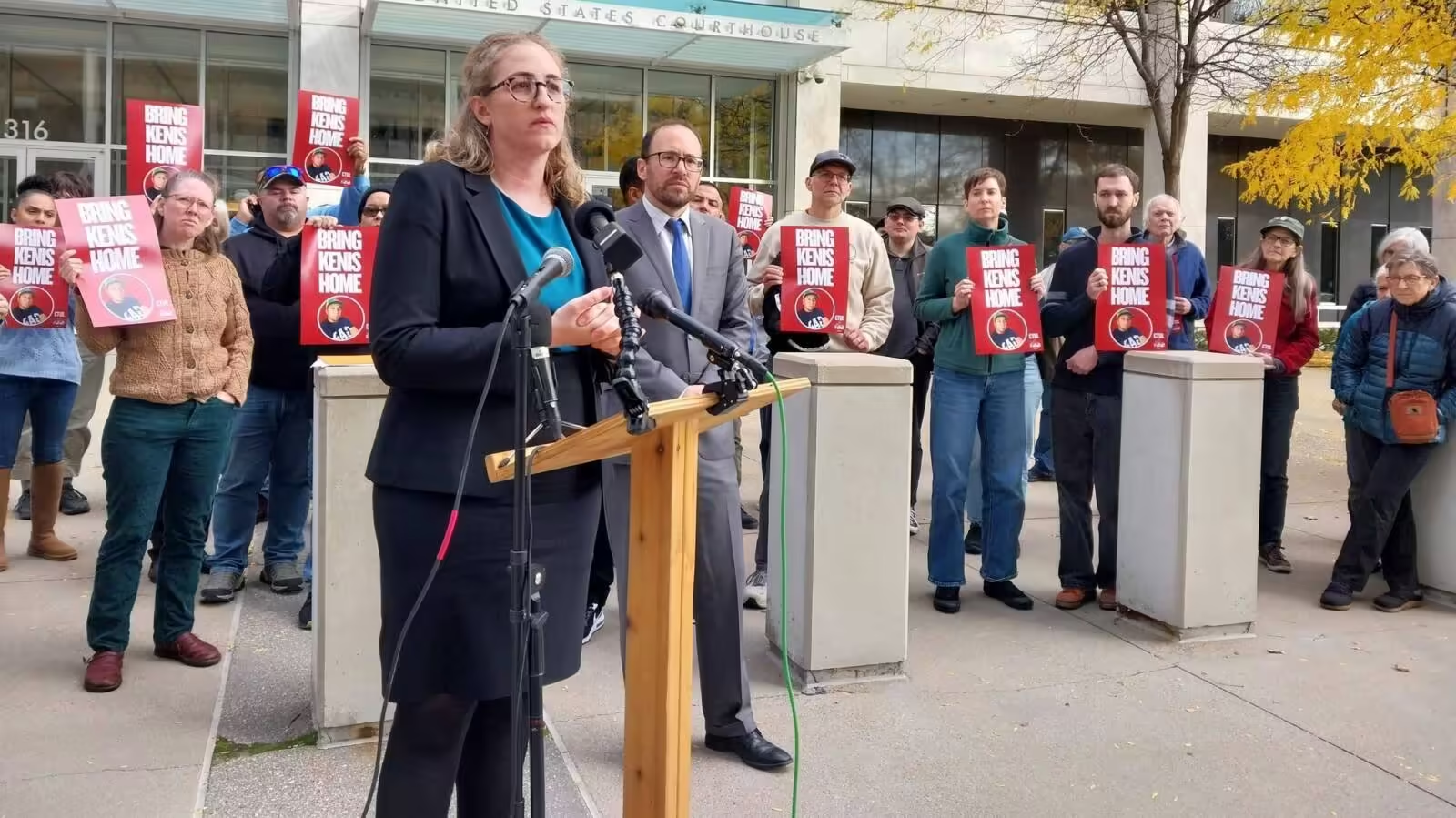
Sandoval-Moshenberg said he was glad to see Judge Bryan order Lopez Gonzalez sent back home. So were his friends at the Centro de Trabajadores Unidos en la Lucha, a Twin Cities labor advocacy organization that’s been keeping in touch with Lopez Gonzalez throughout his detention. Dozens of people gathered outside the St. Paul courthouse after the hearing to celebrate the order.
Judge Bryan’s order also included several deadlines for the federal government to arrange the trip and grant Lopez Gonzalez the appropriate travel documents, since ICE took his passport and ID. Sandoval-Moshenberg said he’s keeping a close eye on the government’s compliance with the timeline.
“Unfortunately, in many such cases, we’ve had to go back to the district court and say, ‘Look, the government’s dragging their feet. They’re not doing anything,’” Sandoval-Moshenberg said.
Even if the government complies with every deadline, it could be a couple of weeks before Lopez Gonzalez is back in Minnesota.
And it could be longer if the order gets stalled in court. The government has now appealed the order and requested to delay it. Judge Bryan has not yet ruled on that request. Until he, or an appeals court, issues another ruling, the order to bring him home stands.
U.S. Attorney Daniel Rosen argued that the judge should wait for a ruling on third-country deportations from the Supreme Court, which plans to hear a case on the issue in December. He also argued that courts currently allow for third-country deportations, in the interest of furthering the government’s goal of removing immigrants who don’t have legal status.
Sandoval-Moshenberg said Lopez Gonzalez should get a ruling sooner. He’s arguing that his initial detention was illegal, too, and that the government violated his rights to due process when they removed him.
For now, Lopez Gonzalez said he’s sticking to his daily routine inside his building: reading the Bible, exercising, and calling his daughter in Houston when he has power. That helps him get through, he said.
“Psychologically, it’s hard to be in this routine day after day,” Lopez Gonzalez said. “But truthfully, I’m doing fine — fine, fine and at peace.”
He’s holding on to that while he waits for more news — or a plane ticket.
Source: www.mprnews.org