
If you’re a fan of elections and numbers, then the New Zealand election offers a fascinating smorgasbord.
After all, it’s an improbably tight result on the raw figures.
More than 2.4 million party votes have been counted so far, with just 3,650 votes separating the two major parties. Labour has 710,330 party votes compared with National’s 706,680, though hundreds of thousands of special votes are yet to be counted.
That margin was somehow even tighter (about 1,500 votes) just before 10pm last night, prompting Henry Cooke, the political editor of New Zealand newspaper The Post, to marvel at the mirror columns of red and blue.
“Millions of people will vote in this election but the party vote margin between the two ‘major parties’ could fit in Auckland’s St James Theatre,” he posted on X.
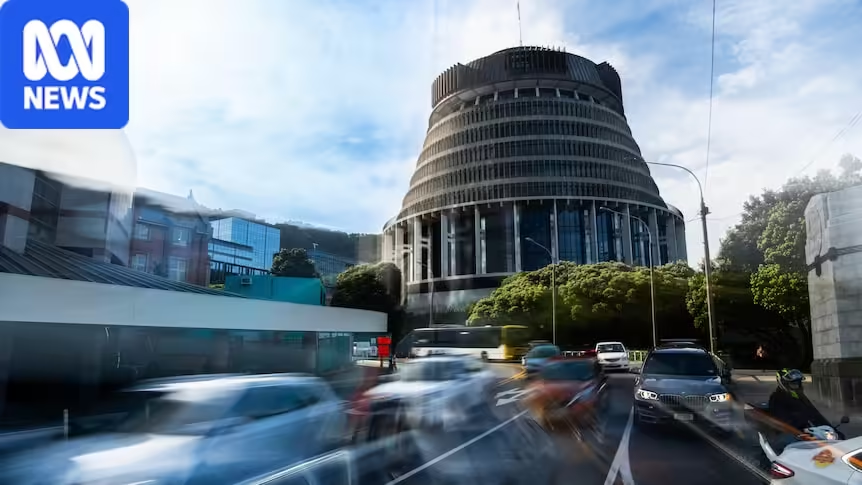
Most New Zealand political observers are now (very understandably) fixated on the minutiae of the vote, the party machinations, the overhang, the special votes, and whether National will need to bring in political newcomers Opportunity in order to keep their hold on government.
Christopher Luxon told supporters on election night his party had a path to government. (Reuters: David Rowland)
National has a clear edge over Labour on seat numbers, with 42 seats projected compared with Labour’s 36 seats. There’s an increasingly settled view that Prime Minister Christopher Luxon has an easier avenue to power than Labour leader Chris Hipkins, who would have to navigate a much more torturous pathway to the top job.
The preliminary results do not include 400,000 or so special votes, which are yet to be counted by the New Zealand Electoral Commission. Special votes have historically boosted Labour’s vote share, although election analysts say it is unclear whether they will be sufficient to push National and its coalition partners below its perilously thin majority.
After a muted speech at National HQ on election night, Mr Luxon sounded decidedly more confident when talking to journalists in Auckland this afternoon, saying his party could claim a mandate to govern.
“Ultimately, New Zealanders have given us the biggest seats in parliament, 42 seats as it stands today, and a pathway to form a government,” he said.
“As a politician, would I love 50.1 per cent? Absolutely, I think everybody would, but there’s no doubt about it, we’ve got a mandate.“
Stats tell a subterranean story
Still, if you’re taking a broader view and asking what this election might tell us about New Zealand’s political trajectory then there’s a subterranean story that deserves as much attention as the blow-by-blow race for the Beehive.
When you pick through the latest data two figures really jump out, because they tell us a story of disenchantment and fracture in the New Zealand electorate.
The first: New Zealand’s two major parties, Labour and National, secured only 59 per cent of the party vote between them.
This is the first time since 1996, when New Zealand embraced its MMP* voting system, that the two major parties have fallen beneath 60 per cent of the vote.
The last time this almost happened (back in 2002) it was off the back of a smashing victory by then prime minister Helen Clark, who secured more than 41 per cent of the vote while National crashed to only 21 per cent.
One commentator put it neatly last night when he mused that it was probably time to stop talking about the “major” and “minor” parties, and just talk about the “seven parties” in New Zealand.
Of course coalition politics have always been a major feature of New Zealand politics since 1996, because MMP strengthens the hand of minor players.
Opportunity leader Qiulae Wong addressed the party faithful at an event in in Auckland. (Jonathan Killick/Stuff via AP)
But the surge in the minor party vote, as well as the dramatic re-emergence of Qiulae Wong and Opportunity (from outside parliament too) might hint at a deeper realignment.
The contrast with 2020 is stark. Jacinda Ardern’s Labour party won an outright majority of the party vote at that election, allowing it to govern alone. The current results raise questions about whether New Zealand’s era of majority style politics is over.
It feels more likely that political polarisation and a fragmenting information space will continue to fuel the rise of other players, with future leaders navigating constantly coalescing, shifting coalitions between several parties.
Of course, this isn’t a shift merely contained to New Zealand, look at the way One Nation has up-ended federal politics in Australia, where the major parties are also seeing a steady long-term decline in support.
The second figure worth dwelling on from this election is turnout, which dipped down to 74.6 per cent, the second lowest in New Zealand’s history.
Attention is beginning to turn to the voter turnout numbers and what is behind the drop. (AP: Alex Robertson)
It’s a number that might worry those tracking democracy’s vital signs in New Zealand, which has a long and proud record of civic participation.
There are plenty of things that could explain this drop.
The weather wasn’t exactly pleasant in New Zealand on Saturday with heavy rain and showers (particularly in the north) which may have kept people at home.
Some analysts have pointed to new enrolment rules as a possible factor after New Zealand introduced a requirement for voters to enrol 13 days before voting began.
Again, disenchantment and political disconnection are hardly unique to New Zealand.
But for leaders trying to navigate tumultuous and uncertain times, they make the hard task of building — and maintaining — a political mandate for difficult decisions all the harder.
* New Zealand uses a mixed-member proportional (MMP) voting system, under which voters cast one vote for a local MP and another for a political party. The party vote largely determines how many seats each party receives in parliament.
Source: www.abc.net.au