

Since 1994, the political scene in South Africa was undoubtedly dominated by the ANC. The party dominated Parliament, national, provincial and most of the local governments in the country for most of the democratic era. The biggest change was brought about when the ANC lost its majority in the 2024 National Election for the first time since 1994. This year surveys are showing a continuing decline in support for the ruling party, while no single party currently commands strong majority support across the country ahead of the November Local Government Elections (LGE2026).
Earlier in 2026, an Ipsos “Pulse of the People” study found that about four in ten South Africans (42%) agreed or strongly agreed with the statement: “I believe that the GNU is working well and that it is a better form of government for South Africa than majority rule by the ANC”. Almost three in ten (29%) disagreed with this view, while a further 22% neither agreed nor disagreed. (7% did not have an opinion on this issue.)
Currently, two-thirds of South Africans (65%) believe that different political parties should also work together on the local government/municipality level1.
“Looking at the pre-election surveys conducted, we will probably have new coalition governments in most of the metropolitan municipalities after the elections, with numerous local and district councils also expected to be governed through coalition arrangements,” says Mari Harris, Political Analyst at Ipsos in South Africa. “Two weeks of intense speculation and uncertainty are likely to follow the announcement of the final election results, as coalition negotiations take centre stage particularly in councils where no single party secures a majority.”
Interviewing for Ipsos’ latest Khayabus “Pulse of the People” study (Wave 2 2026) took place from 12 September to 13 October 2026, during the time when campaigning intensified. Many manifestos were launched, election posters were put up, election advertisements were dominating radio broadcasts and some election-related court cases were fought. 3 600 randomly selected South Africans were interviewed in their homes and home languages. The study is designed to provide insight into the views of South Africans from all provinces, settlement types and backgrounds. Results are weighted and projected to the adult South African population. Filters were applied to isolate those 18 years and older, and registered to vote. This produced a sample of 2,533.
The figures quoted in this press release should not be interpreted as a prediction of the final outcomes of LGE2026, as surveys reflect the voter sentiment at the time of fieldwork. The findings suggest that voter turnout could play a significant role in determining election outcomes in several councils, and thus a change in the figures are definitely possible.
Voter turnout will be critical
Of the 44,9 million South Africans who are 18 years and older, and therefore eligible to vote, only 29,2 million are registered with the IEC (Independent Electoral Commission). This figure represents 65% of those who are eligible to vote, thus 35% of citizens have disenfranchised themselves by not registering.
Turning to survey results, in the latest “Pulse of the People” study, 62% of South Africans agreed with the statement: “I am looking forward to voting in the 2026 Local Government Elections”. While this holds promise for the eventual turnout, the reality might prove to be very different as voter turnout has been on a downward trend for the last decade. If turnout on 4 November 2026 mirrors that of the LGE2021, only about 12,8 million will cast a vote. If turnout is similar to that of the 2024 National and Provincial elections, about 16,3 million voters can be expected to participate.
Although more than 600 political parties are registered with the IEC for participation in LGE2026, 47% of South Africans eligible to vote said in Wave 1 of the “Pulse of the People” survey that: “There is no political party that represents my views”. In the latest Wave this has increased to 53%. This view is shared by half (50%) of those registered to vote.
“Voter apathy is widely blamed, but voters are disappointed, disillusioned and frustrated with the situation in the country, especially with lack of service delivery and political promises without any action or any sense of responsibility on the side of many councils,” says Harris. “As illustration of this sentiment, 68% of registered voters say that “Politicians can’t be trusted”, while only 15% disagree.”
There will therefore be significant pressure on newly elected councils to improve service delivery. Many South Africans regard public protest as a legitimate response when communities are dissatisfied with local services. Almost six in ten (58%) registered voters agree with the statement: “It is quite acceptable to turn to protests such as strikes and marches if you are dissatisfied with the standard of service delivery in your community”.
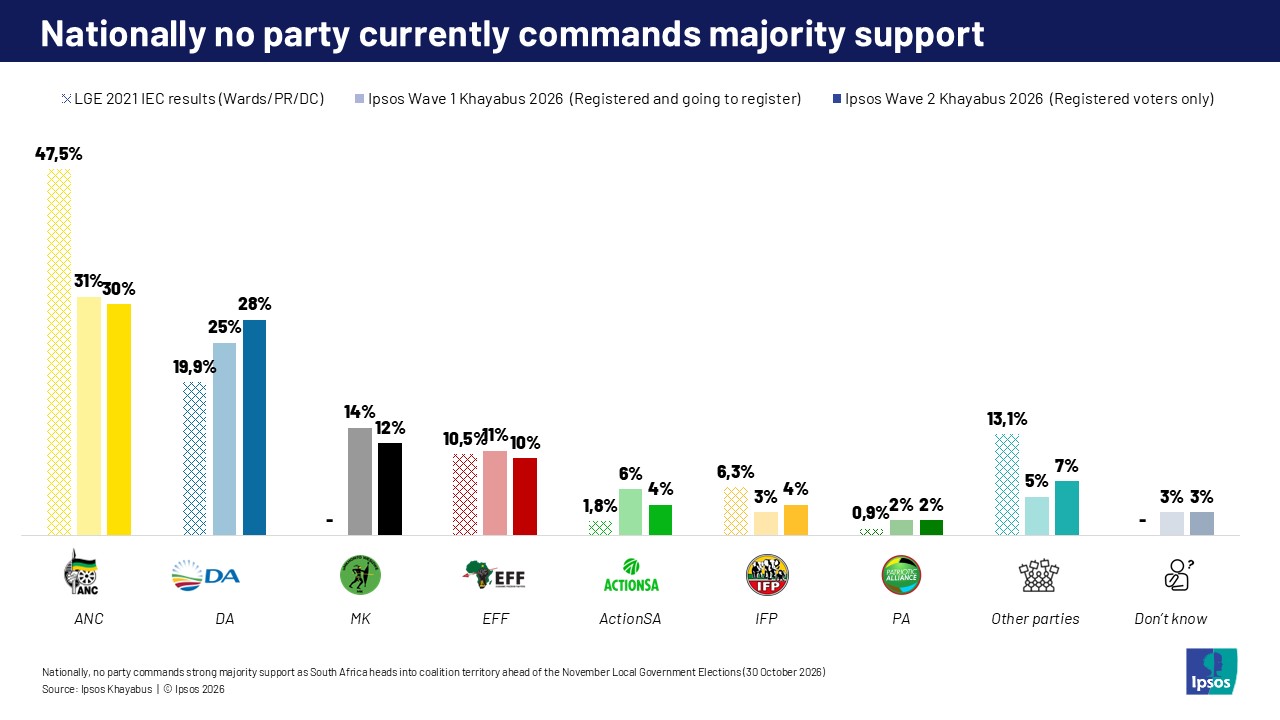
Nationally, no party commands majority support
Although the coming elections focus on South Africa’s 257 metropolitan, district and local councils, as well as 4,488 unique wards, the national view remains important. Current survey results suggest that no single party commands majority support nationally and that coalition politics is likely to remain a defining feature of South Africa’s political landscape in the next two-and-a-half years leading up to the next National Election.
The results illustrate how fragmented the political landscape has become. Although hundreds of political parties are registered to contest the elections, only a small number currently attract meaningful levels of support among registered voters. The remaining parties each account for less than 1% of voter support.
To measure party preferences, registered voters were presented with an electronic ballot paper and asked to mark their preferred political party by drawing an X themselves2. This approach closely simulates the experience of casting a secret ballot. The figures below reflect current levels of support for political parties among registered voters who selected a political party on the electronic ballot paper.
The first column refers to the results from the LGE2021, the second to the results from the Ipsos ”Pulse of the People” Wave 1 study published on 4 September 2026, and the last column refers to the latest results from the Wave 2 study.
The results suggest that support for the ANC has declined significantly since the 2021 Local Government Elections. However, the party has historically strengthened its support during the final stages of election campaigns, and it remains to be seen whether a similar late mobilisation will occur ahead of LGE2026.
Consistent with other surveys conducted over the past year, the DA appears to have consolidated support beyond its 2021 and 2024 levels. The party is executing a very long campaign (especially in Johannesburg) and has also historically performed strongly in the final stages of election contests.
MK is contesting a local government election for the first time, and it appears as if they will largely emulate their performance in the 2024 national election. Support levels for most other political parties remain relatively close to their performances in the LGE2021 and earlier Ipsos polling in 2026.
ActionSA is a notable exception. The increase in support for the party appears to be driven primarily by Gauteng. A small proportion of “Don’t Knows” are also recorded. These voters indicated that they intend on voting, but they are still considering their options on a preferred political party.
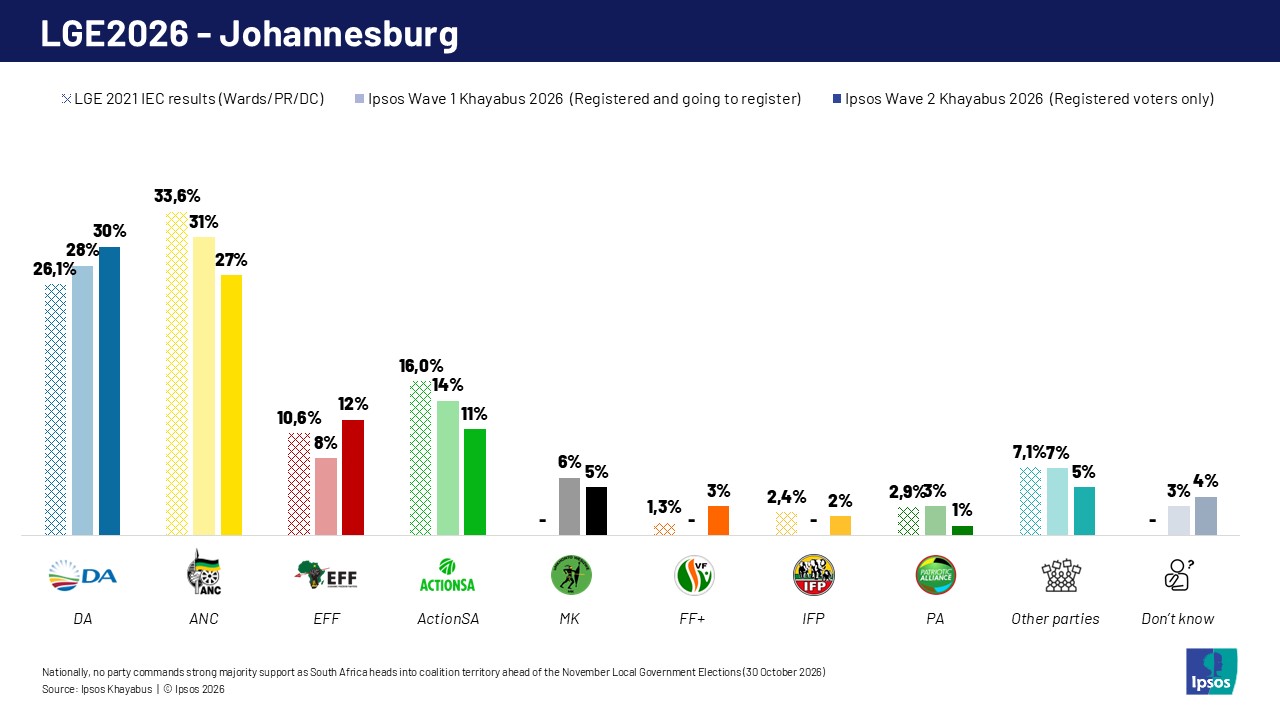
The levels of support recorded for the DA and ANC in Johannesburg broadly reflect the national view, but this time the DA registers slightly higher support than the ANC. Support for MK in Johannesburg appears lower than might have been expected based on other recent indicators. However, it is important to note that fieldwork took place during a period when uncertainty surrounded Jacob Zuma’s hospitalisation. While it is not possible to determine the extent of any impact, the timing may have influenced some voters’ perceptions or willingness to express support.
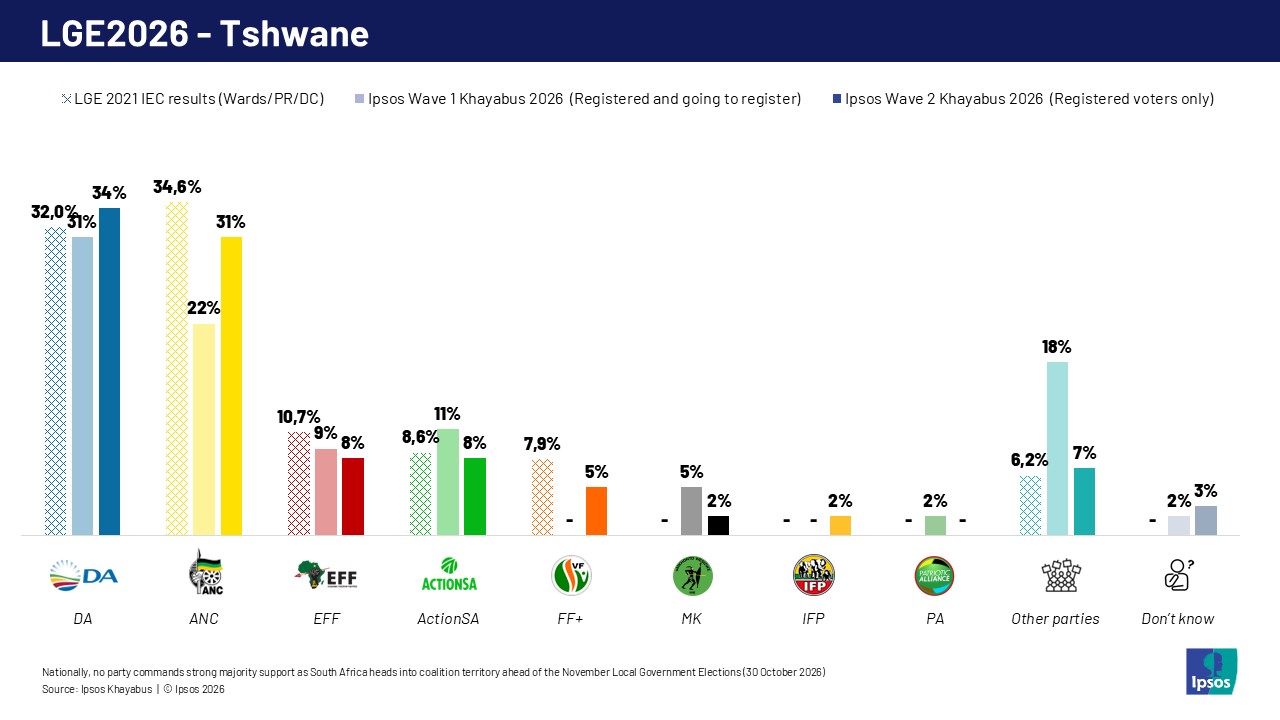
In Tshwane the DA is 3-percentage points ahead of the ANC.
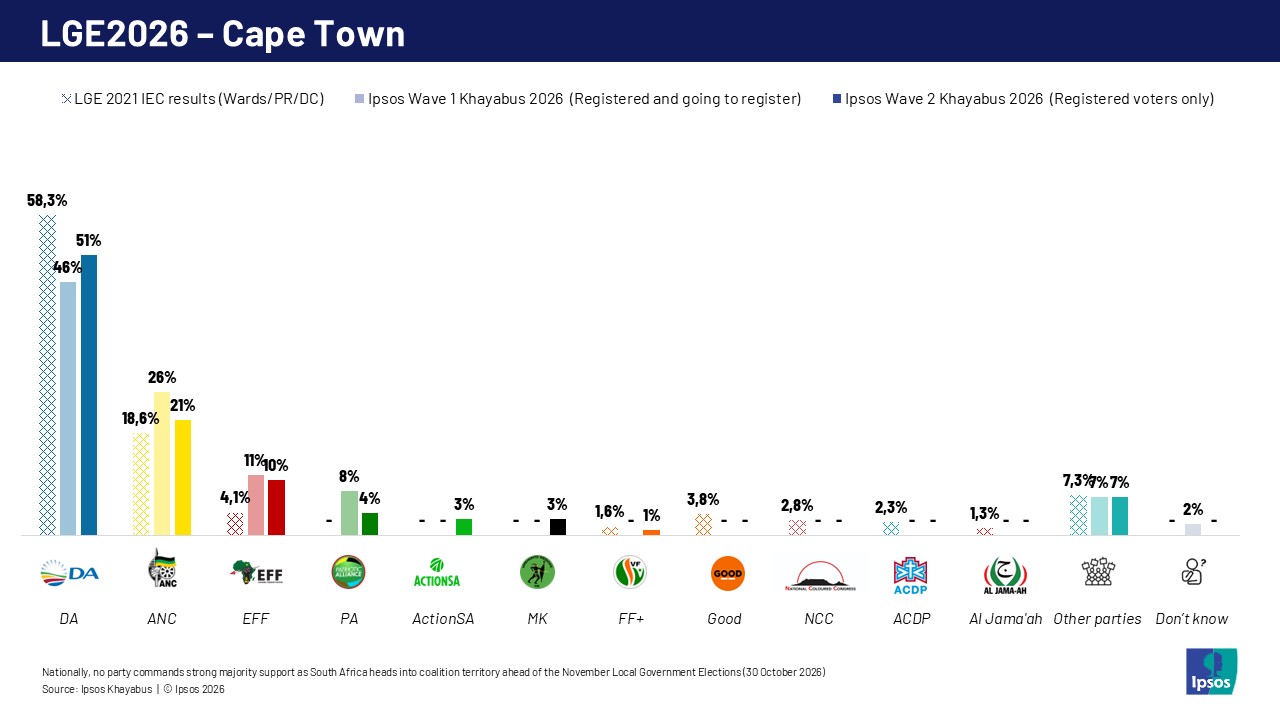
The DA continues to register strong support in Cape Town and currently attracts just over half of voter support in the metro. Consistent with trends observed in recent surveys, the party appears to remain firmly ahead of its nearest competitors in the city.
The PA’s decision to exclude journalists from its public meetings may have affected its media exposure and public visibility during the campaign period. Current support levels suggest that the party is less likely to pose the significant challenge to the DA in Cape Town that some commentators anticipated earlier. However, the situation may be different in the rural areas of the Western Cape.
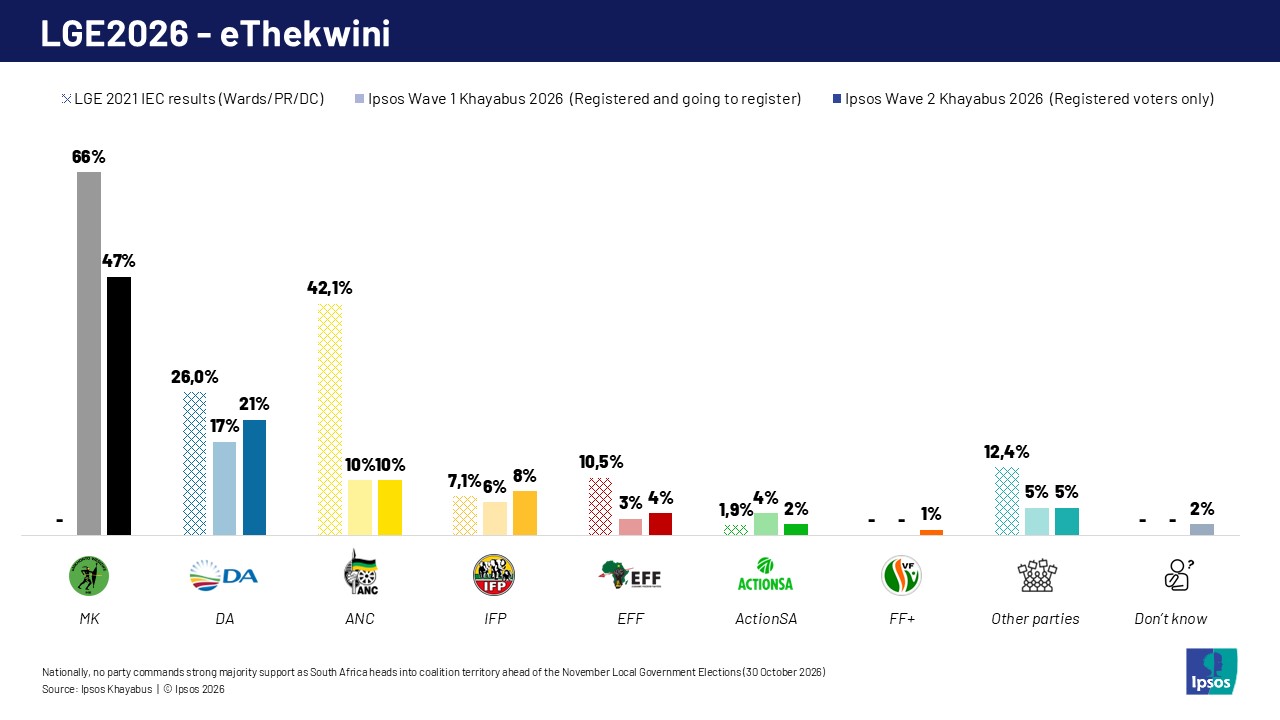
Despite an 8-percentage point shift in support for MK in eThekwini, the party remains comfortably ahead of its competitors and continues to register as the largest party in the metro. However, one can argue that it was also influenced by uncertainty. The DA performance is relatively close to their position in LGE2021, while the ANC and EFF have not recovered the ground they lost to MK in the 2024 National election.
As the Margin of Error in the other four metro’s is bigger than in the four largest metros, results will not be published separately, however a few key remarks can summarise the situation:
- Ekurhuleni: Currently the ANC is ahead of the DA, but the gap between the two parties is relatively narrow. They are followed by MK (with their best performance outside of eThekwini), ActionSA and the EFF. (The relative strong performance of Action SA in Gauteng is again observed.)
- Nelson Mandela Bay: Support levels between the DA and ANC remain extremely close, suggesting a highly competitive race, much as was observed earlier this year.
- Buffalo City: The ANC appears likely to remain the largest party in the metro, although current support levels suggest it may fall short of an outright majority.
- Mangaung: The ANC remains ahead, followed relatively closely by the DA and the EFF.
Coalitions
“If these survey results are indicative of the level of political support ahead of the elections, most metropolitan areas, if not all, depending on what happens with the DA in Cape Town and MK in eThekwini, are likely to require coalition governments,” says Harris. “This places a significant responsibility on political parties to think carefully about potential coalition partners and the long-term implications of those partnerships.
“It may be tempting for parties to assemble coalition governments simply by securing enough partners to cross the 50% threshold, often through the allocation of key council positions or even mayoral posts, however, coalition negotiations should also consider the values, track record and governing principles of potential partners, as well as the practical realities of working together effectively,” notes Harris. “A number of coalition arrangements formed after the 2021 Local Government Elections could be described as marriages of convenience. In many instances, these coalitions proved unstable, resulting in frequent changes in leadership and disruptions to service delivery, in many cases to a breaking point.”
“Reaching agreements with parties of similar size may prove more difficult during coalition negotiations,” concludes Harris. “However, such arrangements are often more balanced and can result in stronger, more stable coalitions. They create genuine power-sharing partnerships, better reflect the wishes of voters and, importantly, provide a stronger foundation for effective service delivery at local level.”
1 22% disagree; 10% neither agree nor disagree and 3% do not have an opinion.
2 Ipsos has used this technique for several years to give respondents the choice to make their own mark to indicate their political choice on an “imitation ballot paper”. This is a simulation of a secret vote and gives respondents who are apprehensive to state their political choices out loud to participate without fear or hesitation.
About the study
Khayabus:
This press release is based on the views of randomly selected respondents. Interviews were conducted by trained Ipsos interviewers in the homes and home languages of respondents. Interviews were conducted between 12 September and 13 October 2026. A scientific process of multi-stage stratified random selection distributed interviews in all areas of the county, including deep rural areas. This methodology ensured that the results are representative of the views of the universe (adult South Africans) and that findings can be weighted and projected to the universe. All results were collated and analysed in an aggregate format to protect the identity and confidentiality of respondents. In data processing filters were applied to isolate the group of respondents who are registered to vote. All sample surveys are subject to a margin of error, determined by sample size, sampling methodology and response rate. The margin of error, dependent on sample size, response rate and sampling methodology, at a 95% confidence level and a response rate of 50% is a maximum of ±1.95% for the sample of registered voters. However, when those who have indicated that they are not going to vote are excluded and the sample is then divided into provinces and metropolitan areas the margins of error for the smaller sample sizes increase. The table below is an illustration of the maximum margins or error for the different provincial samples and metropolitan samples – at a 95% confidence level and a response rate of 50%. Metropolitan areas (Maximum of MofE) – Johannesburg (±5.89); Tshwane (±7.8); eThekwini (±6.42); Cape Town (±5.95).
Source: www.ipsos.com