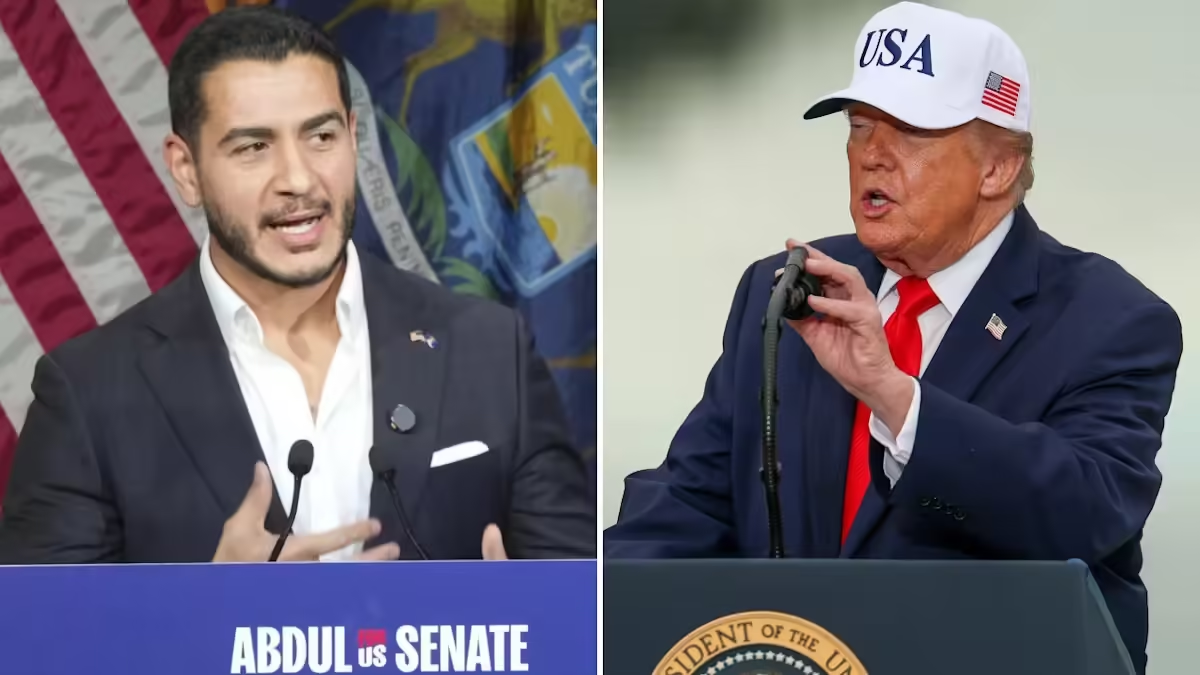
Following the midterm elections, in which Abdul El-Sayed was chosen to represent Michigan in the U.S. Senate, the senator-elect is ready to get to work on an important issue for many in the state.
Tariffs, among other financial issues, were likely on the minds of many Michigan voters as they took to the polls on Nov. 3. Ahead of the election, two separate polls revealed more than 60% of the state’s voters oppose the Trump administration’s tariffs on our Canadian neighbors.
Must Read
El-Sayed is one of those frustrated Michiganders.
“If he [Trump] is interested in working on issues that I want to work on, … (including) stopping these stupid tariffs with Canada, then let’s talk about doing that and deliver for the public,” El-Sayed said on MS NOW’s Morning Joe two days after the midterm elections, CTV News reports.
Seeing that Michigan’s economy is heavily integrated with Canada, especially in the automotive sector, President Trump’s tariffs on the country have been costly for the state. Since January 2025, tariffs on Canada have cost Michigan around $23 billion, including a $10 billion blow to the state’s auto sector, according to Crain’s Detroit Business.
Following Trump’s 25% tariffs on auto imports from Canada, Prime Minister Mark Carney retaliated with his own 25% fees. An angered Trump then threatened to raise the tariffs on Canadian auto parts and vehicles to 50%.
Michigan’s agricultural exports to Canada, which fell 12.3% from 2024 to 2025, have also been costly, leading to a $145 million loss for the state, CTV News reports.
Meanwhile, U.S. Trade Representative Jamieson Greer, Trump’s top trade adviser, is reportedly urging the president to step up negotiations and ease the trade tension with Canada, according to Politico.
Tariff tensions with Canada gets personal
Tensions between the U.S. and Canadian governments may have started as economic, but they’ve increasingly become more personal in recent months.
In early September, Carney took a shot at U.S. Commerce Secretary Howard Lutnick after the Trump administration official said Canada purposefully scuttled trade talks for political purposes.
“I don’t think, with all respect, appointed, unelected Cabinet members in the United States are experts on Canadian politics,” Carney said during a news conference on Sept. 3, CNBC reports. “We are always going to stand up for what’s in the best interest of Canada.”
Read More: Vanguard reveals what’s coming for U.S. stocks — and it could be bad news for this group of investors
Negotiations between the two countries collapsed in August, though Carney says trade talks have intensified since the prime minister’s reported call with Trump in late October.
“We’ve made progress but we haven’t finished,” Carney told reporters on Nov. 3, CP24 reports. “They’re asking less and they’re offering more, but we’re not quite there.”
Trump, however, didn’t seem all that interested in continuing negotiations in early September.
“It is very good for Canadian Politicians like Prime Minister Carney to make President Donald J. Trump ‘the enemy,’ until their Economy collapses,” Trump wrote in a social media post on Sept. 3. “Then it will prove to be very bad for Politics — Worse than anything that has ever happened to a Canadian Politician. Just watch!”
A strained relationship
The U.S. and Canada have been good neighbors for most of their history and have relied heavily on each other economically. More than 66% of Canada’s total exports in July went to the U.S., though that’s down considerably from 72.64% a year ago. Roughly 49% of Canada’s total merchandise imports come from the United States.
Canada is the second-largest trade partner of the U.S. and is responsible for 12.4% of the country’s total trade, beating China and Taiwan combined. But sides have been at odds, off and on, since Trump began his second term in office.
Each country says the other has been making unreasonable demands. Carney, for instance, said Canadian French-language requirements were one of the issues that became a sticking point in the trade talks, though Lutnick and Greer reportedly said the language provisions were not a red line for U.S. negotiators.
“There are a few issues that the United States was arguing right up to the last hour,” Carney said in September, according to the National Post. “Some of what they’re saying now is different than what they were drawing the line on, and we are always going to stand up for what’s in the best interest of Canada workers, Canadian families.”
Lutnick has denied Carney’s account, saying, “Do I care about how that Quebecois speak? I mean, what could matter less to America? We don’t care. So the fact is, we never brought those words up. This is manufactured,” Lutnick said, according to the Toronto Sun.
What To Read Next
Want more Moneywise? Join 250,000+ readers who get our best stories and exclusive interviews in their inbox each week.
This article originally appeared on Moneywise.com under the title: Michigan’s new senator calls Trump’s Canada tariffs ‘stupid’ as $23 billion in costs hammer the state’s economy
This article provides information only and should not be construed as advice. It is provided without warranty of any kind.