
For middle school students, science can sometimes feel like a collection of facts in a textbook. Through the Marquette University Science Exchange Program (MUSE), two Marquette University doctoral students are helping students see science as something they can explore, question and experience for themselves.
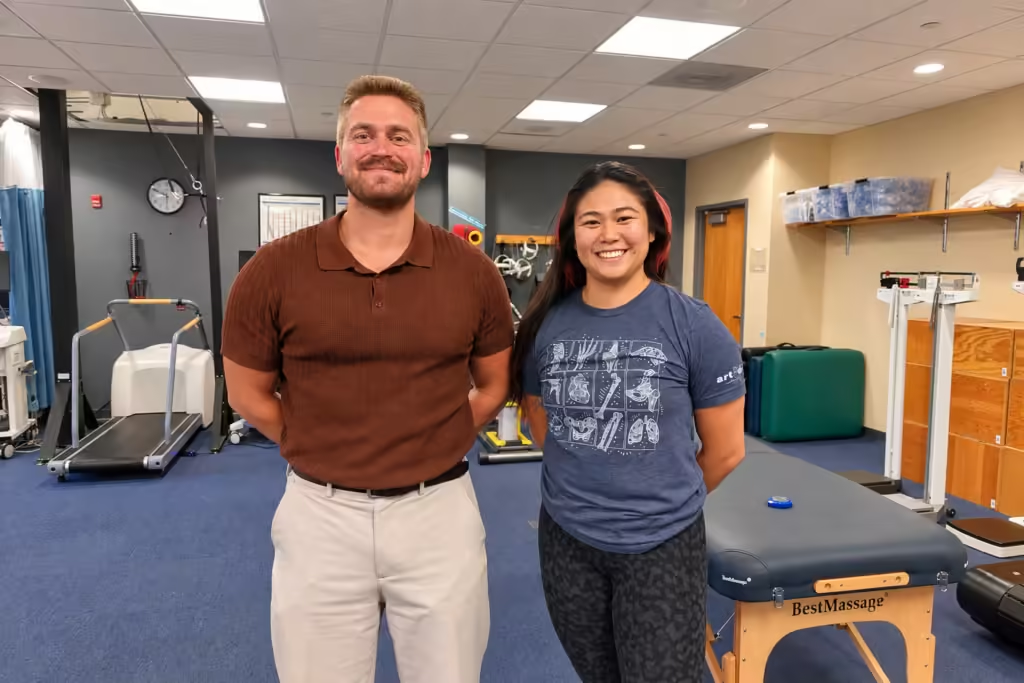
Led by Zebadiah (Zeb) Boos and Wanda Sihanath, doctoral students in Marquette’s Exercise and Rehabilitation Science program within the Department of Physical Therapy, MUSE introduces middle school students to scientific inquiry through interactive experiments, data analysis and opportunities to experience life on a university campus.
Now in its third year, the program was established by former Exercise and Rehabilitation Science doctoral students Taylor Holmes and Lauren Opielinski, who had a connection with Bruce Guadalupe Middle School. Teachers at the school expressed interest in helping students understand what college life looks like and how scientific curiosity can lead to a future career. That initial connection has grown into a collaborative learning experience that brings Marquette graduate students into the classroom and invites middle school students onto campus.
The program’s early development also benefited from the support and encouragement of Dr. Marie Bement, director of graduate studies for the Exercise and Rehabilitation Science program, who helped Holmes and Opielinski as they worked to establish MUSE. Mariah Diemert has also played an important role in connecting program leaders with the department and supporting the program’s day-to-day logistics, including acquiring equipment and coordinating the use of supplies.
Turning scientific questions into hands-on discovery
MUSE operates four times per semester at Bruce Guadalupe Middle School, with sessions held in the school’s gymnasium or lecture hall, depending on the activity. The program follows a two-part approach designed to give students experience with the scientific process, from conducting an experiment to interpreting the results.
During the first session, Marquette graduate students lead an exercise science testing activity in which middle school students participate in experiments, record data and encourage their classmates. The following week, the graduate students return with the collected and organized data to guide students through an introduction to data analysis, graphing and interpretation. Rather than simply presenting scientific concepts, the graduate students invite participants to help make sense of the results and explain what the data reveal. The process repeats later in the semester, giving students additional opportunities to experience how scientists investigate questions and draw conclusions from evidence.
The program’s goal is to introduce students to advanced science testing procedures, the development of scientific questions and the fundamentals of data analysis. By connecting these concepts to practical activities, MUSE helps students understand how scientific inquiry works beyond the classroom.
“We often see excitement and genuine intrigue when working with these kids,” the program leaders explained. Students appear especially interested in discovering how simple tests can help answer larger questions.
Teachers have also expressed appreciation for the program’s approach. By introducing complex ideas through hands-on experiences, MUSE gives students a foundation they can draw upon when those concepts arise in their regular science classes.
Making college and science careers feel possible
For Boos, the program is about more than teaching science. It is also an opportunity to help young students navigate questions about their futures. Reflecting on his own middle school and early high school years, Boos remembers feeling intimidated by the prospect of college and uncertain about what he wanted to study. He once believed students needed to have their entire career paths mapped out before beginning their undergraduate education.
Those experiences now motivate him to help younger students see the many possibilities available to them. “When working with these kids, I feel like I am looking back in time and I think, ‘What would I have wanted to hear?’” Boos said.
His answer is a message of encouragement: students do not need to have every step of their future figured out. Instead, they should pursue the subjects that capture their interest and keep them curious. For students who already enjoy science, Boos believes exposure to the diverse interests of graduate student mentors can open doors to fields and careers they may not have previously considered.
Sihanath brings a similar passion for mentorship and education. She has always enjoyed working with younger students and sees MUSE as an opportunity to step outside the routine of graduate-level research to make science accessible, engaging and memorable. She also credits inspiring science teachers with helping shape her own educational journey. Through MUSE, she hopes to offer middle school students the same kind of positive experiences that can encourage them to continue exploring science.
Together, Boos and Sihanath demonstrate that scientific learning is not limited to laboratories or university classrooms. It can begin with a question, a simple experiment and a mentor willing to help a student discover the answer.
Bringing the laboratory to the community and the community to campus
A highlight of MUSE takes place at the end of each spring semester, when students visit Marquette’s campus for a firsthand look at university life.
Working with Bruce Guadalupe Middle School staff, program leaders organize a campus visit that includes tours of exercise science testing laboratories in the Schroeder-Cramer complex, the Athletic and Human Performance Research Center (AHPRC), and a college residence hall, followed by lunch at the Commons. The visit also gives Marquette graduate students and faculty members an opportunity to showcase their research through interactive demonstrations.
Faculty members Toni Uhrich and Dr. Sam Nemanich have been particularly helpful in making these campus visits meaningful experiences for the middle school students. Both have served as chaperones and guides during the visits, helping students explore campus and learn more about Marquette. They have also welcomed students into their laboratories to introduce them to research taking place at the university.
Past activities have introduced students to biomechanics through force plates and motion-capture technology, exercise physiology and performance testing, motor learning, and the AHPRC’s golf simulation facility. Students have also had opportunities to see how motion-capture models can help researchers study human movement.
These experiences provide a tangible connection between the experiments students conduct at school and the work happening in university research facilities. A college campus becomes more than an unfamiliar place; it becomes a setting where students can envision themselves learning, exploring and pursuing their interests.
The involvement of graduate students and faculty members also highlights the collaborative nature of scientific research at Marquette, showing students the many people and specialties that contribute to answering scientific questions.
A rewarding opportunity for graduate student mentors
While MUSE benefits the middle school students, the experience also offers meaningful opportunities for Marquette graduate students to develop their teaching and communication skills.
Explaining scientific concepts to younger audiences requires mentors to translate complex ideas into clear, approachable language. For graduate students interested in teaching, outreach or working with children, the program provides practical experience communicating their research interests outside a university setting. The program leaders encourage fellow graduate students to participate, whether by leading an activity, helping develop curriculum or contributing to an individual session.
With a flexible and relatively small-time commitment, MUSE offers an accessible way for graduate students to support a local school while sharing their enthusiasm for science. The program’s informal, welcoming environment is intentional: the goal is for both mentors and students to learn, ask questions and enjoy the experience.
Getting involved with MUSE
Middle school students participate through an after-school program and sign up through their teachers, who coordinate with MUSE leaders to schedule sessions.
Marquette graduate students interested in volunteering or learning more about the program can contact [email protected]. Boos or Sihanath will follow up with additional information about opportunities to participate.
For Boos and Sihanath, the value of MUSE lies in the connections it creates between university research and middle school learning, between graduate students and young scientists, and between curiosity today and the possibilities of tomorrow. By making science hands-on and college life more familiar, the program offers students an opportunity to discover not only how science works, but also where their own curiosity might lead.
Source: today.marquette.edu