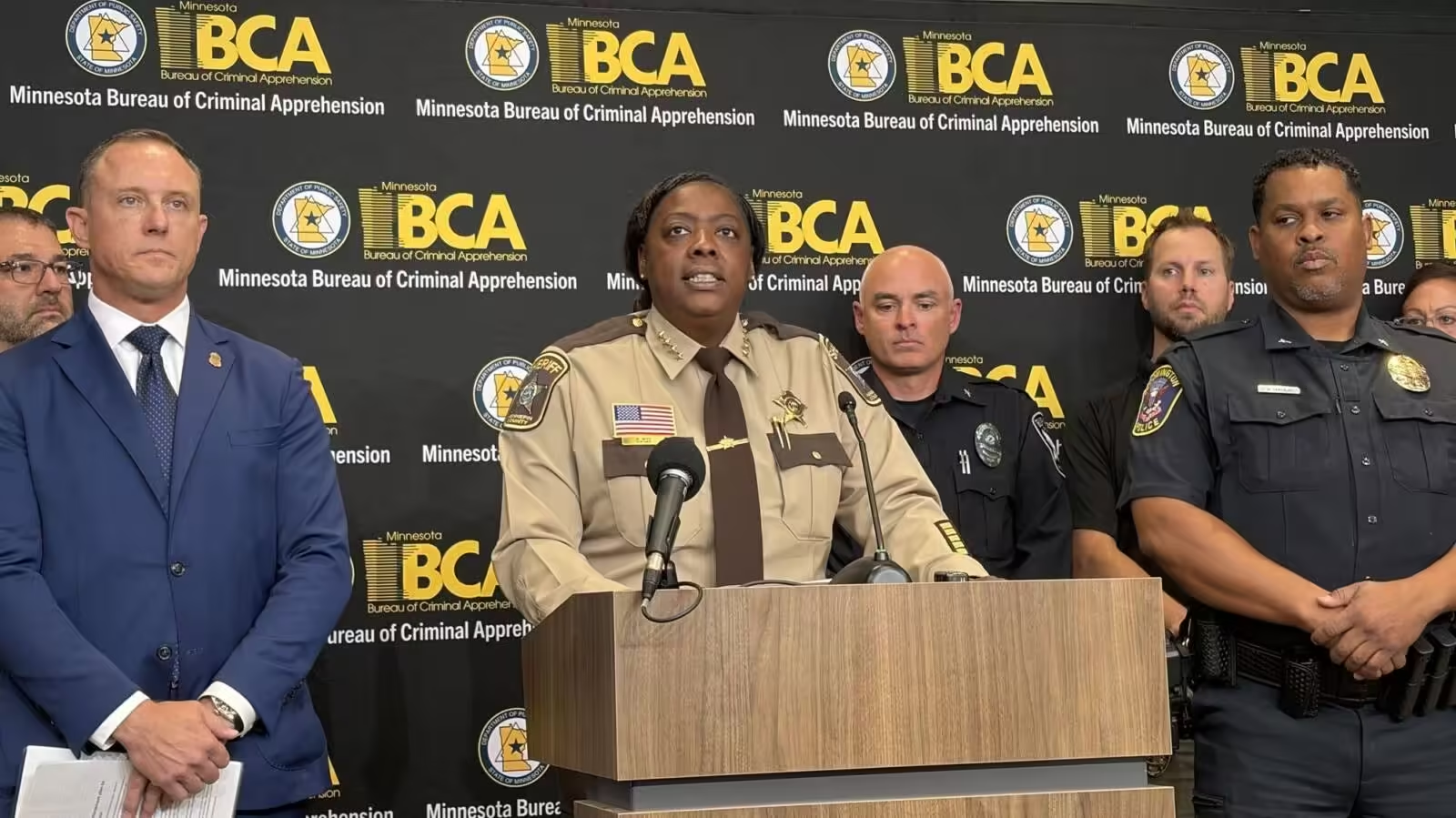

DAWANNA WITT: So please help us do our jobs. Work with us, and let’s not have any more unnecessary stereotyping of an entire community.
EMILY BRIGHT: The Minnesota Bureau of Criminal Apprehension said this new approach is modeled after something called the New Jersey Strategy. Joining me now to explain what that is is James Densley. He’s a professor at Metro State University and researches gang violence. Thank you for coming back on the program.
JAMES DENSLEY: Oh, it’s my pleasure. Thanks for having me.
EMILY BRIGHT: So can you start by telling us what is the New Jersey Strategy?
JAMES DENSLEY: So New Jersey decided that gun and gang violence wasn’t an individual city problem– it was a state problem. And I know that that sounds simple, but in most of America and Minnesota included, every police department is an island. They run their own records, they chase their own cases. So what New Jersey did was build a bridge.
They said, let’s run this from one place. And they created a statewide task force with federal, state, and county prosecutors working together in regional teams. Now, this started in 2007. So it’s actually an old initiative. The governor’s crime plan set out a few basic rules for this– using data to find problems, have the state support local police, and then make everybody share information. And I think that’s what now Minnesota is trying to replicate.
EMILY BRIGHT: Did it work in New Jersey?
JAMES DENSLEY: Well, shootings are presently at the lowest level in New Jersey that they’ve ever recorded. The state counted about 500 people shot last year. That’s down from a high of 1,000. So that’s a real decline. And it means that hundreds more people are alive today and unhurt than would have been otherwise.
But I’d be careful to give the strategy all the credit, because homicides have been falling in all-American cities nationwide in recent years. The whole country has actually got a lot safer. And even the researchers that evaluated the New Jersey program, they found that the approach made investigations better and it produced new leads. But they said that you can’t tie the entire drop in violence to that one initiative.
EMILY BRIGHT: I’d be curious– so this model is nearly 20 years old– how it’s evolved over the years.
JAMES DENSLEY: Yeah, so there’s two major components, which I think Minnesota is going to try and utilize. Number one, they followed people committing violence across City Lines. So shooters don’t stop at city limits. And the data shouldn’t stop there either. So when the analysts looked at the people arrested over and over again in New Jersey, they found that only 14% of people arrested five or more times were arrested in the same city.
In fact, a quarter were arrested in four or more different cities. So what this was about was breaking down silos and coordinating intelligence to see that bigger picture. And then the second thing they did was they expedited the evidence. And this is actually really important. You see, every gun used in a crime leaves marks on a shell casing. It’s a bit like a fingerprint. And if you match those marks, you can link shootings that look otherwise unrelated.
So what New Jersey did is they set up these dropoff sites around the state, and they cut the wait times for the results on the forensics between– it used to be between 6 and 10 months to get data on these crime guns. They got it down to one or two days. And a lead that shows up that quickly can actually stop the next shooting. So this was about smart, data-driven policing.
EMILY BRIGHT: It’s completely fascinating. My understanding is we don’t have a lot of current data on gangs in Minnesota. Law enforcement has publicized it as a problem. We don’t really know how many gangs or gang members there are today, say, compared with 20 years ago. We do know, as you said, that violent crime is down. I think there is skepticism about overpolicing a potentially small group or a single ethnicity. Do you have any concerns that that could happen here, or because this is data-driven, is this a case of no harm done in collecting and sharing more data?
JAMES DENSLEY: Oh, no. I think those concerns are very valid. Any system built on intelligence about people can turn into a list of the usual suspects. And we know that gang databases across the country have a poor record. And Minnesota, let’s be honest, has a pretty bad history with gang task forces. So the distinction I draw here, though, is that the dragnet approach sweeps up everybody in a neighborhood, and the core of the New Jersey approach was actually the opposite. It tried to narrow police attention to the small number of people actually linked to shootings.
And so that ballistic work that I talked about is the clearest example. It was tying a shell casing to a gun, and then it was tying a gun to a shooting, which is evidence, not just a hunch that somebody is affiliated with a gang, for instance. So the honest answer, I think, is the tools can be precise, but there absolutely has to be transparency and accountability, because the last thing we want is communities stigmatized and terrorized by new tactics that don’t work. So as long as we are driven by the data, I think we’re in a good place. But we’re going to have to see how that plays out.
EMILY BRIGHT: Yeah, I’m thinking about the concern that’s come up over technology like flock cameras shared across agencies. So I mean, you’ve kind of touched on this, but how should law enforcement be weighing surveillance concerns versus violence prevention?
JAMES DENSLEY: Yeah, I mean, I think it’s a reason for scrutiny, which is to say that let’s not forget that although maybe certain populations are involved in the violence, it’s also that certain victims are also from these communities as well. And those communities will pay the highest price for the violence, but they also pay the highest price for bad policing.
So a good strategy has to reduce both. And that means there has to be clear rules for the work. And there has to be constant communication with the public so that we can check what is happening and ensure that it’s actually targeting the people that it needs to be targeting.
EMILY BRIGHT: I was struck by reading through the New Jersey Plan that there’s also an approach to how do we keep people from getting involved in violence in the first place, and then how do we make sure after they get out of jail that they don’t fall back into it? Are those strategies that are also part of the plan moving forward in Minnesota, as far as you know?
JAMES DENSLEY: I’ve not seen that be discussed yet. I think at the moment, the Minnesota plan is really more focused on that law enforcement coordination. But I think in time, we will see more emphasis on the prevention and intervention work as well, coordinating outreach work and community violence intervention to ensure that people who are embroiled in conflicts can actually get the help and support that they need.
And then, as you also mentioned, it’s so vitally important that we do work on reentry as well. People are in gangs and let’s say they have been processed by the justice system, but then they are just released right back into the community and into the same conditions that they originally came from. That’s not a recipe for success later in life.
And so the more that we can do to ensure everyone’s getting the help and the support and the services they need, that has to be a vital part of this as well. So working on the prevention, working on the intervention, in addition to the enforcement side, which is what usually law enforcement is working with. But you have to do that in coordination with community partners.
EMILY BRIGHT: Absolutely. So my final question in our last minute– what will law enforcement need to do to be successful using this model?
JAMES DENSLEY: Well, I think New Jersey gives us some hope that there is a blueprint to work from. And really, it comes down to law enforcement being willing to put down the jurisdictional, territorial issues that they have maybe had in the past and recognize that by coordinating resources and collaborating with one another, they can do this.
This is actually an ongoing debate with law enforcement. I mean, ever since 9/11, for instance, which is a completely separate issue– counterterrorism. But we’ve always been told that law enforcement is too siloed and that they’re not sharing data enough and they’re not collaborating enough. And this seems to be yet another example. So steps taken to move in that right direction, I think, are positive. But of course, we have every right to be a little bit skeptical. And we want to make sure that it’s doing it with the best intentions.
EMILY BRIGHT: James, thank you for your expertise, I appreciate it.
JAMES DENSLEY: Oh, my pleasure. Thanks for having me.
EMILY BRIGHT: James Densley is a professor and department chair of Criminology and Criminal Justice at Metro State University.
Source: www.mprnews.org