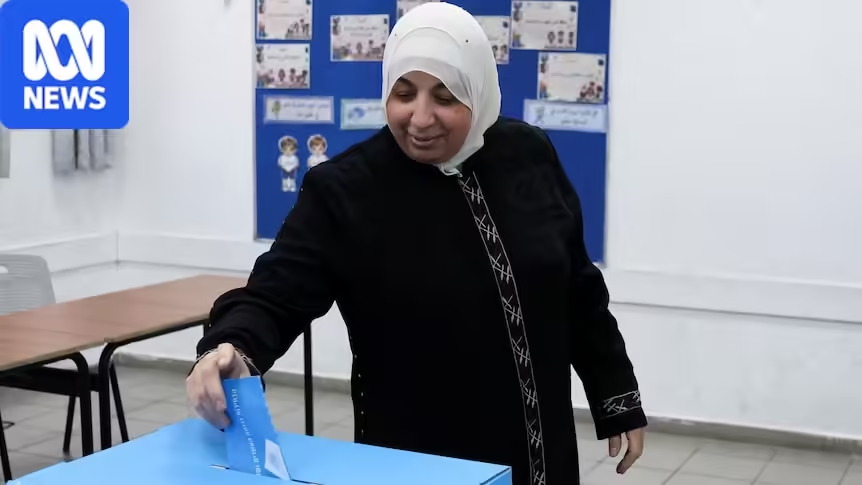

When schoolteacher Ranya Farhat voted in the Israeli election for the very first time this week she, like many Arab Israelis, did not believe it would affect the outcome.
But on Tuesday a record turnout of Arabs, many of whom identify as Palestinian citizens of Israel, tipped the political scales and turned the Arab-majority parties into kingmakers in a deadlocked result.
Votes from Bedouin communities also surged, with some drawing attention on social media for riding camels and donkeys to polling places.
“It’s making a difference this time,” Ms Farhat says.
Their main motivation was toppling Benjamin Netanyahu’s government and sending a clear message about its policies towards the Palestinian population, both in Israel and in the occupied territories.
Ms Farhat believes hatred towards Arabs had reached a “persistent” all-time high under the current government, driven by extremist cabinet members.
“Voting serves as a demand for full equality in citizenship, asserting that these rights are an obligation of the state, rather than a ‘grant’ contingent upon political loyalty,” she says.
In Tarabin, a Bedouin village in the Negev Desert, where Netanyahu’s Likud party had the majority vote in the past two elections, turnout nearly doubled and secured a win for the United Arab List party.
Some of these communities are not recognised by the government and are often cut off from access to basic services. They are among the most economically isolated in the country.
But it was the turnout among first-time voters and women, like Ms Farhat, that was a particular surprise to Amnon Be’eri-Sulitzeanu, co-executive director of the NGO, Abraham Initiatives, which engages with Arab communities.
These groups, along with the Bedouin communities, are typically considered to be the “weaker links”.
“It’s a democratic achievement … a clear sign of eagerness … for civic and political engagement of the Arab citizens,” Mr Be’eri-Sulitzeanu says.
“It exceeded our wildest dreams.“
The kingmakers that will be hard to ignore
Netanyahu’s coalition and that of his main rival, former military chief Gadi Eisenkot, failed to secure majority in the election. They are now scrambling to find new alliances to form government.
Gadi Eisenkot has said the results, which did not deliver either party a majority, are a vote for change. (Reuters: Shir Torem)
Both had vowed not to work the Arab-majority parties but after they secured a record 19 seats in the Israeli parliament, the Knesset, their significant leverage will be hard to ignore.
Amir Badran, a member of the Hadash party (now part of Joint List), describes the situation as “political checkmate”.
“Nobody wants to collaborate or to make any coalition with Arabs, just for the simple fact that they are Arabs, nothing more,” he says.
“Now, they are a huge political force … and none of the blocs are able to do a coalition without the Arab votes.
“So, we are the kingmakers.“
But Mr Badran fears the sentiment towards Arabs means this could be their last chance to vote.
“The racism reached a point that Arab minorities can clearly see the day coming … where Arabs do not have the right to vote,” he says.
Amnon says the Arab community has “had enough of politics … that doesn’t bring concrete achievements”.
“They want to be engaged in the political system … and to play the political game … and engage in constructive politics and bring results,” he says.
The Arab parties, despite previous objections to working with Jewish-Israeli parties over Gaza and the West Bank, are making moves to help oust Netanyahu.
The United Arab List (UAL), a party with roots in the Islamic Movement, recruited former lawmaker and deputy public security minister Yoav Segalovitz — a Jewish Zionist — as the number two candidate.
Joint List leader Yousef Jabareen and party member Ahmad Tibi said they were extending a hand to the opposition and would do what they could to bring down Netanyahu and his coalition.
But Mr Be’eri-Sulitzeanu says the opposition fell into Netanyahu’s trap and “made this commitment that is not moral, not democratic and makes no political sense, that they won’t sit with the Arabs”.
What drove voters to the polls
Netanyahu’s camp has been running an anti-Arab campaign, which has ramped up with allegations the parties “stole” the election.
It has used the slogan “Right or Palestine” — a phrase that rhymes in the original Hebrew “yemin o falastin” — in an attempt to paint the opposition as against Israel.
Benjamin Netanyahu has claimed the election was “stolen”. (Reuters: Ammar Awad)
Before the polls had even closed, the Netanyahu camp began claiming Arabs were “stealing” the election and posting AI-generated content urging right-wing voters to “get out” in an “emergency”.
Then came the calls for an investigation and later allegations of foreign interference involving Qatar. Mansour Abbas, head of UAL welcomed the probe to preserve the “purity” of the elections.
Eisenkot supported the investigations, but accused Netanyahu of manipulating public opinion, delaying publication of the results and casting doubt on the legitimacy of the incoming Knesset.
The vilification of Israeli Arabs ensued across social media, and politicians from Zionist Israeli parties played up the language of danger and fear.
The anti-Arab sentiments are not new to Arab-Israelis who voted out of frustration with the current government’s policies.
Most of this community are descendants of families that remained in the newly established Israel in 1948, and have faced decades of hostility and racism.
Many complain of facing worse conditions in their municipalities when compared to Jewish counterparts, including funding cuts, higher crime rates, poorer education levels and fewer economic opportunities.
“They wanted, plain and simple, to send this government home and to change the unbearable situation,” Be’eri-Sulitzeanu says.
“People felt an urgency to do something about this situation … there was no need for anyone to tell them, drive them, convince them.”
For some, the fate of Palestinians in Gaza or the West Bank was a deciding factor in their voting, but others focused on issues affecting them.
Aram Hosen Kewan, from the town of Umm al-Fahm in northern Israel, worked the phones this election to encourage members of his community to vote and says many of the conversations centred on issues affecting Arabs in Israel, not Gaza.
Aram Hosen Kewan in the Northern Israel town of Umm al-Fahm. (ABC News: Hamish Harty)
“The space to be Palestinian in Israel is always shrinking,” he says.
“If the right wing continues, it will not end in Gaza. It will continue to the West Bank, after this to the Arab citizens.
“I’m more worried than scared, because every Palestinian had the feeling that he’s next in line.
“I always say, ‘We are one people, three societies in Palestine.'”
Mr Be’eri-Sulitzeanu is outraged at the government’s reaction to the turnout, given that it had previously criticised Arabs for not voting.
“There’s a risk that the level of disappointment will be so high we won’t see this level of engagement in the future.”
“If their extended hand is not met with a [gesture] from the bloc … then next time I’m afraid they will not vote in such numbers.”
Voters hope outcome serves ’causes that matter to the people’
In Kafr Qasim in central Israel near the West Bank border, the mood is mixed.
There are no celebrations on the street as people go about their daily lives, unsure whether the vote will lead to change.
Some are optimistic and happy to have woken up to a result that felt inclusive.
Ahmed Issa, who owns a shop in the Kafr Qasim village. (ABC News: Ron Bavarsky)
Ahmed Issa, who owns a shop in the village, stood outside the day after the vote in pride.
“We are here and we have participated … the results make us proud, and Arabs have kept their promise.”
He feels the government’s “racism” means citizens like him are being ignored and says he doesn’t have rights in the country.
“Arabs are suffering from a haemorrhage of violence, home demolitions, and a lack of support from the current government.”
Others are weary. They are aware they are not accepted by any camp and believe the reaction and lack of allies prove how marginalised they are even if they have the numbers.
Azzam Sarsour, standing on a busy street in Kafr Qasim in central Israel near the West Bank border. (ABC News: Ron Bavarsky)
Azzam Sarsour, standing on a busy street, says all his relatives came out to vote hoping for change, but that he won’t bother next time after seeing the Jewish parties refuse to sit with the Arab parties.
“We voted for nothing. Even if the Arab parties won 40 seats, it would mean nothing. To be honest, I’m considering leaving this country,” he says.
One shopkeeper remarks the election was two days before the anniversary of the Kafr Qasim massacre, which had become a symbol of injustice for Palestinians in Israel and a reminder of the fraught history and context that shapes how the discussion is unfolding.
For Aram Hosen Kewan, any change will be better than the current situation, saying even if the parties don’t differ when it comes to Gaza, he’d take a “government who kills 10 people in a day, not a government who kills 100 people in a day”.
Despite the scepticism, Ms Farhat is still hoping for change.
“Hopefully, the outcome will serve the causes that matter to the people, rather than reflecting a ruler’s selfish desire to cling to power at the expense of the people’s interests,” she says.
Source: www.abc.net.au