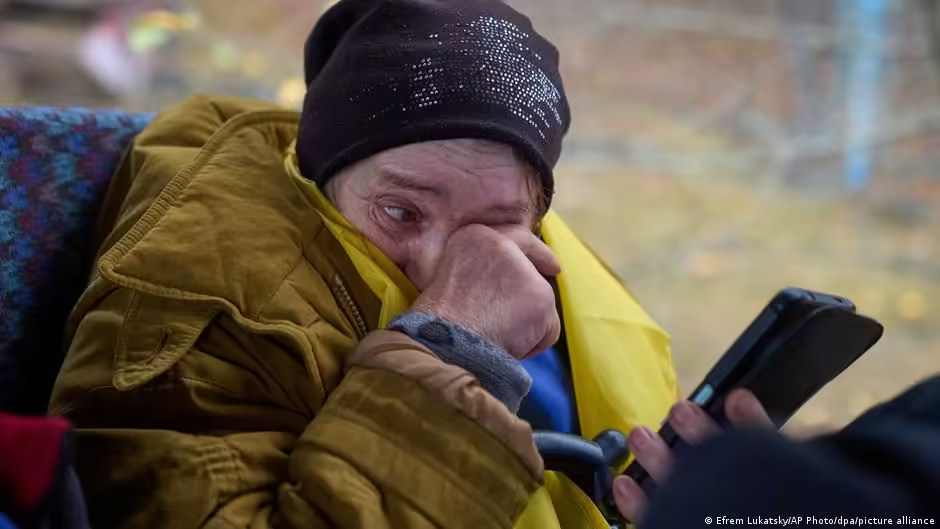

Nearly 800 residents have been evacuated from the Russia-occupied city of Oleshky in southern Ukraine. This was announced by US first lady Melania Trumpwho was credited with helping to mediate the ceasefire. The mission was coordinated by Ukrainian Human Rights Commissioner Dmytro Lubinets and his Russian counterpart, Yana Lantratova.
Most evacuees chose to be sent to Ukrainian-controlled territory, although some opted for transfer to Russia. Currently, more than 1,000 people remain in Oleshky, according to Kherson’s regional administration. They were supplied with food, water and medicine.
Melania Trump hailed the mission as a success, taking to social media to thank Kyiv and Moscow for their “leadership and cooperation.” She said the Oleshky ceasefire could go on to inspire a “lasting peace between the two peoples.”
Dmytro Lubinez similarly wrote on the Telegram messaging platform that it is “important to maintain this cooperation mechanism,” adding that “we are currently exploring options with Yana Lantratova to continue similar humanitarian efforts.”
The Kremlin, however, was quick to dampen any such expectations, making clear that no further plans for humanitarian missions exist at this stage.
Did Russia exploit the ceasefire to strengthen military hold?
One day after the ceasefire ended, Ukraine’s general staff stated that Russia had “used the humanitarian pause to fortify its positions.” It also said Russia had carried out troop rotations, expanded its anti-drone defenses, and brought in ammunition.
British broadcaster Sky News aired drone footage, produced with the support of the Ukrainian army, showing the Russian army transporting heavy equipment, weapons, personnel and food to Oleshky and neighboring villages.
“It was clear to the Ukrainian government and international mediators that Russia could exploit the pause in this way. But it was the right thing to do to allow people to leave the country,” Volodymyr Vyatrovych of the Ukrainian European Solidarity opposition party wrote on Facebook.
He believes Russia would do the exact same thing if Kyiv were to withdraw its troops from the Donetsk region, as Russian President Vladimir Putin is demanding.
“Russia would use this to prepare for its next offensive, to further destroy Ukraine,” Vyatrovych wrote. That said, humanitarian missions have their place, says Ihor Chalenko of the Ukrainian Center for Analysis and Strategies. “We shouldn’t speak ill of the Oleshky mission, even though it’s clear that the Russians have used the ceasefire in the occupied territories to their advantage,” Chalenko told DW. That’s why he says Kyiv should insist on banning such behavior in future ceasefires.
What did Washington and Moscow gain from the pause in fighting?
The Oleshky mission took place just shortly before US voters headed to the polls in the midterm elections. Dmytro Levus of the United Ukraine research center believes the timing was no coincidence. “The Russian side played right into the hands of US President Donald Trump, whose Republican Party was expected to face a crushing electoral defeat,” Levus said.
Involving Melania in the mediation was a “subtle public relations move” for Trump, through which he hoped to score points ahead of the election, Levus explained. First Lady Melania Trump has long been an advocate for humanitarian causes.
Chalenko says the Oleshky ceasefire was in Washington’s interest because it allowed Donald Trump to cast himself as a “peacemaker.”
Moscow also hoped it could improve its image through the humanitarian mission, especially as it caused Oleshky’s humanitarian catastrophe in the first place, Chalenko said. Rescuing civilians is intended to serve as proof that “not everything is bad in Russia.”
What can the Ukrainian and Russian human rights commissioners accomplish?
Cooperation between the two human rights ombudspersons had reached “a new level,” Chalenko said, adding that the Oleshky case was just one of several noteworthy examples that also included prisoner swaps and foreign representatives gaining access to Ukrainian political prisoners held in Russia.
He does not, however, believe that Russian Human Rights Commissioner Yana Lantratova makes her own decisions. “We are seeing a certain top-down realignment of Russian policy,” Chalenko told DW. He also said it was important to further develop this communication channel. The lessons learned from the evacuation of Oleshky could be applied to other towns along the front, Chalenko believes.
Dmytro Levus says the Oleshky mission has proven that, if Moscow were so inclined, a ceasefire could be established along the entire front line. Yet Russia has so far shown no willingness in doing so, partly because Ukraine has not agreed to Putin’s terms, Levus explains.
Will the ceasefire inject momentum into the upcoming talks?
Preparations are underway for a new round of negotiations between Ukraine, the US and Russia on November 10 and 11 in Abu Dhabi. Dmytro Levus believes the Oleshky ceasefire could provide substance to talks on humanitarian issues. He does not, however, think there will be much progress on a political level, even though he does see scope for a ceasefire at sea, for example.
Levus says that the US will be particularly keen to present further humanitarian successes. Ukraine may use the talks to negotiate a new prisoner exchange, though Levus says Russia will likely only budge under pressure.
Ihor Chalenko says one should not expect too much of the upcoming talks. He believes that Russia is looking for a pretext to withdraw from the negotiations, preferring instead to expand its cooperation with the US, without wanting to make any concessions to end the Ukraine war.
Samuel Greene of King’s College London is similarly skeptical. “I assume that at some point, the Kremlin will come to realize that there is nothing left to gain on the battlefield and that they will have to reach an agreement.”
“That moment hasn’t yet come though,” Greene told DW, adding that Russia was still trying to buy time by feigning a willingness to engage in dialogue with the US.
This article was translated from German.
Source: www.dw.com